RFP template for purchasing ERP, CRM, and custom development
Other
RFP template for ERP, CRM and custom development procurement | Syneo
Practical, copyable RFP template for purchasing ERP, CRM, and custom development — structure, requirements, integration, data quality, pricing, and evaluation to get comparable quotes.
rfp, erp, crm, custom development, procurement, integration, data quality, tco, sla, it consulting
March 3, 2026

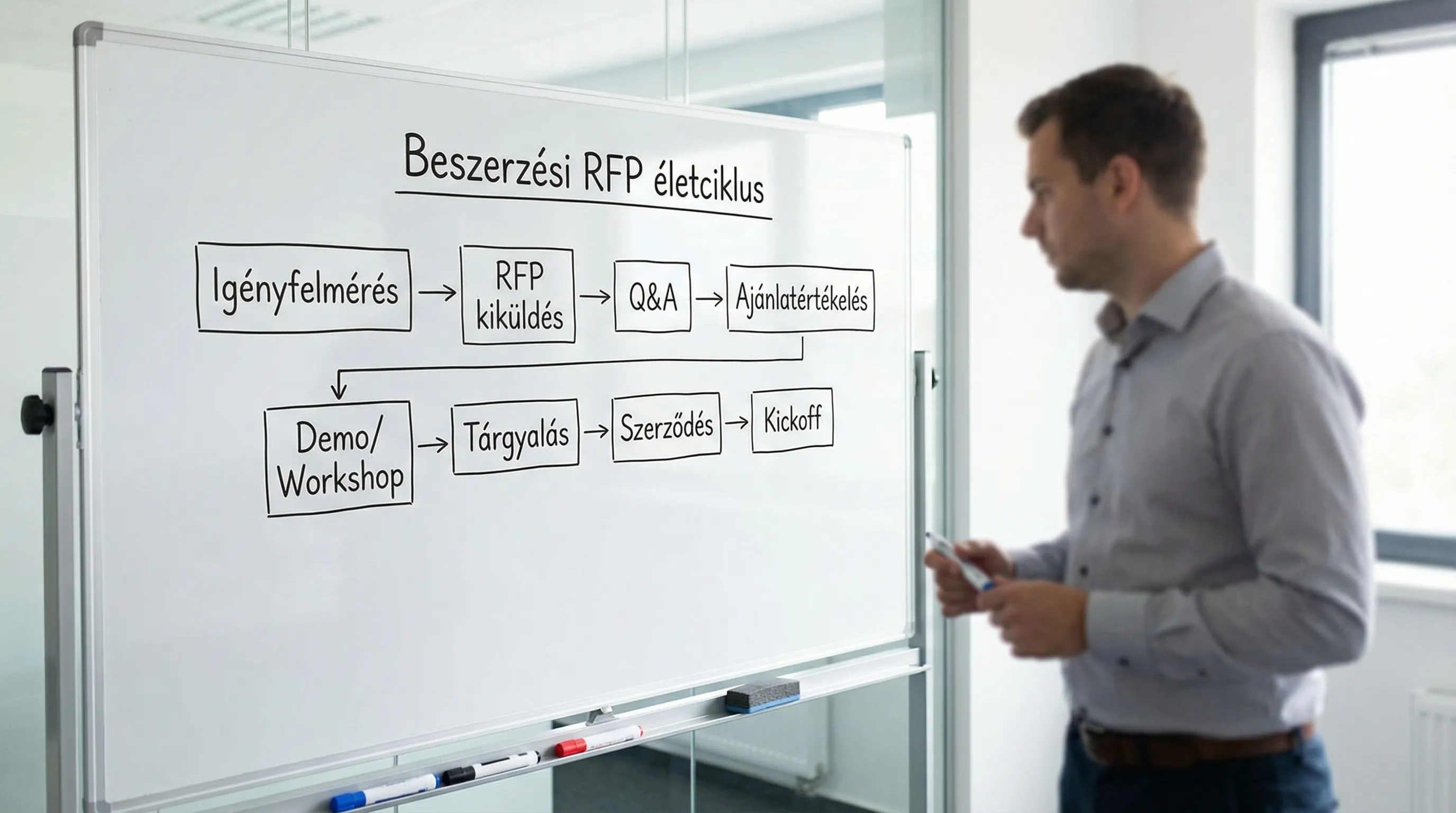
The procurement of an ERP, CRM, or custom development often fails at many companies because the supplier "recommends" and the customer "hopes." In contrast, a good RFP (Request for Proposal) ties the project to measurable business goals and verifiable supplier commitments. This is particularly important in 2026, when system integration, data quality, cybersecurity, and automation (AI) are no longer extras but basic requirements.
The following RFP template is designed for the procurement of ERP, CRM, and custom development. It is structured so that a procurement team, a business owner, and IT can work together to complete it and ensure that the bids received are comparable.
Who is this RFP template for?
The sample is most helpful when:
You are planning to implement ERP, or you would like to replace or expand your existing ERP system.
CRM was introduced, or the current system became a "data graveyard."
You need custom development (portal, workflow, integration layer, manufacturing/sales-specific module) because the boxed solution does not cover the process.
They requested quotes from several suppliers (implementation partner, development team, operator, possibly software manufacturer).
This is a typical MOFU/BOFU situation: you have already decided to invest, now the goal is selection and risk reduction.
What makes a good ERP, CRM, or custom development RFP?
A good RFP is not long because it contains a lot of text, but because it is strong in the following ways:
clearly defines the criteria for success (KPI, deadline, quality, compliance)
clarifies ambiguous areas (scope, integrations, data, responsibilities)
requests evidence (references, methodology, team, security controls)
provides a mandatory structure for the response, making the offer comparable
Practical rule: anything you don't write down will be "understood" (or omitted) according to the supplier's own assumptions.
Recommended elements of the RFP package (summary table)
Document / attachment | What is it for? | Who's giving it away? |
RFP master document | Context, requirements, response structure, evaluation | Customer |
Process descriptions (high level) | What the system needs to support, where the pain is | Business + IT |
Integration map (current) | Systems, data flow, interfaces | IT |
Data samples / data quality assessments | Reducing migration risk | IT + data managers |
Minimum security and compliance requirements | GDPR, logging, access, audit | IT security / DPO |
Pricing template | Comparability of offers | Procurement |
Contractual expectations (draft) | SLA, warranty, IP, exit | Legal + IT |
RFP template for purchasing ERP, CRM, and custom development (copyable structure)
You can use the following sections verbatim. It is worth adapting the sample texts briefly to your own situation.
1) Introduction, business background, and objectives
Objective: the supplier understands why the purchase is being made and what business results you expect.
Sample text:
"Our company's goal is to modernize its [ERP/CRM] capabilities over the next 12–18 months and, where necessary, support key processes with custom development. The success of the project is linked to measurable business results (reduced lead times, improved data quality, proportion of automated steps, better reportability). We are looking for a partner who can deliver implementation and integration in an auditable manner with an operable solution."
Please provide a brief description:
industry, locations, countries
number of users (internal, external)
critical periods (season, closing, inventory)
2) Project scope and exclusions
Goal: to prevent scope creep and "that wasn't in the scope" debates.
Write down separately:
In scope: modules, processes, integrations, reports, migration, training, hypercare
Out of scope: what is definitely not included (e.g., complete BI redesign, hardware replacement, replacement of legacy systems in certain areas)
It is good practice to state: "Please list optional items as separate items in the quote."
3) Current environment (as-is) and target state (to-be)
Objective: the supplier prices the transition and integrations realistically.
Minimum information:
current systems (ERP, CRM, webshop, WMS, DMS, BI, HR)
data sources and "system of record" designation (where the source of truth is)
interface types (API, file, EDI, manual export)
access models (SSO, AD, local accounts)
If, for example, you work in product development and manufacturing (materials, samples, part numbers, supplier data), it is worth mentioning the need for supplier collaboration. An example of such end-to-end operation in the apparel industry is a comprehensive apparel development and manufacturing partner, where processes run across multiple actors and systems, making data reconciliation, status management, and deadline tracking critical.
4) Functional requirements (ERP, CRM, custom development)
Goal: don't buy a "list of features," but rather a system that provides solutions for your own processes.
Suggestion: Use this table for each module and ask the supplier to indicate the coverage.
Requirement identifier | Area | Requirement description | Priority (Must/Should/Could) | Coverage (standard/config/custom) | Comment / dependency |
ERP-FIN-01 | Finance | Example: Approval process with multiple levels and audit trail | Must | ||
CRM-SALES-03 | Sales | Example: lead-to-cash pipeline rules and mandatory fields | Should | ||
CUST-WF-02 | Unique | Example: internal workflow portal integration (ERP + CRM) | Must |
The pattern works well if you don't write the requirements as 300 lines at first, but rather:
Define 20–40 must-have requirements that are business-critical.
Add 30–80 Should/Could elements, which are differential.
5) Integration and data requirements
Goal: integration should be planned, logged, and reversible, not an ad hoc connection.
Ask your supplier:
integration proposal (API-first, event-based, iPaaS/ESB, or other approach)
error handling and retry logic
data model alignment (master data, keys, duplication management)
logging and auditability
Sample text:
"The proposal includes a description of the integration architecture, the designation of critical data objects (customer, product, order, invoice) as the system of record, and the synchronization strategy. Fault-tolerant operation, transaction traceability, and an operational runbook base are required."
6) Data migration and data quality
Objective: to address one of the biggest hidden risks.
Ask:
migration strategy (big bang vs. incremental)
data cleansing and reconciliation steps
validation methodology (sampling, reconciliation, control reports)
Tip: In the RFP, ask the supplier in a separate line what they require from you in terms of data management and decision-making. This will make the plan realistic.
7) Non-functional requirements (reliability, performance, DevOps)
Goal: the completed system should work in real life, not just in the demo.
Write down at least:
availability (e.g., operating time, planned maintenance)
RPO/RTO requirements for backup and recovery
performance (expected load on key screens or APIs)
environments (dev, test, UAT, prod) and release expectations
monitoring, logging, alerts
If you request custom development, make it clear that controlled delivery (CI/CD, version management, automated testing, documented operation) is expected. The level of detail will depend on how critical the system is.
8) Information security and compliance
Objective: GDPR, audit, business continuity, and supplier risk management.
Ask the supplier to describe:
access management (RBAC, SSO, MFA support)
logging and log retention (who did what, when)
encryption (transmission, storage)
vulnerability management process (patch, scan, incident management)
list of subcontractors and data processors (if any)
Sample text:
"In your proposal, please describe the security controls, role-based access management, logging, and incident management process. The solution must support auditable operations and GDPR requirements."
9) Project methodology, governance, and communication
Goal: predictable delivery, with decision points.
Ask:
Proposed schedule with phases (discovery, design, build, test, cutover, hypercare)
roles (project manager, solution architect, developers, testing, change)
risk and scope management methods
demo, status reports, and steering meeting schedule
This is where the difference lies between a team that merely "implements" and one that is truly capable of carrying out the delivery under business control.
10) Training, change management, implementation support
Goal: not only activate, but also accept.
Write down:
how many user groups there are (back office, sales, managers, external partners)
What kind of training do you expect (basic, advanced, admin)?
What kind of support do you require after go-live (hypercare period, SLA)?
11) Pricing and TCO (comparable offer)
Goal: avoid comparing apples and oranges.
Request a uniform breakdown:
Cost element | One-time | Monthly/annual | Comment |
License / Subscription | User numbers, modules, limits | ||
Introduction / implementation | Scope conditions | ||
Custom development | Daily/hourly rate and estimate | ||
Integrations | Number of pieces, complexity | ||
Data migration | Sources, quality dependence | ||
Operation / support | SLA levels | ||
Education | Groups, materials |
Important: ask them to indicate assumptions and elements that are not included. This is one of the main sources of later disputes.
12) Response format and evaluation logic
Goal: Get structured, short, evidence-based answers.
Provide a fixed structure:
company presentation and relevant references
Proposed solution and architecture
project plan, team, risks
safety and operation
pricing (according to the template)
Commitments and SLAs
You can use a weighted table for the evaluation.
Criterion | What are you looking at? | Weight (total 100) |
Functional fit | Coverage of must requirements, fit-gap quality | 30 |
Integration and data | system connections, migration plan, auditability | 20 |
Operability | monitoring, release process, runbook, SLA | 15 |
Safety and compliance | RBAC, logging, incident management, data management | 15 |
Project team and methodology | governance, risk management, references | 10 |
Cost and TCO | transparency, options, risk items | 10 |

Typical RFP mistakes that later cost millions
The following mistakes are common when purchasing ERP, CRM, and custom development:
Unclear scope: there is no description of what the "first release" (MVP) is and what the next phase will be.
Rushing integrations: "We'll figure it out later," and then it turns out that the data model doesn't fit.
Underestimation of data migration: no data owner, no validation plan.
No functional requirements: no SLA, no backup requirements, no minimum monitoring.
Pricing is not comparable: one is fixed, another is T&M, and the third is "from-to," and it is not clear what is included.
If any of these apply, it is worth conducting a short (1–2 week) survey before the RFP so that the procurement is based on clear foundations.
Quick "mini-RFP" for SMEs (if it needs to go out within 2 weeks)
If you don't have time for a full RFP, stick to these minimum requirements:
10–15 Must requirements (2–3 per process)
integration list (which system, what data)
list of migration sources
minimum operation (backup, access, logging)
standard pricing template
This is enough to prevent suppliers from offering completely different "worlds."
Frequently Asked Questions (FAQ)
What is the difference between RFI, RFP, and RFQ? RFI is information gathering (market overview), RFP is a detailed request for proposals (solutions and methodology), and RFQ is typically a request for quotes for a well-defined scope.
Do you need separate RFPs for ERP and CRM? If the two systems are closely related (shared customer and order data, shared reports, tight integration), it is often better to have a joint RFP with separate module sections. If they are completely separate projects with different timelines, then separate them.
How many requirements should be included? In practice, 20–40 Must requirements and 30–80 Should/Could requirements are sufficient, provided they are well formulated and embedded in the process. Overly long lists often only provide a false sense of security.
How do I request a comparable quote? Provide a mandatory pricing template (license, implementation, custom development, integration, migration, operation) and ask for separate indication of assumptions, exclusions, and options.
What should I do if the supplier labels everything as "standard"? Ask for examples, screenshots, configuration descriptions, and include 2-3 real-life process scenarios (end-to-end) for which you would like a demonstration.
Next step: Turn the RFP into a selection tool, not an administrative burden
The Syneo team supports ERP, CRM, and custom development projects on both the business and IT sides, from specifying requirements to selecting suppliers to integration, with DevOps and operational foundations and the incorporation of information security considerations.
If you would like your RFP to:
be based on measurable goals and KPIs,
result in comparable offers,
and reduce integration, migration, and operational risks already at the selection stage,
then contact us on Syneo and we will review the RFP draft together in a short, targeted workshop.