ABB robot programming course: who is it for and what is it good for?
Other
ABB robot programming course — who is it for and what does it cover? | Syneo
What does an ABB robot programming course teach, who benefits from it, and when is integrator support necessary? A guide for maintenance technicians, engineers, and managers.
ABB, robot programming, RobotStudio, RAPID, automation, training course, maintenance, manufacturing, safety, integration
February 6, 2026
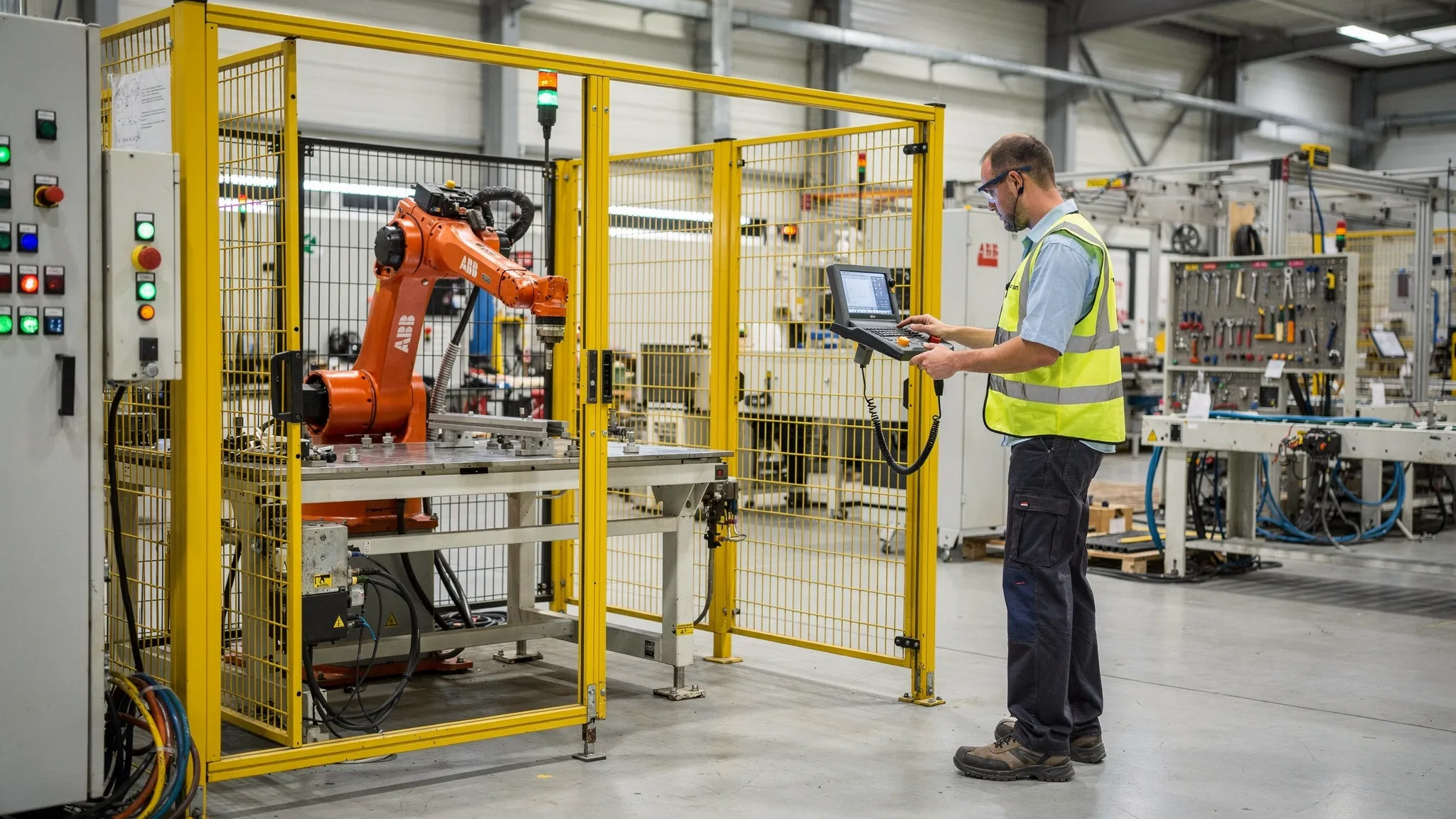
The launch of an ABB robot cell often fails where most manufacturers do not expect it: the program is not just a "series of movements," but a combination of safety, cycle time, I/O, error handling, versioning, and manufacturing discipline. This raises the question again and again: is an ABB robot programming course really enough, or is it just a good introduction to practical implementation?
The following guide will help you realistically assess who will benefit, what you can expect in terms of learning outcomes, and when it is advisable to involve integrator and consultant support.
What does "ABB robot programming" actually mean?
The programming of ABB industrial robots typically covers two main areas:
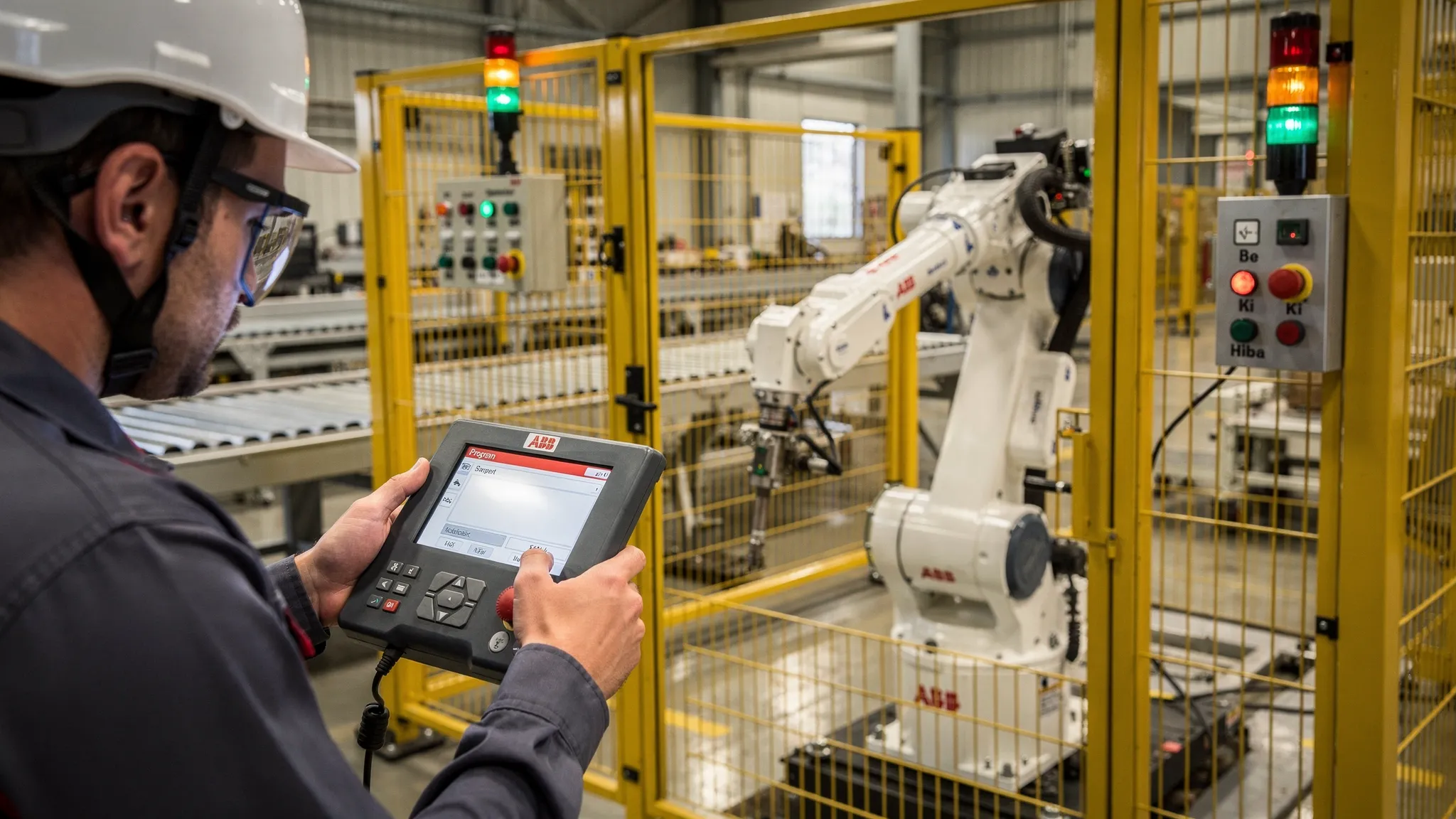
Online (teach pendant) programming: recording points, movements, simple logic, I/O management on the robot's teaching unit.
Offline programming and simulation: design in a digital cell model, collision testing, cycle time estimation, program generation, then fine-tuning on the actual cell.
The programming "language" side is often RAPID (ABB robot programming language), and the simulation environment is often ABB RobotStudio. (The exact focus may vary depending on the course, of course.)
What many people underestimate: in an industrial environment, the goal of programming is not to "start" the robot, but to run it stably in shifts, handle exceptions, and not stop at every minor deviation.
What types of ABB robot programming courses are available?
The term "course" actually covers a variety of training objectives. The following categories will help you find your way around (names may vary depending on the provider).
Course type | Main focus | Typical output | Who is it a good choice for? | What is not enough on its own |
Basic (operator, training) | Point recording, basic movements, basic I/O | Creating and running simple programs, making minor modifications | Operators, shift supervisors, maintenance personnel | Complex error handling, cycle time optimization, cell-level architecture |
Advanced (RAPID, structure) | RAPID logic, modular structure, routines | More maintainable, scalable programming | Automation engineers, technologists | Comprehensive delivery of integration projects, safety concept |
Offline (RobotStudio) | Simulation, cell design, collision testing | Faster commissioning, better preparation | Project engineers, integrator roles | Real manufacturing variance, grip, complete control of material behavior |
Special (e.g., welding, gluing, machine operation) | Technology-specific cycles, peripherals | Practical solutions for a confined space | Technology managers, cell owners | Porting to other technologies without general programming fundamentals |
When making a decision, the most important factor is not how many days the training lasts, but rather what role and cell life cycle it prepares you for (operation, development, introduction of new cells, standardization).
Who benefits most?
1) For maintenance personnel and shift support
If the goal is to have someone in-house in production who:
can make minor adjustments (point corrections, speeds, simple waits),
understands basic errors and the logic of recovery,
does not "ban" security out of necessity,
then a basic, practice-oriented ABB robot programming course can quickly pay for itself, as it reduces the number of external interventions and shortens troubleshooting times.
2) Automation engineers, technologists
It is particularly worthwhile for them if:
multiple cells run in parallel, and the program structure must be standardized,
Frequent product changes, recipe management, parameterization,
The goal is to improve cycle time and availability (not just "working" status).
The real value of the course lies in its engineering mindset: structured RAPID, clear state machine logic, and reversibility.
3) Production managers and project managers (indirect benefit)
Programming depth may not necessarily be for them, but targeted training will help them understand:
What competencies are needed for the stable operation of a robot cell?
why commissioning is delayed (I/O, peripherals, safety, material distribution),
how to define realistic delivery criteria and KPIs.
This is particularly useful when multiple suppliers, multiple technologies, and multiple shifts are involved.
What is enough for a course, and what is not enough?
After completing a good ABB robot programming course, it is typically realistic to expect that:
Be confident in handling the basic operation of the robot (mode switching, running, basic diagnostics).
modify simpler programs, add new points,
understand basic I/O logic (signals, handshakes),
work with basic RAPID structures (variables, routines, simple branching),
Prepare tasks using basic RobotStudio concepts (if covered in the training).
Where most organizations fail is when they start with the wrong expectations:
Safety concept design and validation: safety in robots is not just a setting, but a system design. Standards such as ISO 10218 (safety requirements for industrial robots) and, for certain collaborative applications, ISO/TS 15066 are often relevant in industrial environments.
Deep peripheral integration: PLC, vision system, force/torque sensor, welding power source, feeder, measuring systems. With these, the robot program is just the tip of the iceberg.
Robust error handling and recoverability: "perfect" raw materials and a consistently identical environment are rare in manufacturing.
Cycle time optimization and quality stabilization: here, mechanics, grippers, tracks, accelerations, and technological parameters often come into play together.
The course is therefore often a necessary but not sufficient condition for professional operation.
What prerequisites are necessary (and what should be clarified in advance)?
Most participants get the most out of a training course if they prepare the following in advance:
Basic automation concepts: digital signals, sensors, limit switches, relays, basic principles of safety circuits.
Knowledge of the manufacturing process: what the product is, what the critical quality points are, where the variation lies.
Goal and scope: Do you need knowledge for operation, or do you want to develop a new cell?
Access to practice: will there be robots, simulation environments, test cells, and mentors after the course?
If you don't have the opportunity to practice within 2-4 weeks, your knowledge will quickly fade. This is not the fault of the teaching, but stems from the nature of the skill.
How to choose a course that will really pay off?
The best filter is not the price or the number of days, but rather the problem that the training addresses.
Questions to ask before applying
Will there be practical training with real robots, or just theory?
Does the training cover error handling (not just the "happy path")?
How much does the curriculum cover I/O handshaking and peripheral cooperation?
Is there a RobotStudio section if your goal is offline preparation?
Will you receive a sample program structure (modularity, naming convention, documentation principle)?
Quick decision table (manufacturer's perspective)
If this is the case for you... | Then this is the right direction | Because... |
There is a robot cell, but it is often down due to minor modifications. | Basic + troubleshooting focus | Operations are accelerating, reducing the need for external deliveries |
New products are coming, frequent changes | Advanced RAPID+ parameterization | A more maintainable, scalable program is needed |
New cell introduced, deadline tight | RobotStudio + commissioning methodology | Virtual commissioning can reduce the number of on-site iterations |
Multiple locations, multiple robots, many different program qualities | Standardization, coding style, versioning approach | Key person risk is reduced, transparency is increased |
Industry example: when robot programming is about process stability
Robots are not only found on automotive welding lines. They are increasingly appearing in manufacturing and packaging environments where environmental conditions (moisture, dust, chemicals), cleanability, and reliability are critical.
For example, companies that manufacture or operate industrial water treatment solutions may require robotic material handling, dosing, packaging, and even assembly tasks. If you are looking for equipment or components in this area, it is worth taking a look at Takabani's industrial water treatment equipment, as the technological environment greatly influences the type of robot cell design and programming discipline that will be required.
The lesson: the programming basics acquired during the course must always be adapted to the actual technology and operating conditions.
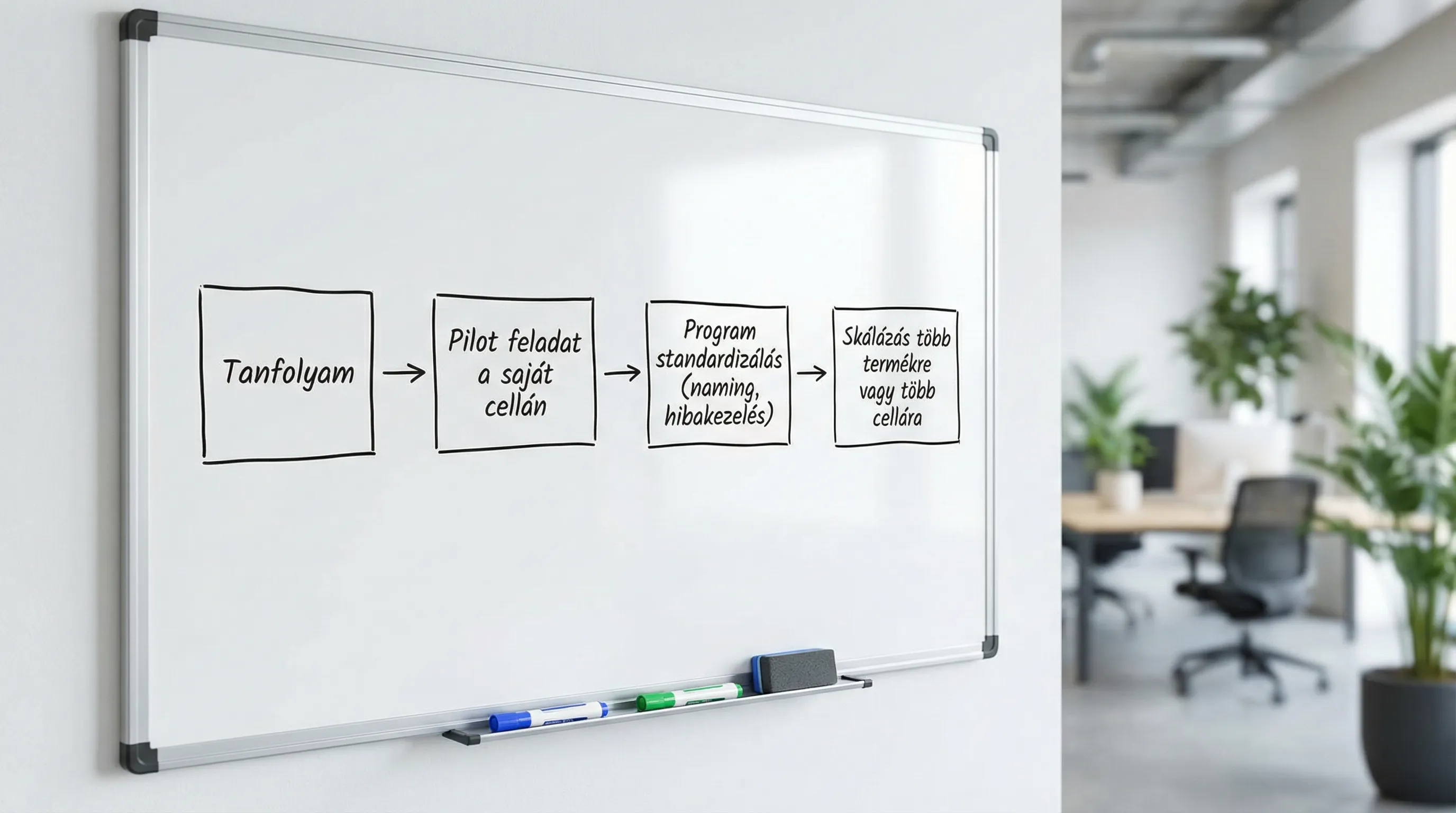
What should you do in the first 30 days after the course?
Most organizations lose money because there is no structured follow-up after training. A short, practical plan makes a big difference.
Choose a clear, low-risk improvement (e.g., fine-tuning accuracy, simple error handling branch, tidying up symbol handling).
Create programming rules (naming conventions, commenting, folder and module structure).
Agree on who is responsible for approving changes (especially those related to safety).
Document the most common error situations and write down the steps to restore them.
This course will not be just "training," but the beginning of a sustainable skill.
Frequently Asked Questions (FAQ)
How long does it take to acquire usable knowledge of ABB robot programming? Generally, the basics can be learned in a few days, but "shift-ready" knowledge is developed through targeted practice after the course and by dealing with real errors.
Is an ABB robot programming course enough to set up a new cell on my own? Rarely. Setting up a new cell involves several disciplines (mechanics, safety, PLC, peripherals, technology). The course is a good foundation, but complex projects typically require experience or integrator support.
Is it better to learn RAPID or RobotStudio first? If your goal is operation, the teach pendant and basic logic are more important. If you are preparing a new cell or want to speed up commissioning, RobotStudio is a powerful addition.
For which roles is the training most useful? Maintenance (quick troubleshooting), automation engineers (structured development), and project managers (realistic scope and delivery criteria).
When should special attention be paid to safety issues? Whenever the robot's range of motion, speed, mode change, or cell access changes. Safety modifications should only be made with the appropriate expertise and in compliance with the relevant regulations.
How can the return on training be measured? Good indicators include a reduction in the number of external callouts, a reduction in the average time taken to resolve faults, faster changeovers, and an increase in the proportion of documented and standardized programs.
Next step: training course + implementation with business results
An ABB robot programming course brings the most value when you build on the knowledge you have acquired with a specific development plan (pilot, standards, documentation, integration). If you want to do this reliably and with measurable results, the Syneo team can help with consulting and implementation support, from robot programming and automation tasks to related IT, integration, and digitization steps.
Take a look at our services on the Syneo website, and let's discuss your goals before you finalize your training, implementation, and internal competency building schedule.