Step-by-step corporate digitization: a proven framework
Digitalization
Step-by-step corporate digitalization — a proven framework | Syneo
A practical, 5-step (5F) framework for corporate digitization: assessment, prioritization, technical foundations, piloting, and scaling—deliverables, KPIs, and typical pitfalls.
digitalization, AI, integration, data quality, ERP, CRM, KPI, IT consulting
February 6, 2026

Corporate digitization is no longer an "IT project," but a matter of business survival. By 2026, most companies will feel this firsthand: accelerating compliance requirements (such as e-invoicing), more and more systems and data, increasing cyber risks, and constant pressure to reduce costs and increase efficiency. The good news is that you don't have to solve everything at once, but you do need a framework that guides you through your decisions and prevents you from getting stuck in a dead end with a "let's buy some software" approach.
Below you will find a proven 5-step (5F) corporate digitization framework with specific deliverables, metrics, and typical pitfalls. The goal is to get started quickly while maintaining control (security, integration, ROI).
Why is corporate digitization slipping in practice?
Most digitization programs fail not because of technology, but because of a lack of focus and execution. It is often said in the industry that a significant proportion of digital transformations do not deliver the expected business results (according to many reports, the failure rate is around 70%). This is regularly discussed in McKinsey's digital transformation analyses, for example (overview: McKinsey: digital transformation).
The recurring reasons are typically as follows:
There is no clear business objective, only a vague intention to "modernize." In such cases, there are no KPIs, and therefore no success.
Lack of data and integration foundations: separate ERP, CRM, Excel files, manual transfers, duplicated master data.
Underestimating change management: processes and roles are changing, but the organization is not prepared for it.
Security and compliance after the fact: auditing, authorization, logging, data management "built on top" at the end, which is expensive and risky.
The essence of the framework is that it incorporates "restrictions" and decision points in advance.
The 5F framework: Assessment, Focus, Fundamentals, Execution, Scaling
This model works for SMEs and larger organizations alike, because it does not list industry-specific technologies, but rather provides decision-making logic and implementation rhythm.

What should you consider "complete" at the end of each phase?
A typical mistake in digitization is that everything starts at once. Instead, there should be a clear, verifiable output at the end of each phase.
Phase | Goal | Minimum deliverable | Typical time frame |
Survey | A clear picture of the initial situation | Process map (top 5), system and data inventory, risk list | 2-4 weeks |
Focus | Selecting 1-2 high-impact use cases | Priority score, business case, pilot scope | 1-2 weeks |
Fundamentum | Scalable technical and data foundations | Integration plan, data quality plan, IAM/logging baseline, architecture framework | 2-6 weeks |
Running | Pilot with live solution control | Activation plan, test report, training, KPI dashboard v1 | 4-10 weeks |
Scaling up | Repeatable operation | New use case pipeline, governance, continuous measurement, and optimization | continuous |
Step 1: Assessment (mapping out the "reality")
The purpose of the survey is not to document everything, but to provide you with enough information to make decisions. A good survey describes the problem in business language.
In practice, it is worth focusing on three areas:
Processes: where is manual routing, double entry, slow approval, SLA slippage.
Systems and integrations: ERP, CRM, CMS, invoicing, document management, ticketing. What are the data connections, where is the "human API" (Excel, email, PDF).
Data and security: master data quality, access, logging, backup, GDPR requirements, supplier exposure.
At the end of the survey, there should be a brief summary at the management level:
What are the top 5 process pains (time, money, risk)?
What are the top 5 technical obstacles (integration, data, operation)?
What are the top 5 risks (security, compliance, operational downtime)?
If you are considering AI in the coming weeks, the survey may also include an AI opportunity map. In this case, an external, structured review, such as an AI audit and implementation training service, can be useful to help you quickly separate real business value from "nice to try" projects.
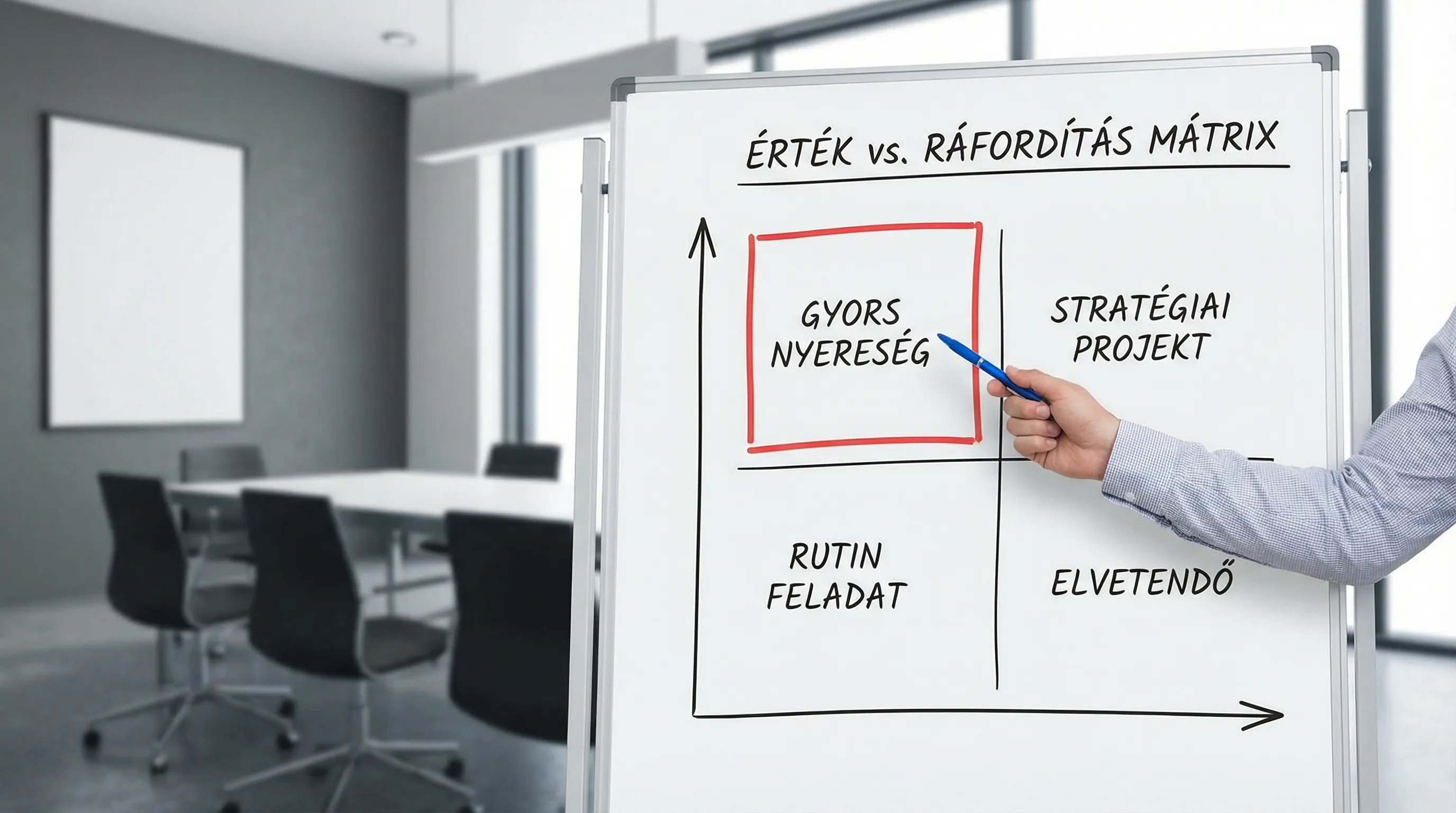
Step 2: Focus (priority, what you really put your resources into)
The focus phase determines whether your digitization program will be a learning project or one that generates business results.
The best method is a simple scoring system that both management and key users can understand. Example of a weighted model:
Evaluation criteria | Question | Recommended weight |
Business impact | How much time/money can be saved from the process? | 35% |
Feasibility | Do you have the data, integration, and expertise? | 25% |
Risk reduction | Is compliance or IT security exposure decreasing? | 20% |
Time to profit | Will results be visible within 90 days? | 20% |
Important: Focus does not mean neglecting other areas. It means changing only as much as you can control at any given time.
Step 3: Fundamentals (basics without which there can be no scaling)
For most companies, "fundamentum" means two things: integration and data. In 2026, this will be inseparably linked to the security baseline.
Integration: don't build islands
Corporate digitization accelerates when information does not stop between systems. Typical examples:
ERP and CRM integration (customer, order, status)
Linking documents and workflows (approval, archiving)
Integration of billing, logistics, and customer service data
A "large integration platform" is not necessarily the answer here. Often, a well-designed API layer, event-based data transfer, or even a regulated ETL process is sufficient if the goal is clear.
Fact: Quality is the biggest accelerator (or brake)
AI, automation, and reporting do not require "a lot of data," but rather reliable data. Good minimum steps:
Appointment of master data owners
Duplication and deficiency measurement (baseline)
Standardized terminology (what constitutes an "active customer" or a "closed case")
Security baseline: build it in from the start
Digitization increases the attack surface (new cloud providers, integrations, users, automation). It is worth setting the minimum here:
Identity and access management (IAM), principle of least privilege
Basics of logging and monitoring
Recovery and restoration objectives (RPO/RTO)
If you are looking for a reference point for guidelines, the NIST Cybersecurity Framework is a good, practical starting point, even if compliance is not an audit objective.
Step 4: Run (live system, not demo)
The essence of "running" is to ensure that the selected use case is fully operational. A pilot is good if:
there are key performance indicators (KPIs) and measurement methods (instrumentation)
user acceptance and training
there is an operational plan (who supports it, what is the error handling)
DevOps industry metrics, which are also promoted by DORA summaries (overview: DORA metrics), are useful for measuring delivery capacity. You don't have to implement everything at once, but in a pilot project, it is worth paying attention to, for example, release frequency or the reversal rate of changes.
Change management: the hidden critical path
The "real" project plan for corporate digitization is often not the development task list, but the organizational transition:
Who will own the process? Who will decide on exceptions?
Which team's daily routine will change?
What is the minimum training and internal communication?
If you mess this up, the system will be ready, but they won't use it.
Step 5: Scaling up (repeatable success, not a one-time heroic achievement)
Scaling means that your company will be able to continuously deliver new digitalization developments without disproportionately increasing risk and operational burden.
Three practical elements that help:
Governance and portfolio: have a visible "digital backlog" where initiatives are evaluated using the same logic.
Internal competence and partnership model: don't outsource everything, but build internal product manager and process manager roles. The external partner is there to speed things up, not to take control.
Continuous measurement and optimization: what is not measured quickly reverts to manual work.
KPIs that can truly measure digitalization
KPIs should be understood in such a way that both business and IT departments have the same understanding of them. Examples:
Area | KPI example | Why is it useful? |
Finance/admin | Lead time from invoicing to accounting | Manual work and quick error indicator |
Customer service | First response time, resolution time | Service level and load |
Operation | Failure rate, returns, downtime | Quality and hidden costs |
IT delivery | Release frequency, lead time | Development speed and stability |
Data | Duplication ratio, incomplete records | Prerequisite for AI and automation |
Common pitfalls (and how to avoid them)
Instead of an equipment purchasing strategy: first the decision-making framework and use case, then the product.
"We'll integrate it later": integration is not an extra, but a prerequisite for operation.
Pilot without KPIs: if there is no measurement, there is no learning and no ROI.
Security after the fact: IAM, logging, and backup should start at least at the baseline level.
If you would like more practical material on a similar topic, it is worth checking out Syneo's related articles on planning a digitization project with goals and KPIs, and the digital transition checklist for SMEs.
Frequently Asked Questions (FAQ)
How long does it take to see the results of corporate digitalization? A realistic goal is a 60-90 day initial pilot, where measurable KPI improvement or risk reduction can already be seen. Full scaling typically takes place in several waves.
What should be the first digitization project? A process that is painful and measurable, has data, and delivers results within 90 days (e.g., approval workflow, customer service triage, document searchability).
Should I start with ERP or CRM? It depends on where the biggest business bottleneck is. If finance and operations are the problem, go for ERP; if sales and customer management are the pain points, go for CRM. Often, integrating the two provides the greatest benefit.
Is AI necessary for digitalization? It is not mandatory, but it is increasingly becoming a catalyst for return on investment. It is worth incorporating AI once the process, data quality, and areas of responsibility have been clarified.
What should I pay most attention to in terms of security? Authorization management, logging, backup, and supplier exposure. With digitalization, the number of integrations increases, and with it, the possibility of errors.
How can we avoid the pilot becoming a "permanent pilot"? There should be activation criteria (KPI targets, testing, training, operation) right from the start, and a designated person responsible for operation after implementation.
Next step: build a 90-day plan for your company
If you would like a specific, scheduled implementation plan (with use case selection, KPIs, risks, and technical basis) from the above framework, the Syneo team can help with digitalization and AI consulting, custom software development, and ERP/CRM/CMS and DevOps support.
Start by contacting us on the Syneo website, and let's see together where corporate digitization will bring the fastest measurable results.