The benefits of digitization: 10 measurable business outcomes
Digitalization
The benefits of digitalization — 10 measurable business results | Syneo
10 measurable business results from digitalization: shorter lead times, lower operating costs, better customer experience, faster cash flow, and stronger security.
digitalization, KPI, business results, CRM, ERP, e-invoicing, DevOps, cybersecurity, AI services, customer experience
February 5, 2026

For many executives, "digitalization" still means a list of tools (ERP, CRM, cloud, automation, AI). From the company's perspective, however, the essence is simpler: what business results change measurably and how quickly. If you see this clearly, digitalization becomes not a cost but a controlled investment with a baseline, a target value, and a person responsible for it.
Below, I present 10 business outcomes that are typically measurable with KPIs and applicable to most industries as examples of the benefits of digitalization. Not every point is relevant to every company, but it is a good "menu" from which to choose where the fastest return on investment can be expected.
What makes digitization truly "measurable"?
Measurability depends on three things:
Baseline: what are the current lead times, error rates, costs, SLAs, DSOs, downtime, etc.?
Instrumentation: where does the data come from (ERP/CRM log, ticketing, BI, finance, manufacturing system, call center, SIEM).
Target value and time frame: what will be achieved in 30, 90, and 180 days (pilot, implementation, scaling).
If you want a framework for this, it is worth treating KPI planning as a separate task, not as a "by-product." Syneo's guide to planning a digitalization project (goals, KPIs, risks) can help with this.
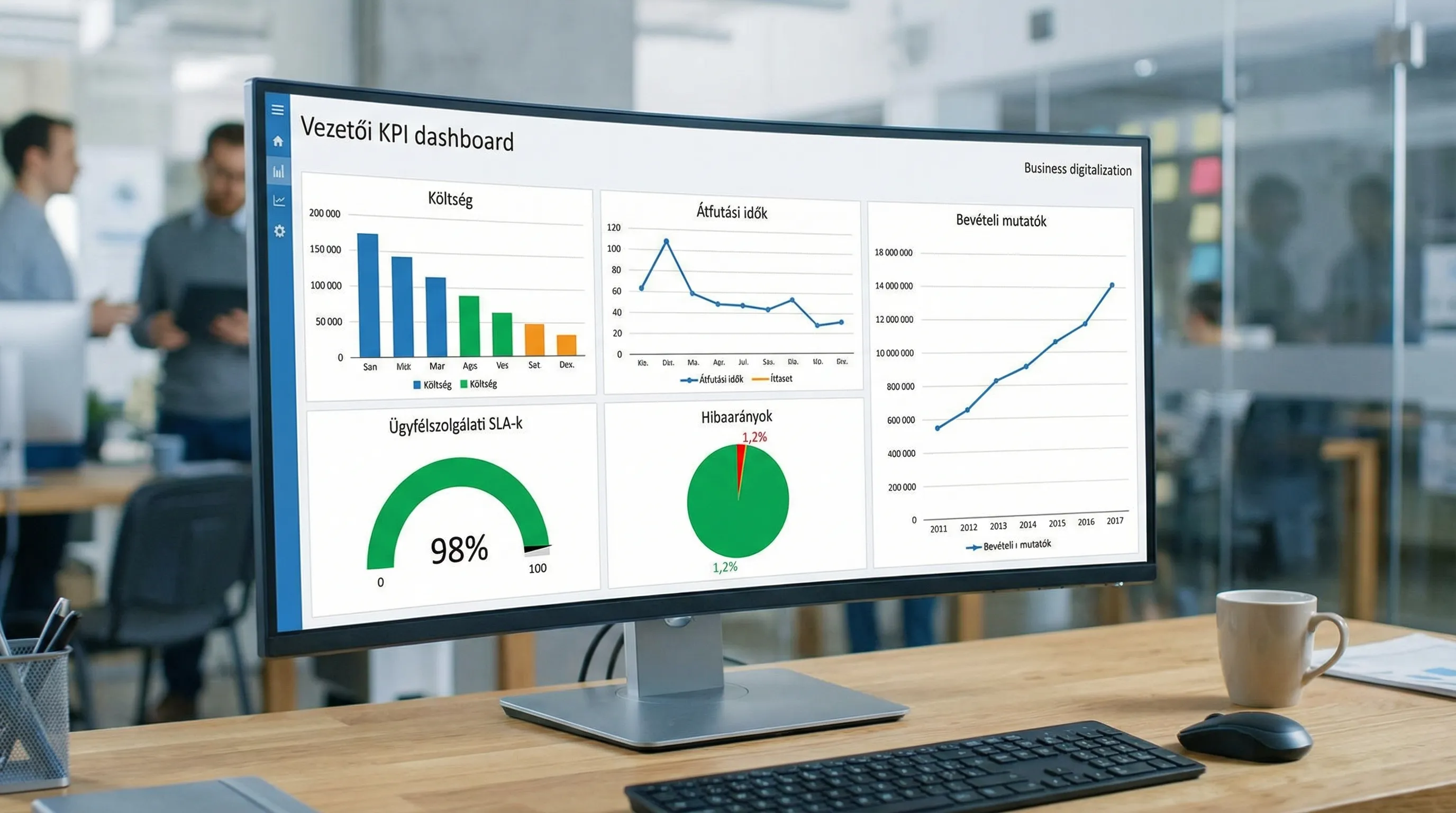
The benefits of digitization: 10 measurable business results (with KPIs)
The table below provides a quick overview of how digitization can be "translated" into business language.
Measurable business results | Example KPI | Typical data source | When does it first appear? |
1. Shorter lead times | Lead time, cycle time, turnaround time (days/hours) | ERP/Workflow, ticketing, process log | 2-8 weeks |
2. Lower operating costs | Cost/transaction, admin hours/month | Finance, timesheet, ERP | 1-3 months |
3. Fewer errors, complaints, rework | Defect rate, rejects, returns % | ERP/QMS, CRM, support | 1-3 months |
4. Faster cash flow | DSO, billing cycle time | Finance, e-invoicing, ERP | 1-2 months |
5. Higher sales efficiency | Conversion, pipeline velocity | CRM, marketing automation | 1-3 months |
6. Better inventory and capital utilization | Inventory accuracy, turnover rate. | ERP/WMS | 2-4 months |
7. Better customer experience (service) | SLA, AHT, FCR, CSAT | Helpdesk/call center, CRM | 2-6 weeks |
8. Faster delivery in IT | Deployment frequency, change lead time | CI/CD, DevOps toolchain | 1-2 months |
9. Better decision-making (data quality) | Report delays, data quality errors | DWH/BI, MDM, ERP/CRM | 1-3 months |
10. Stronger security and compliance | Incident count, MTTD/MTTR, audit finding | SIEM, IAM, GRC | 1-6 months |
In the following chapters, I will provide practical measurement and implementation considerations for each of these.
1. Shorter lead times (eliminating "waiting" from the process)
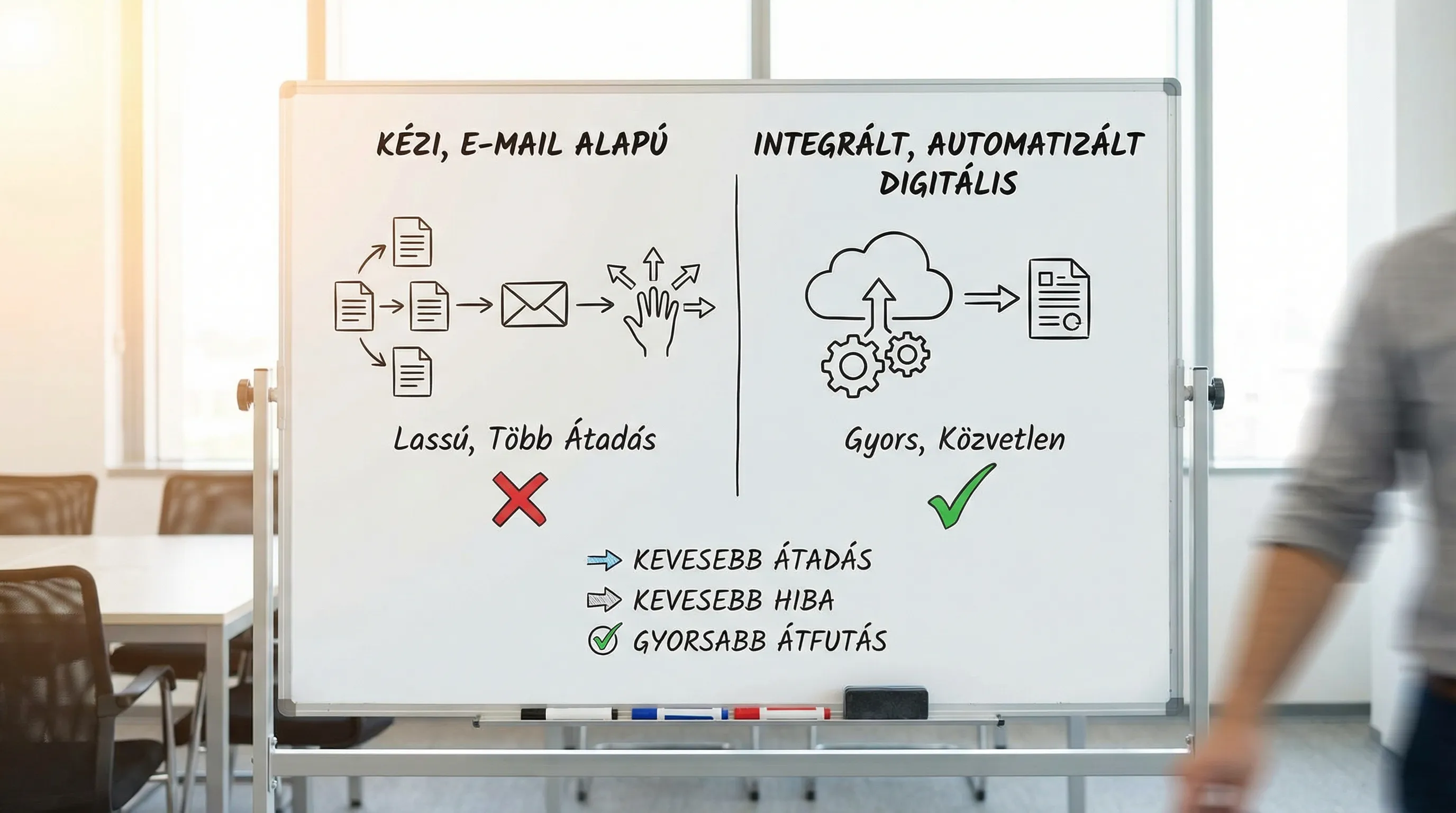
One of the fastest ways to see a return on investment is when workflow, integration, and automation take over tasks instead of manual steps, email ping-pong, and duplicate data entry.
What should be measured?
Total lead time (from order to fulfillment, from quote to contract, from ticket opening to resolution)
Waiting times between process steps
Backlog age, i.e., how long cases have been pending
Common digitization solutions: forms and approvals (workflow), document management, ERP-CRM integration, automatic notifications.
2. Lower operating costs (cost/transaction logic)
Cost reduction will be credible if it is measured not by "feel" but at the cost/transaction or cost/function level. For example: how much does it cost to process an invoice, register a new customer, or handle a complaint?
What should be measured?
Cost/transaction (HUF/invoice, HUF/ticket, HUF/order)
Reduction in administrative hours per team
External service provider costs (paper, postage, manual data entry)
It is worth breaking down the cost impact of cloud and automation separately (infrastructure, licensing, operation). Related topic: how cloud-based software reduces costs.
3. Fewer errors, complaints, and rework (measurable quality)
Digitization often not only speeds up work, but also makes it more consistent. Validation, mandatory fields, version management, permissions, and automated rules reduce human error.
What should be measured?
Error rate per process step (e.g., incomplete data, incorrect invoices)
Complaint rate (number per 1,000 transactions)
Rework rate and time
Where does AI come in? When processing documents and emails (OCR, extraction, categorization), some errors can be filtered out at the time of recording. In several Syneo projects, document structuring has led to spectacular acceleration (for examples, see the case studies on the website).
4. Faster cash flow (DSO and billing cycle time)
Many companies are "profitable" yet struggle with cash flow tensions. Digitization can be seen here in very concrete terms: invoices are issued faster, there are fewer errors, approvals are quicker, and status is more transparent.
What should be measured?
DSO (Days Sales Outstanding)
Invoice issuance cycle time (from fulfillment to invoice)
Proportion of disputed invoices
This is particularly relevant in 2026, as the market is moving towards e-invoicing compliance and structured formats. Context: E-invoicing 2026: new rules and deadlines.
5. Higher sales efficiency (not just more leads)
The introduction of CRM alone does not guarantee results. Results will only be achieved if sales are standardized, measurable, and automated: the next step is mandatory, activities are visible, the pipeline is clear, and offers are prepared more quickly.
What should be measured?
Conversion by stage (lead -> qualified -> offer -> won)
Pipeline velocity (how much value passes through per unit of time)
Average sales cycle length
When CRM and ERP work together (inventory, pricing, delivery promises), sales accuracy and speed can also improve. Related reading: CRM vs ERP: Which System Do You Need?
6. Better inventory and capital utilization (working capital release)
In terms of inventory, the "digital" advantage often manifests itself in more accurate data, fewer shortages, less over-ordering, and faster response times for procurement.
What should be measured?
Inventory accuracy (system vs. reality)
Inventory turnover rate
Number of stockout events and their business impact
ERP/WMS discipline is key to measurability here: barcodes, standard warehouse processes, integrated order data.
7. Better customer experience: faster and more consistent service
The digitization of customer service is easily measurable because calls, tickets, and response times are quantifiable. What's more, AI makes it easy to automate triage (identification, categorization, response suggestions).
What should be measured?
First response time (FRT)
Average Handling Time (AHT)
First Contact Resolution (FCR)
SLA fulfillment and CSAT
In one Syneo case study, multilingual AI-based automation significantly reduced the need for human intervention and response times, while integrating with CRM processes.
8. Faster and more stable software delivery (with DevOps metrics)
If your product or internal operations are software-based, one of the biggest hidden benefits of digitalization is delivery speed and change security. This should be managed not based on "gut feeling," but rather using DevOps KPIs.
What should be measured?
Change lead time (from modification to production)
Frequency of deployment
Change failure rate
Mean time to restore (MTTR)
These metrics are also widely used by the DORA (DevOps Research and Assessment) research line as industry benchmarks (background: DORA on Google Cloud). Practical basics: DevOps basics in 2026.
9. Better decision-making: data quality and reduced reporting delays
Many management decisions are poor because they are delayed or because data means different things in different systems. Digitalization leads to a "single source of truth": uniform definitions, data connections, and automated reports.
What should be measured?
Report delay (e.g., how many days after closing is the management report ready)
Number of data quality errors (duplicates, missing fields, conflicting data)
"Manual Excel hours" (how much time is spent on manual report generation)
The processing and searchability of document assets is a particularly strong example: with the help of industrial OCR and NLP, searchable and analyzable data assets can be built from previously "dead" documents.
10. Stronger security and compliance (fewer incidents, faster response)
Digitization can also be a risk if system complexity increases rapidly, but when managed properly, it can also deliver security and compliance benefits: unified rights management, logging, automated patching, controls.
What should be measured?
Number and severity of security incidents
MTTD/MTTR (detection and recovery time)
Number of audit findings, compliance with correction deadlines
Here, the key to "measurability" is logging and process: if there is no SIEM, no unified IAM, and no incident management policy, then security remains nothing more than an impression.
How do you choose the 2-3 out of 10 that will pay off quickly?
For most companies, the best way to start is not to "digitize everything," but to focus on two or three KPIs over a 90-day horizon.
Good decision filter:
Where is waiting or rework most expensive?
What affects direct cash flow (invoicing, collection, order fulfillment)?
Where is there imminent compliance pressure (e.g., e-invoicing)?
In this regard, Syneo's article may be useful: Digitalization in 2026: where to start?
Final thought: "Measurable" digitization is not a hardware project, but business management.
The benefits of digitization become a real competitive advantage when the technological implementation is backed by a measurement plan: baseline, KPI, data source, responsible party, target value. This way, the project will not be a matter of debate, but rather a performance improvement under management control.
If you would like to select 2-3 results from the above 10 points that can be measured most quickly at your company, and add a realistic implementation plan (pilot, integration, data, and security), it is worth looking at their processes from an expert perspective. The Syneo team supports digitization and information security projects from assessment to implementation with unique IT and AI solutions and consulting. Further background: Corporate digitization made easy: the roadmap to guaranteed success.