Planning a digitization project: goals, KPIs, risks
Digitalization
Planning a digitalization project: goals, KPIs, risks | Syneo
A practical guide to digitalization projects: how to set goals, measurable KPIs, manage risks, and get started in the first 30 days.
digitalization, AI services, custom software development, ERP/CMS/CRM, DevOps, IT consulting, risk management, KPI
February 2, 2026

Is a digitization project "successful" if it is completed on time? In practice, managers care about other things: shorter lead times, fewer errors, lower costs, better customer experience, and stronger information security. However, these will only be tangible results if you set precise business goals, measurable KPIs, and manageable risks during the planning stage.
It is no coincidence that McKinsey's finding is often cited in digital transformations: a significant proportion of transformation programs fail to achieve their goals (the "70% failure" statement is echoed in several McKinsey materials). This is not a "flaw" in the technology, but typically a problem of goal setting, measurement, change management, and risk management.
The framework below helps ensure that the planning of a digitization project is not just a Gantt chart, but a control panel that decision-makers can use to guide the organization through the implementation.
1) What counts as a digitization project (and what doesn't)?
We refer to any initiative that transfers business processes and decisions to digitized data, integrated systems, automation (and in many cases AI) as a digitization project.
Typical examples:
ERP/CMS/CRM implementation or consolidation
document digitization and searchable knowledge base (OCR, NLP)
customer service automation, chatbot, ticket triage
collection of manufacturing data (IoT), predictive maintenance
reporting and controlling modernization, unified data assets
It is not a good direction if the goal of the project is to "introduce a system," "have a cloud," or "have AI." These are tools. The real subject of planning is: which business indicators will we improve, by how much, and by when.
2) Setting goals: defining the "why" and protecting the scope
When formulating goals, it is useful to separate them into:
Business performance targets (what we improve): for example, lead time, scrap, SLA, revenue, customer satisfaction.
Capability goals (what we will be capable of): for example, end-to-end process tracking, real-time inventory, automated approval.
Technical objectives (what the solution will be like): for example, integration layer, auditability, authorization management, availability.
Scope creep is one of the most expensive risks of digitalization. When planning, write down:
What is included (in-scope) and what is not included (out-of-scope)
assumptions and constraints
decision points (e.g., "scale after pilot")
Practical rule: if an item cannot be directly linked to improving a target KPI, it is suspiciously "nice to have."
3) Planning KPIs: without measurement, there is no control
It is worth dividing KPIs into two groups:
Result KPI (lagging): business impact, which depends on many factors (e.g., cost/transaction, NPS, machine downtime).
Leading KPI: early indicator that measures implementation quality and adoption (e.g., percentage of active users, percentage of automated steps, number of data quality errors).
A good KPI definition consists of five parts:
definition (what exactly are we measuring)
calculation formula
data source (which system it comes from)
baseline (current value)
target (target value) and deadline
KPIs that work in most digitization projects
The table below provides KPIs that can be used in ERP/CRM, document management, customer service, or data platform projects.
Target area | Example KPI | What does it actually mean? | Typical data source |
Lead time | Time elapsed from order to fulfillment (days/hours) | Process efficiency and bottlenecks | ERP/OMS event log |
Quality | Percentage of incorrect invoices (%) | Data quality + process discipline | ERP + invoicing |
Customer experience | First response time (minutes), resolution time (hours) | Operation and SLA fulfillment | Ticketing/CRM |
Automation | Percentage of automated steps (%) | Real relief | Workflow engine, RPA log |
Adoption | Percentage of active users (DAU/MAU) | Is it actually used? | IdP, application log |
Data assets | Percentage of duplicate customers, completion rate | MDM and data quality | CRM/MDM |
IT reliability | Availability (%), number of incidents | Operational stability | Monitoring, ITSM |
Safety | Number of high-risk accesses, patch SLA | Exposure reduction | IAM, vulnerability management |
Important: you don't have to measure everything. Six to ten well-chosen KPIs are usually enough, provided that business and operational managers actually use them.
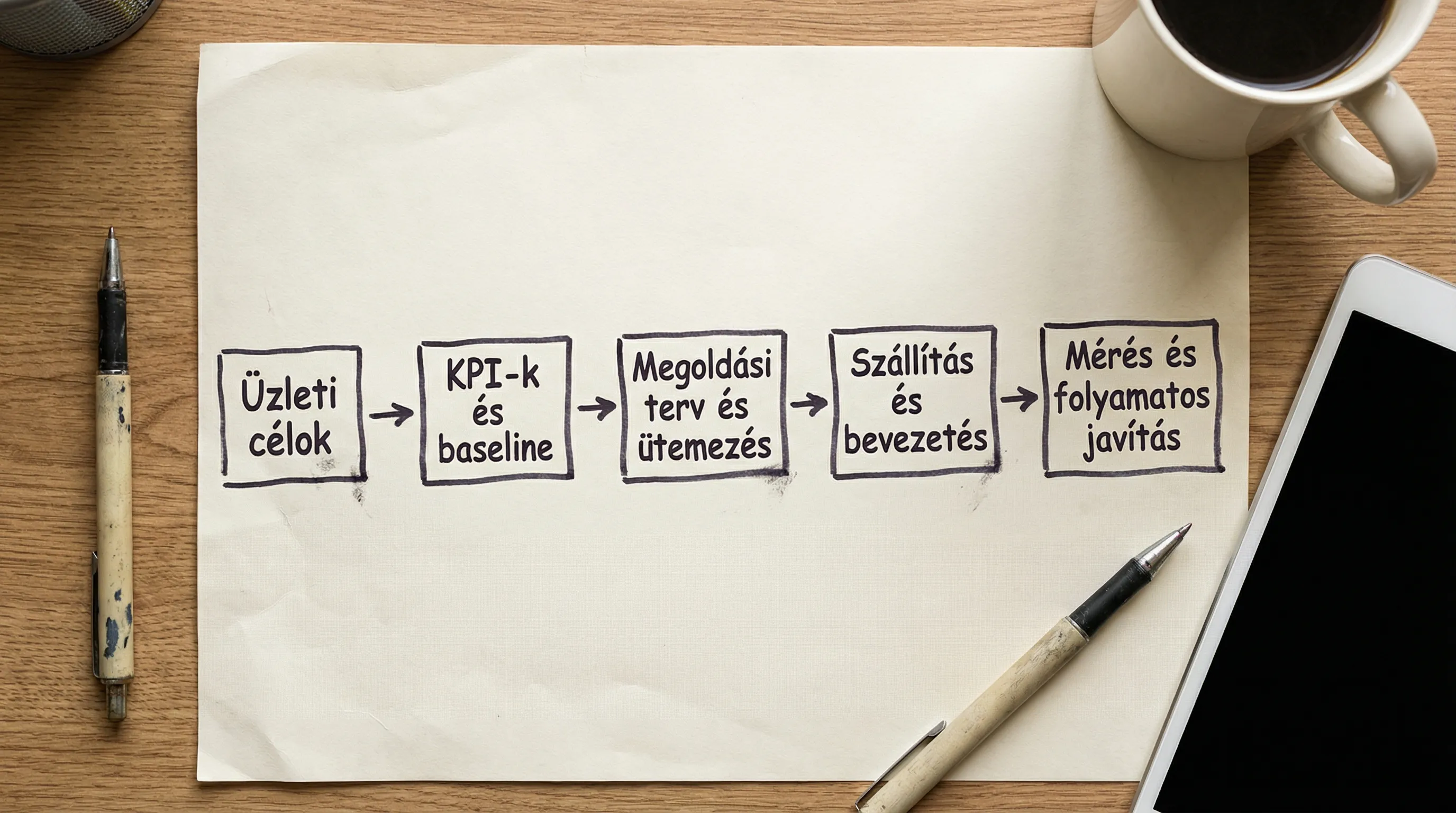
KPIs slip up due to the three most common "misunderstandings"
1) There is no baseline. If no measurements were taken at the start, there will be debate later about whether there has been any "improvement."
2) KPIs are confused with deliverables. "We have implemented ERP" is not a KPI. It is a milestone at most.
3) The source of KPI data has not been planned. For example, everyone wants to measure "throughput time," but there is no standardized event log, or statuses are rewritten manually.
4) Incorporating measurability into the solution (instrumentation + data model)
One of the underrated aspects of digitization projects is "measurement technology." However, you can only track KPIs reliably if the system is capable of:
logging events (who, what, when)
use unique identifiers (customer, order, case, asset)
provide auditable permissions and change tracking
Practical planning issues:
Where will the "source of truth" (system of record) be for an entity? (e.g., customer data)
What data quality rules are needed for KPIs? (e.g., mandatory fields, validation)
How do you handle historization? (e.g., status changes, prices, entitlements)
If AI is also involved (e.g., automated categorization or customer service responses), it is worth planning separate KPIs:
accuracy on approved samples (precision/recall basis)
human review rate
error impact (e.g., incorrect classification of business expenses)
drift signals (does performance deteriorate over time)
5) Risks: dealing with "what could go wrong" in advance
Risk management is not a mandatory administrative task. In digitalization, most of the high costs come from late discoveries:
the data cannot be used
integration is more complicated than expected
users do not accept
safety and compliance requirements are "falling behind"
The best approach: a risk workshop at the beginning of planning (business, IT, security, data owners, key users), followed by a live risk register monitored by project management.
The NIST Cybersecurity Framework 2.0 (2024) provides a strong foundation for cyber and compliance, while the updated version of ISO/IEC 27001:2022 provides a strong foundation for corporate ISMS.
Typical digitization risks and mitigations
Risk | Leading indicator | Effect | Mitigation in planning |
Poor data quality (incomplete, duplicated, inconsistent) | Many manual corrections, many "unknown" values | KPIs are immeasurable, automation fails | Data collection + data quality rules + designation of data controllers |
Underestimation of integrations | Many "later" interfaces | Delays, rework, cost overruns | Integration map, API strategy, sandbox tests |
Scope creep | New requirements without KPI connection | Deadline and cost fly away | Change control, "KPI connection" mandatory for new requirements |
Low adoption | Low active users, many bypassing Excel | The system "exists, but is not used" | Key user network, training, UX fine-tuning, incentives |
Security exposure increases | Authorizations manual, audit incomplete | Incident, fine, reputation | DevSecOps, IAM, logging, least privilege, compliance checklist |
Supplier lock-in | Unique components without documentation | Expensive change, weak negotiation | Exit plan, data export, SLAs, contractual clarification |
6) Linking KPIs and risks: the "minimum sufficient" plan
One of the best tricks in planning is to ask two questions about each main deliverable:
Which KPI does it improve?
Which top 5 risks does it reduce?
Anything that does not provide a good answer to either of these questions is suspiciously overdesigned or simply a "nice document with little value."
7) Governance: who decides, and at what pace?
In digitization projects, technology changes faster than organizational operations. Therefore, governance must be both business-oriented and operational.
Proven minimum roles:
Executive sponsor (business owner): goals, priorities, conflict resolution
Product owner / process owner: backlog, requirements, acceptance
Project management: scheduling, dependencies, risk management
Data owners: data quality and definitions
Security/compliance: controls, logging, access
The cadence should be preset:
weekly operational status (progress, blockers)
biweekly or monthly steering (scope, cost, risk decisions)
measurement review (KPI trends, adoption)
8) Design package (deliverables) that can actually be used
A plan is not good because it is thick. It is good because it is suitable for decision-making.
A realistic design package typically includes:
goal hierarchy and scope (in/out)
KPI catalog (definition, baseline, target, data source)
solution concept (architecture, integrations, data model fundamentals)
scheduling broken down into phases (pilot, rollout, stabilization)
resource and budget logic (not just numbers)
risk register and mitigation plan
change management plan (communication, training, key users)
If you would like a "sample" structure for the entire transition process, it is worth taking a look at Syneo's guide: Corporate digitization made easy: a roadmap to guaranteed success.
9) Realistic goals: how can the plan be ambitious yet achievable?
Overly cautious goals will not motivate the organization, while overly aggressive ones will lack credibility.
Practical approach:
Choose 1–2 "north star" business indicators (e.g., lead time, machine downtime, customer service response time).
plus 3–5 leading KPIs (adoption, automation, data quality)
Specify the target values broken down into phases (after pilot, after rollout, after stabilization).
In some industries, internal case studies can also provide a good benchmark. For example, in one of Syneo's industrial projects, the report shows significant improvements in operational efficiency and reduced machine downtime as a result of comprehensive digitization and AI integration. Details can be found here: Case Study 1.
10) The "First 30 Days" Plan: How to get started quickly, yet in a controlled manner?
If you are just starting to plan, the goal for the first month is not to write down "everything," but rather the basis for your decisions.
Good focus for the first 30 days:
Finalization of objectives and scope with the sponsor
Defining KPIs and initiating baseline measurement
system map and data inventory (what is integrated with what)
Top risks workshop + initial mitigations
selection of pilot candidate processes (where rapid measurable improvement can be achieved)
With this package, it is usually possible to agree with suppliers, internal teams, and management that the project is based on numbers rather than feelings.
How can Syneo help with this?
Syneo provides consulting and implementation support for digitalization projects, typically where business objectives, system integration, data assets, AI opportunities, and information security considerations need to be coordinated simultaneously. If you would like to create a KPI-based project plan, risk framework, or implementation roadmap, it is worth starting with a goal and status assessment with the Syneo team.