The concept of digitalization: what does it mean in practice?
Digitalization
The concept of digitalization — What does it mean in practice? | Syneo
What does digitization mean in practice? Practical areas (admin, CRM, ERP, document management), KPIs, and first steps for SMEs — Syneo tips and case studies.
digitalization, digital transformation, AI, ERP, CRM, e-invoicing, SME, DevOps
February 2, 2026

"Digitalization" is one of the most widely used business buzzwords, yet many people understand it differently. Some think of scanning documents, others think of implementing CRM or ERP, and still others think of artificial intelligence. In reality, digitalization is not a single tool or project, but a change in business operations, where processes, data, and decisions are placed on a digital foundation so that the company can operate faster, more measurably, and more securely.
The concept of digitization in brief
In practice, the concept of digitalization means that a company reorganizes its operations based on data and digital systems. Not just "paper to PDF," but:
redesigning processes (who does what, when, and according to what rules)
system integration (data should not exist in silos)
measurability (KPIs, reports, auditability)
automation (where appropriate)
and increasingly frequent use of AI (where it adds business value)
The goal is not "the use of digital tools for its own sake," but rather efficiency, quality, speed, better customer experience, and better decisions.
Digitization, digitalization, digital transformation: what's the difference?
We mix up these concepts in everyday life, even though they refer to different things. Clarification helps to ensure that a project starts with realistic expectations.
Definition | What does it mean? | Typical example | Result | Common misconception |
Digitization | Conversion of analog content to digital format | scanning paper-based contracts | digital files | "We are ready for digitalization." |
Digitalization | Digitizing processes for digital operation | electronic approval process, integrated invoicing | faster, measurable process | "All you need is new software." |
Digital transformation | Deep transformation of business model and operations based on digital technology | data-driven services, new channels, AI-based operations | competitive advantage, new revenue | "It can be checked off in a year." |
For most companies, digitization is the next realistic step: tangible, fast-payback developments that prepare them for greater transformation.
What does digitization mean in practice? Six tangible areas
Digitalization is "real" when it is visible in daily operations: less manual work, fewer errors, faster response times, and greater transparency. Here are the most common areas of application.
1) Administration and finance: e-invoicing, automated accounting input
One of the areas where results can be measured most quickly is administration. Examples include preparing for e-invoicing, standardizing data structures, and organizing related processes.
If the topic is relevant, it is worth reviewing the relevant guidelines:
E-invoicing 2026: What Every Business Needs to Know About the New Rules
How to Implement Electronic Invoicing? A Practical Guide for Beginners
Digitization here refers not only to "digital" invoices, but also to the processing, approval, archiving, data reporting compliance, and control point establishment of incoming invoices, for example.
2) Sales and customer management: CRM, channels, and data integration
A common starting point is that customer data is scattered (Excel, email, notes), which slows down sales and impairs the customer experience. The practical result of digitization:
single customer database
traceable pipeline and bidding
automated reminders, tasks
reports (the decision is not based on feelings)
Related reading:
3) Operations and production: ERP, IoT, traceability
Digitalization is not only relevant in office environments. In manufacturing and logistics, typical objectives include:
consistency of inventory and order data
real-time tracking of production data
making the causes of downtime visible
predictive maintenance (if data is available)
These are typically linked to ERP systems, sensor data, and integration, with an emphasis on using data to support decision-making.
4) Document management and knowledge assets: searchability, OCR, structuring
For many companies, the term "digitization" is primarily associated with documents. Scanning alone is not enough; value is created when:
documents can be retrieved using metadata
the content can be processed by a machine (OCR)
can be categorized according to rules
knowledge assets do not reside in people's heads, but are systematized
This approach is well illustrated by one of Syneo's case studies, in which a large volume of documents was made searchable and analyzable: Case Study 2.
5) Customer service and back office: automation and AI assistance
Digitalization increasingly means partial or complete automation in repetitive administrative processes. Examples include:
Automatic generation of tickets and tasks from forms
automatic answering of frequently asked questions
multilingual customer service pre-screening
Support for CRM/RMA processes
The real business value comes when automation is integrated with systems, not just a "separate chat on the website." Related example: Case Study 3.
If you are interested in typical questions about AI implementation, here is a comprehensive article: Artificial Intelligence Implementation: Frequently Asked Questions.
6) IT fundamentals: cloud, integration, operations, DevOps
Many digitization programs slow down or fail because the fundamentals are not in order. Typical "invisible" areas:
integration layer (APIs, data flow)
access management and permissions
reliable operation and monitoring
automated release (CI/CD) for rapid development and improvement
Related background materials:
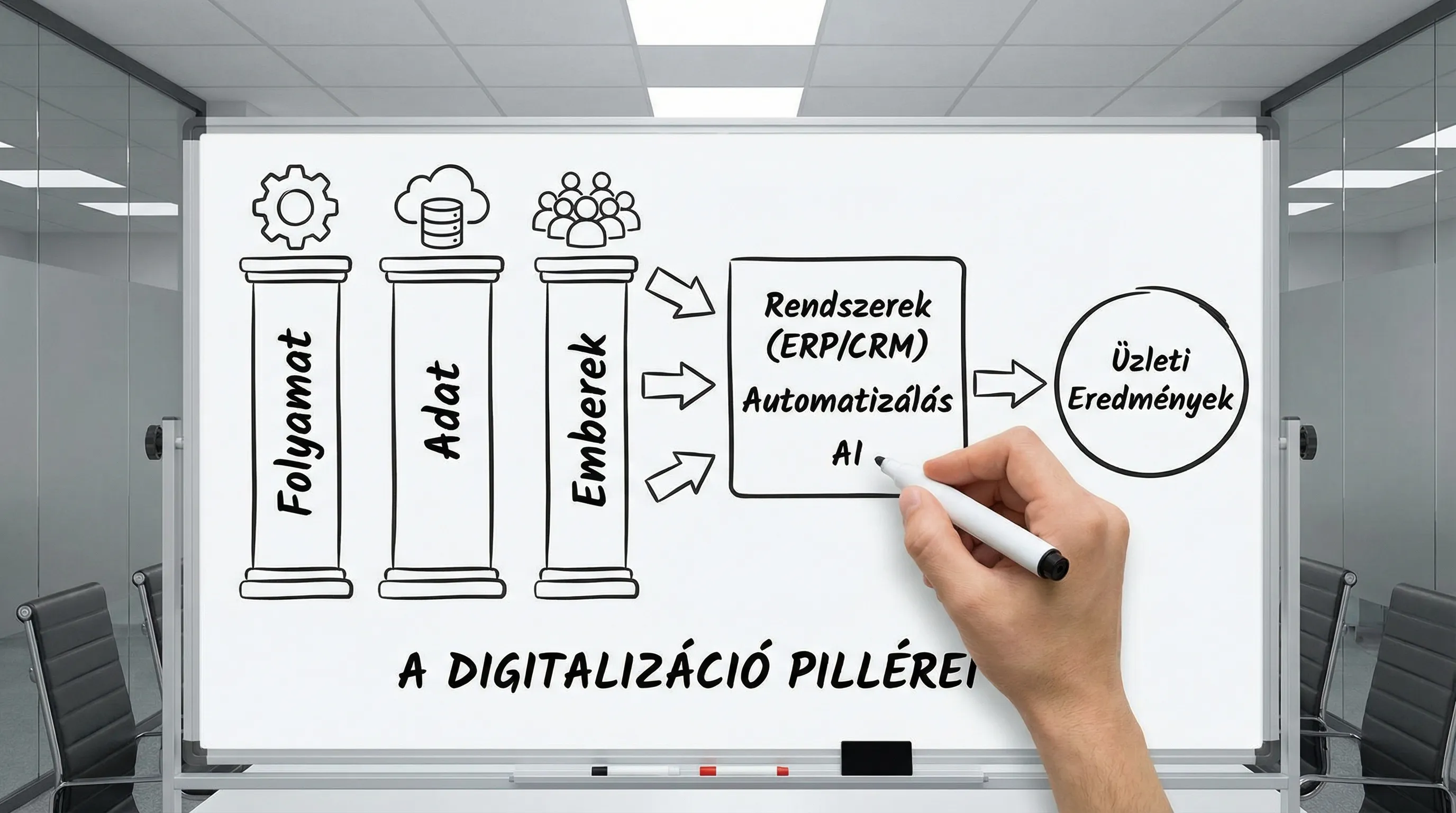
Digitalization is not (just) technology: 3 pillars
In practice, successful digitization rests on three pillars. If any one of these is missing, the project will be expensive and less profitable.
Process
What is happening now, and what will happen tomorrow? Who is responsible? At which stage does the error occur? Where is the delay? One of the greatest benefits of digitalization is that processes become "visible."
Data
Poor-quality data leads to poor decisions, even with modern systems. Without data owners, data definitions, uniform master data, and integration rules, digitization only provides a new interface for old problems.
People and operations
If the team does not understand why the process is changing, there will be resistance. If there is no training and support, there will be workarounds. Digitalization should therefore be treated as change management, not just a software project.
What is the company's level? Simple digital maturity model
The answer to the question "Where do we start?" is often to first understand where the organization currently stands. The following table provides a quick, business-oriented framework.
High school graduation level | Typical operation | Typical risk | Good next step |
1. Ad hoc | Excel, email, custom solutions | loss of information, dependence on individuals | process and data assessment |
2. Partially digitized | there are a few systems, but they are isolated | duplicate data, manual copying | integration plan, master data order |
3. Integrated | ERP/CRM/CMS connected, shared reporting | excessive customization, technical debt | standardization, KPIs, automation |
4. Data-driven | decisions are based on data, forecasts are displayed | data quality and governance burden | data platform, controls, scaling |
5. Intelligent operation | AI supports both decision-making and execution | compliance, distortion, security | Responsible AI, auditability, continuous optimization |
Level 5 is not the goal everywhere. For many SMEs, even moving from level 2 to level 3 brings spectacular results.
How can the results of digitization be measured? (KPI examples)
Digitalization is good when it is measurable. KPIs should always be linked to business goals, not just IT metrics.
Area | Example KPI | What does it indicate? |
Finance/admin | invoice processing time, error rate | automation and control |
Sales | lead-to-close time, conversion | process efficiency |
Customer service | first response time, resolution time | improved customer experience |
Operation | downtime, lead time | stability and predictability |
IT | number of incidents, release frequency | operational maturity |
Compliance/safety | audit findings, eligibility errors | risk management |
Common misunderstandings that cause projects to fail
"We'll buy a system and that's it."
The software is just a tool. If the process and data are not in order, introducing the system will only formalize the chaos at great expense.
“Digitization is an IT task”
IT plays a key role, but digitization is a business program. Without ownership sponsorship, business process owners, and decision frameworks, it will not be a priority.
“Let’s automate everything”
Not everything is worth automating. Automating a bad process results in faster bad performance. The correct order is typically: simplification, standardization, then automation.
“AI will solve it”
AI only brings value if there is adequate data, integration, and a framework of responsibility. (And if we link it to business goals, not technological curiosity.)
Where to start? Five sensible considerations for decision-makers
The best place to start is usually where the impact is quick and measurable, yet the risk is manageable.
Choose a process that involves a lot of manual work and is prone to errors (e.g., approvals, data entry).
Find out where the "data island" phenomenon hurts the most (for example, sales and invoicing are not connected).
Make it clear who the owner is (who is responsible for the process, not just the system).
Be prepared for change management (training, internal communication, support).
Start with a pilot project and scale based on KPIs.
If you are looking for a tangible, SME-specific roadmap, this article is specifically about that: Digital Transformation Checklist for SMEs.
Outlook: why is it urgent in 2026?
Digitalization will typically be accelerated by three forces in 2026:
regulatory and industry digitization pressure (e.g., e-invoicing requirements)
labor shortages and wage costs (pressure to automate)
competitive pressure (data-driven, faster operation)
At the macro level, it is also clear that digital maturity and competitiveness are linked. Context for this topic is provided by the European Commission's digital indicator system, DESI (Digital Economy and Society Index), which tracks digitization performance year on year.
Frequently Asked Questions (FAQ)
What is digitalization in a nutshell? Digitalization is the development of business operations where processes and decisions are based on digital systems and data, resulting in measurable efficiency gains.
Is digitization the same as scanning documents? No. Scanning is, at most, digitization. Digitization occurs when documents are searchable, structured, and the processes associated with them (approval, archiving, access) also operate digitally.
Which is better, CRM or ERP? It depends on where your biggest business pain points are. CRM typically delivers quick results in customer acquisition and sales, while ERP is the backbone of operations and finance. Detailed comparison: CRM vs ERP.
Is AI necessary for digitalization? Not necessarily. For many companies, the greatest gains come first from organizing data and basic processes. AI is worth introducing if you have a stable database, integration, and clear business goals.
How long does it take for digitization to pay off? This depends heavily on the process. Areas that can be measured quickly (admin, reporting, customer service automation) often yield results sooner, while integrated programs involving multiple systems take longer. The key to return on investment is a well-chosen scope and KPI-based implementation.
Next step: translate it into your company name
If you want to see clearly what digitization means for you in practice, it is worth starting with a short, goal-oriented assessment (process, data, system image). The Syneo team supports digitization and system implementation projects with unique IT and AI solutions and consulting, with a technology and implementation plan tailored to your goals.
Further information and contact details: Syneo