Digital switchover checklist for SMEs
Other
January 30, 2026

Digital transformation is no longer just an option, but a necessity for SMEs. Below, we outline the key steps that will help businesses become more efficient and remain competitive in the digital age:
Assess the situation: Examine the technological infrastructure, the digital skills of employees, and business processes.
Set goals: Determine what you want to achieve with digitization (e.g., cost reduction, improved customer experience).
Resource planning: Take advantage of funding opportunities, such as EU funds, and invest in employee training.
Implementation of tools: Automate financial, logistical, and marketing processes with the help of modern systems.
Track results: Measure the effectiveness of digitization with specific metrics and update your systems regularly.
Digitalization is not a one-time project, but requires continuous development, the success of which is determined by the human factor and a well-planned strategy.
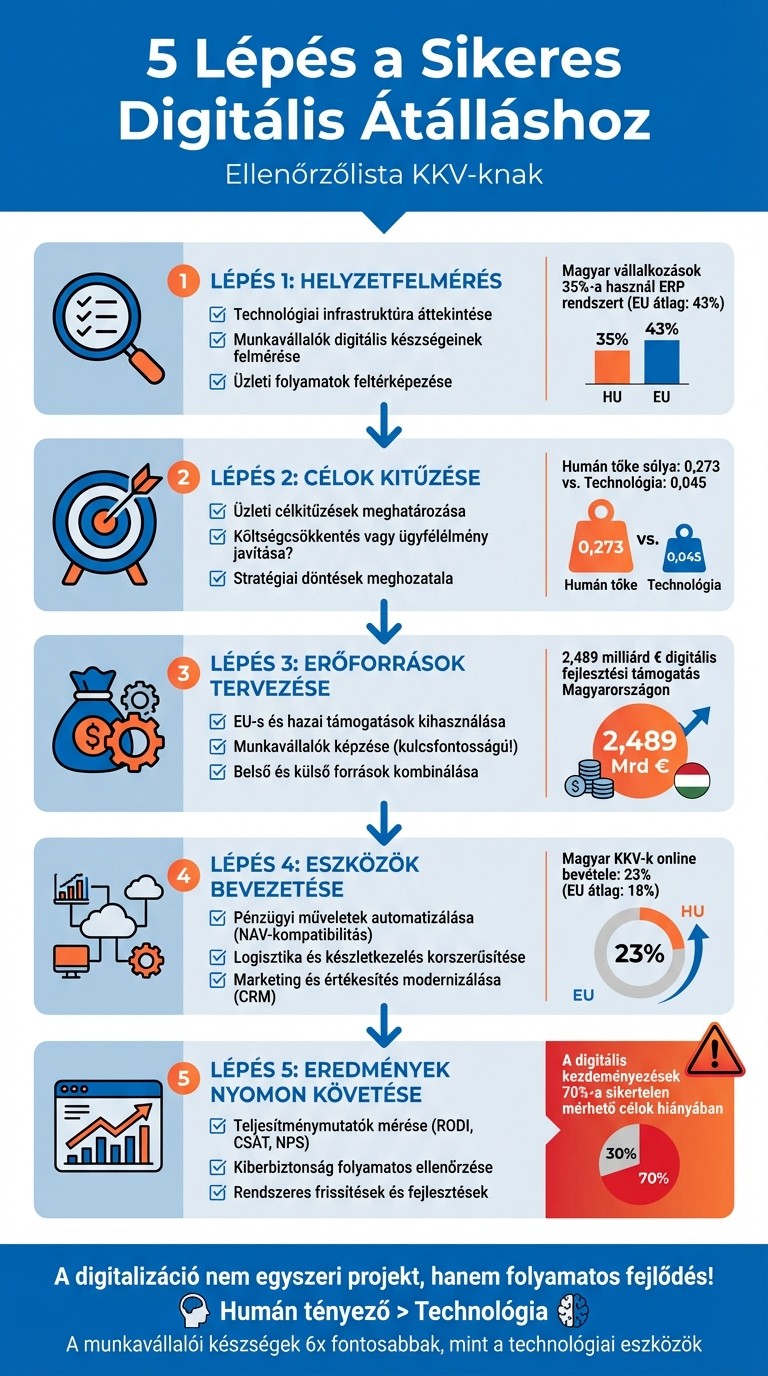
5 steps to digital transformation for SMEs – checklist
Assessment of the current situation
Overview of technological equipment
First, review your company's current technology systems: this includes hardware, internet connection, and software used, such as ERP, CRM systems, or cloud-based solutions. In Hungary, 35% of businesses use ERP systems, while the EU average is 43%. This difference highlights that there is still room for domestic SMEs to digitize their internal processes.
When introducing new technologies, compatibility is a key issue. Many people are concerned about how well new systems—such as artificial intelligence—will fit into existing infrastructure. It is worth completing a 26-question digitalization assessment to help you get an accurate picture of your current situation. It is important to note that basic IT infrastructure, such as the internet and computers, is now a basic requirement. The real difference lies in advanced business applications. Once these basics are in place, move on to assessing the digital skills of your employees.
Assessment of employees' digital skills
Human capital is key to digital development. According to the Digital Maturity Index, human capital has a weight of 0.273 in a company's digital maturity. In addition, there is a strong correlation of 0.471 between employee skills and the successful integration of digital applications.
"Human capacity development promotes the adoption of digital technologies." – Central European Journal of Operations Research
It is important to determine how many employees have digital skills and at what level. The use of cloud services, for example, can be a good indicator of the level of internal expertise available. Currently, only 3.7% of Hungarian companies use artificial intelligence-based solutions, compared to the EU average of 8%. It is therefore particularly important to plan training programs in advance, especially in the use of ERP systems and internal communication tools. Once you have assessed your employees' skills, move on to analyzing your business processes.
Mapping core business processes
Examine and document your financial, logistical, and sales processes. Identify areas where further digitization is needed. E-commerce is particularly strong in Hungary: 23% of businesses' net sales come from online sales, which exceeds the EU average of 18%. For SMEs, this figure is even higher, at 18%, while the EU average is only 12%.
Hungarian companies use artificial intelligence primarily in marketing, sales, accounting, and finance. Keep in mind that digital maturity depends not only on your internet connection, but also on the advanced business applications and cybersecurity solutions you use.
Setting goals and making plans
Setting business objectives
Based on the results of the technology and skills assessment, it is worth clearly defining your business goals and resource allocation. Digitalization only brings tangible results when paired with a well-thought-out strategy. Clarify what you want to achieve: more efficient internal processes, cost reduction, better customer experience, or even greater market share. E-commerce, for example, continues to offer significant opportunities for Hungarian SMEs, as analyses show.
The introduction of ERP systems, for example, improves data management and simplifies internal operations. Artificial intelligence can deliver rapid results in areas such as marketing, sales, and finance. It is important to understand that successful digitalization is not only a technological decision, but also a strategic one that affects the entire company's operations.
Planning the allocation of resources
Human resource development is key. According to the Digital Maturity Index, employee skills are six times more important than technological tools: the former score 0.273, while the latter score only 0.045.
"Human capacity development promotes the adoption of digital technologies." – Central European Journal of Operations Research
Invest in training and developing a skilled workforce! To do this, it is worth taking advantage of EU and domestic support opportunities. Hungary's digital development program, for example, has allocated €2.489 billion, of which €1.822 billion is available from public funds. Significant resources are also available from the EU Cohesion Fund and the Recovery Fund (€2.6 billion and €1.7 billion, respectively). Unfortunately, many SMEs rely solely on internal resources, even though external support would enable larger-scale developments. Once you have secured the resources, develop a detailed roadmap to achieve your goals.
Development of an implementation schedule
After planning your resources, it is important to schedule the digitalization processes so that they are implemented on time and in a measurable manner. Start with a self-assessment, examining your company's situation in the following five dimensions: connectivity, human capital, internal and external applications, and digital public services. Schedule training before introducing new tools, as employee readiness and successful technology adoption are closely related, as shown by a correlation of 0.471.
For Hungarian SMEs, automating internal processes is a priority. If you are planning to introduce artificial intelligence—especially given that Hungary's 3.7% rate lags far behind the EU average of 8%—it is worth starting in marketing, sales, or finance, where visible results have already been achieved.
Installation of digital devices
Automation of financial operations
One of the most important factors in the digitization of financial processes is NAV compatibility. It is worth choosing a system that supports the NAV Online Invoice 3.0 platform and is capable of automatically handling VAT returns and e-invoicing. Before starting the automation process, it is worth thoroughly reviewing your current ERP or accounting software to identify any errors in your tax management processes.
The new tool must integrate seamlessly with existing systems while complying with GDPR regulations and ISO/IEC 27001 security standards. If you already have an IT system in place, it may be advisable to add new modules rather than replacing the entire system. This is not only more cost-effective, but also carries lower implementation risks.
After the automation of financial systems, the digitization of logistics processes can follow.
Modernization of logistics and inventory management
For the digitization of warehouse management and logistics processes, choose systems that are capable of tracking inventory movements in real time and can be easily integrated with your ERP system. Cloud-based solutions are particularly popular among small and medium-sized enterprises in Hungary: 56.25% of companies already use this technology. It is important that the chosen system (whether cloud-based, local, or hybrid) is aligned with your business infrastructure and even the needs of colleagues working remotely.
The scalability of the system is also crucial: it must be capable of handling anywhere from a few dozen invoices to hundreds of thousands of data entries. If you manage multiple companies or need real-time data at the executive level, be sure to consider these factors when making your decision.
Automated inventory management provides a solid foundation for developing customer relationships, so the next step is to modernize sales and marketing.
Modernization of sales and marketing
By linking internal processes and financial automation, improving customer relations becomes the next logical step. The introduction of CRM systems not only helps to improve customer relations, but also increases sales. In Hungary, net revenue from online sales reaches 23%, which is well above the EU average of 18%. It is worth choosing systems that support social media integration, marketing automation, and AI-based analytics.
Early adoption of AI in marketing, sales, and finance has already yielded tangible results. If you are looking for financing options, consider DIMOP Plus 1.2.3/A-24 grant program, which offers loans ranging from HUF 3 million to HUF 20 million at 0% interest for the implementation of ERP, CRM, and e-invoicing systems. Up to 50% of the grant is available in a non-repayable form.
Monitoring progress and managing risks
Once digital tools have been implemented, the next step is to measure results and manage risks. This process is key to long-term success.
Tracking performance indicators
The effectiveness of digital transformation can be assessed using specific indicators. According to the data, more than 70% of digital initiatives fail, often because companies do not set clear goals and do not track progress. For example, half of companies do not define any measurable indicators for digital transformation.
Some important areas to keep an eye on:
Financial indicators: These include, for example, return on digital investment (RODI) and the proportion of revenue generated by online channels. In Hungary, businesses generate 23% of their revenue from online sales, which exceeds the EU average of 18%.
Customer-centric metrics: Customer satisfaction metrics such as CSAT, NPS, or CES show how digital changes affect the user experience.
Operational efficiency: The cycle time of business processes, throughput capacity, and the usage rate of new software (e.g., number of daily active users) can also be important metrics. In Hungary, the rate of data analysis usage is 53.2%, while the EU average is only 33.2%.
Protection against cyber threats
Digitalization brings not only opportunities but also challenges, especially in the area of cybersecurity. Outdated ERP systems, for example, do not always support modern encryption solutions, which can pose a serious data protection risk. According to one expert:
"There are many reasons for ERP data migration failures, but underestimated data complexity is what we see most often. Clear rules, strict validation, and accountability are required at every step."
New systems must support modern encryption methods and data masking, and ensure access rights that comply with the GDPR. However, 30% of businesses consider poor data quality to be the biggest obstacle to the introduction of technologies such as AI. It is therefore advisable to carry out thorough data profiling before the transition so that errors and deficiencies in the data can be identified in good time.
A few additional steps for security:
Full backups at multiple locations.
Written and tested disaster recovery plan.
Test integrations from third parties in a sandbox environment to avoid operational disruptions.
Regular updates and improvements
Digital transformation is not a one-time project, but requires continuous development. According to Berthold Puchta, one of the leaders of Ness Digital Engineering:
"Innovation is a never-ending process."
Successful digital transformation is more of a marathon than a sprint. By applying CI/CD (continuous integration and delivery) practices, you can make software updates faster and more efficient. With automated testing, you can significantly reduce the duration of testing cycles from weeks to days.
In Hungary, the National Digitalization Strategy aims to provide 95% of households with gigabit network coverage by 2030, creating an ideal foundation for cloud-based solutions and regular updates. With the help of maturity matrices or diagnostic surveys, you can regularly assess the digital status of your business and identify areas for improvement. 81% of people in Hungary believe that digitalization makes life easier, which creates a favorable environment for further development.
Summary and next steps
Summary of key points
The digital transition is not just about technological developments, but also about completely transforming the way a business operates. It is a strategic business model change, the success of which depends largely on the human factor. Hungarian businesses often focus on information and communication problems, while the real challenge lies in developing digital skills and shaping the right mindset. The checklist guides you through the process from assessing the situation to setting goals and introducing tools to continuous monitoring.
One of the most important lessons is that the human factor is the most significant determinant of digital maturity. Digital skills and the number of ICT professionals carry significant weight in maturity matrices (with a weighting of 0.273), far exceeding the role of any technological tool.
Collaboration with Syneo International
Syneo International offers comprehensive solutions to support the digital transformation of small and medium-sized enterprises. Its experts provide assistance in implementing digital systems that comply not only with central requirements but also with local regulations. Services include system audits, data flow analysis, and the development of a completely paperless accounting system. This solution provides real-time access to financial data and generates customized reports for management.
Continue
The digital transition cannot wait any longer. As a first step, it is worth conducting a digital maturity assessment to reveal your business's current situation in five key areas: human capital, connectivity, external and internal integration, and digital public services. In addition, developing the digital skills of your employees is also crucial, as this lays the foundation for the effective use of technologies. Basic internet connectivity and digital devices are now essential, but advanced business applications, data protection, and cybersecurity are what make the real difference.
The goal of the National Digitalization Strategy 2022-2030 is to integrate digital solutions into all areas of life. This creates a stable foundation for the wider spread of cloud-based systems and other modern technologies in Hungary.
Frequently Asked Questions
How can I begin the digital transformation of my business?
In order for your business to successfully enter the digital age, it is first worth thoroughly assessing your current situation. Review the digital tools and infrastructure you are currently using and identify areas where improvement is needed. This step will help you see clearly where you stand and what needs to be changed.
The next step is to develop a digitization strategy. This should be clear and goal-oriented: determine what results you want to achieve and what technologies can help you do so. For example, it is worth considering introducing systems such as ERP (enterprise resource planning) or CRM (customer relationship management). These tools can not only make business processes more efficient, but can also be a great help in managing customer relationships.
At the same time, it is important not to overcomplicate things. Focus on solutions that offer real benefits for your business and can be easily integrated into your daily operations. The goal is for digitalization to be a source of tangible results, not a burden.
How can I measure the effectiveness of digitization in my business?
The effectiveness of digitization can be measured in several ways, and one of the most common methods is to use a digital maturity index. This index provides a comprehensive picture of a company's level of adoption of digital tools, infrastructure, employee skills, and technological solutions.
Some key indicators that can help evaluate results:
Time and cost savings: How much more efficient have processes become with the introduction of new digital solutions? For example, have administrative costs been reduced or workflows accelerated?
Increased customer satisfaction: Has the customer experience improved? This can be measured, for example, by faster response times, personalized services, or the number of positive reviews.
Efficiency of internal processes: Has the number of manual errors decreased? Has data processing or information flow within the organization become faster?
These data not only show the results of digitization, but also how competitive the company is in the market and in which direction it should continue to develop.
What support is available for the digitization of SMEs in Hungary?
In Hungary, there are numerous opportunities for small and medium-sized enterprises to promote their digitalization. Among these, preferential loan programs stand out, such as 0% interest rate schemes, which are generally available for amounts between HUF 3 and 20 million. These programs can provide up to 50% support intensity, which can be a significant help in financing technological developments.
In addition, there are also innovation grants available, such as the GINOP Plus programs, which aim to support technological development and innovation capabilities in businesses. These grants are specifically targeted at projects that promote the competitiveness of companies through the use of modern technologies.
The Hungarian government's digital strategy also provides significant guidance for modernization. This strategy places particular emphasis on developing digital infrastructure, improving digital skills, and digitally transforming the economy.
Tip: It is worth keeping an eye on current calls for proposals and programs, as these can effectively support the achievement of digitization goals.