Introduction to artificial intelligence: frequently asked questions
AI
January 30, 2026

Nowadays, the use of artificial intelligence (AI) is not just about simple automation; it can also support business decisions, reduce the possibility of errors, and speed up processes. Integrating AI enables companies to operate more efficiently and introduce new business models.
Important points:
Advantages: Reduction in manual work (35–65%), cost reduction (up to 45%), real-time analyses.
Challenges: Data quality issues, system integration difficulties, regulatory compliance (e.g., EU AI Act).
First steps: Aligning business goals and AI, ensuring data quality, auditing IT infrastructure.
Platform selection: Scalability, suitability, integration with existing systems.
Training: Preparing employees for the use of AI is essential.
The introduction of AI requires long-term planning and continuous performance measurement. The key to success is data quality, choosing the right platform, and developing the human factor.
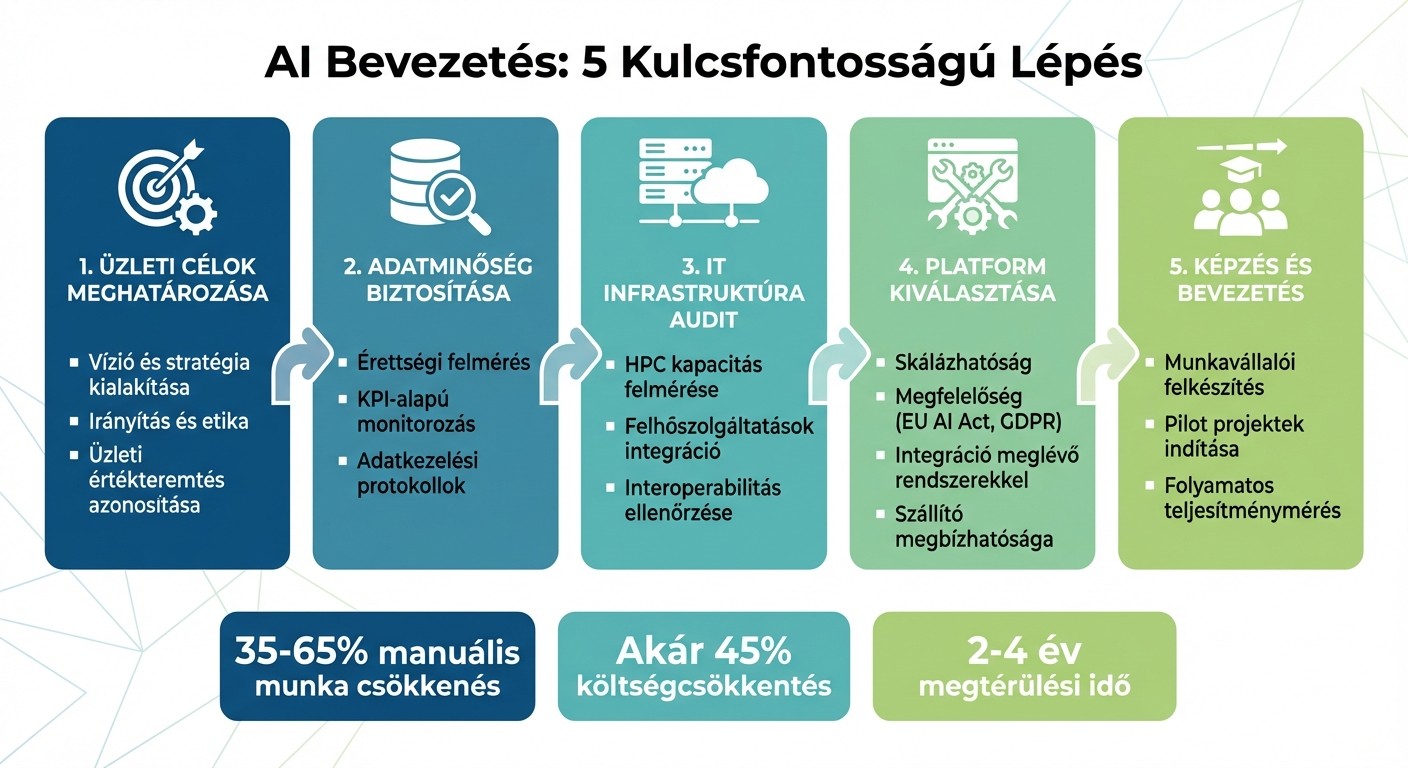
5 key steps for companies to implement AI
AI in corporate practice – Webinar 11 March 2025
https://youtu.be/XJqntFIZJsU
First steps in introducing AI
The introduction of AI is not a simple technological project, but a strategic decision that can affect the entire operation of a company. For the process to be successful, it must be based on three main pillars: aligning business goals with AI, ensuring data quality, and thoroughly assessing the IT infrastructure.
Aligning AI with business goals
The primary goal of AI implementation is to create tangible business value, not merely technological advancement. This requires a well-thought-out strategy based on six key areas: vision and strategy, governance and ethics, technology and tools, data management, processes, and people and culture. Companies must first identify the areas where artificial intelligence can make the most progress and align this with specific business challenges. AI should not be treated in isolation; integration with existing processes and data enables more accurate decision-making and more efficient operations. Once alignment with business objectives has been achieved, the next step is to ensure data quality.
Data quality control
The performance of artificial intelligence systems depends heavily on the quality of the data used as a basis. Therefore, companies must first conduct a maturity assessment, examining data management practices, data availability, and compliance aspects. The Hungarian National AI Strategy aims to establish at least 1,000 agreements on the secondary use of data, thereby supporting the development of a data-driven economy. KPI-based monitoring tools are essential for maintaining data quality, as they help to continuously monitor large amounts of data. In addition, it is essential to clearly define data collection and storage rules, as well as ethical usage protocols. Once data quality has been ensured, the next step is to assess the technological background.
Auditing IT infrastructure
Assessing the state of existing IT systems is a key step in introducing AI. Companies need to examine whether their infrastructure can handle the computational load required by AI, especially if high-performance computing (HPC) capacity is needed. The Hungarian National AI Strategy has set a target of achieving 5 petaflops of HPC capacity by 2022. The audit should cover the state of data centers, the integration of cloud services, and interoperability to ensure smooth data flow between existing systems and new AI applications. Advanced software tools and frameworks are also essential to support AI development processes, from data processing to model deployment and monitoring.
Selecting an AI platform
After the audit results, the most important step comes: selecting the ideal AI platform. This decision fundamentally determines how quickly and efficiently AI can create value for the company.
What to look for when choosing an AI platform
When choosing the right platform, it is worth considering several factors, such as the company's vision, governance, technology requirements, data management, processes, and human resources. Among the technological considerations, scalability is particularly important, as it shows how the platform handles growing computing capacity demands. In addition, the platform must support hybrid cloud environments so that the company can flexibly switch between its own data centers and cloud providers.
Integration capabilities are also essential: the platform must connect seamlessly with existing systems, including RPA (robotic process automation) solutions. Combining these with the "thinking" capabilities of AI results in effective automation.
"Technology is moving faster than governments, and regulators can't keep up."
Compliance is also key: the system must comply with regulations such as the EU AI Act and the GDPR.
The reliability of the provider is also important. Platforms backed by international partners such as Microsoft, Google, or OpenAI offer continuous development and a high level of support. According to a survey, 54% of finance and accounting executives believe that "deeper, more flexible analysis and reporting capabilities" are essential for future success. It is therefore important that the platform also offers modern analytical tools.
Customized AI solutions for your company
When selecting a platform, it is not only technological capabilities that matter, but also the extent to which it supports company-specific solutions. Generic applications rarely deliver outstanding results.
A good example of this is Optimaze Consulting Kft.'s "WIKI" assistant, which functions as an internal knowledge base. This system indexes the company's internal documents and responds to employee questions in real time with version management. This is particularly useful when training new employees, as it saves a significant amount of time.
Other advantages of customization include support for automated competitor monitoring and the fact that modern AI-based assistants can interpret and translate up to 175 languages.
Planning for future flexibility and support
AI technology is advancing so rapidly that it is no longer sufficient to review strategies every few years. The Hungarian government, for example, has switched to an annual review cycle in order to keep pace with technological and legal changes. It is therefore essential that the chosen platform be able to continuously adapt to new requirements.
Regular updates and modular design are also important, as they enable the easy integration of new features. A good example of this is the National Laboratory for Autonomous Systems, established as part of the National AI Strategy launched in September 2020. Here, under the leadership of SZTAKI and in cooperation with the ZalaZone test track, solutions for autonomous road vehicles and aircraft are being continuously developed.
The table below summarizes the most important aspects:
Factor | Key consideration |
Infrastructure | HPC and hybrid cloud support |
Compliance | EU AI Act and sector-specific regulations |
Integration | Compatibility with RPA and legacy IT systems |
Data processing | Support for data anonymization and secondary use agreements |
Support | Access to international partner ecosystem (Microsoft, Google, OpenAI) |
Before selecting a platform, it is worth running proof of concept (PoC) projects. These help to assess how compatible the system is with the existing IT environment. The Hungarian AI Challenge initiative, which aims to provide basic AI training to 100,000 people, clearly shows that, in addition to technological preparedness, the development of human competencies is also extremely important for the successful introduction of a platform.
Solving common AI implementation problems
After selecting an AI platform, practical obstacles may slow down implementation. However, these difficulties can be anticipated and managed if the right strategy is applied.
Data protection and compliance management
The risk classification of AI systems is crucial: they can be classified into four categories – unacceptable (prohibited), high risk, limited risk, and minimal risk. Incorrect classification can have serious consequences, such as fines of up to €35 million or 7% of global annual turnover for violations of the EU AI Act.
Since February 2, all Hungarian companies are required to ensure that their employees understand the operation and risks of the AI systems they use. As the Schoenherr law firm put it:
"The AI Act applies to all companies that develop, use, import, or distribute AI systems in the EU, regardless of their place of establishment."
The first step is to conduct a risk audit: all AI applications must be mapped and then classified into categories defined by law. For high-risk systems, such as credit scoring models or employee assessment tools, the legislation requires detailed documentation, human oversight, and logging. In the financial sector, it is particularly important that the Hungarian National Bank (MNB) retains supervisory authority over AI systems.
Once legal compliance has been ensured, the next step is to strengthen internal knowledge and employee training.
Preparing the workforce for AI
In addition to legal compliance, employee training is also essential. Knowledge of AI is now not only an advantage, but also a legal obligation. According to KPMG Hungary:
"Strong emphasis must be placed on training across the entire organization so that employees have the necessary basic knowledge and realistic expectations."
Training programs are more effective when tailored to specific roles. Basic knowledge is sufficient for general staff, while managers need more in-depth knowledge to support and manage AI projects. According to Hungary's national AI strategy, the goal is to provide targeted AI training to 8,000 adults and basic training to 100,000 people.
One practical solution could be the use of AI-based internal knowledge bases, which help to train new employees more quickly while reducing the workload of experienced colleagues. Training should also cover how AI works with other technologies, such as RPA.
Once the legal and human factors have been secured, technical integration follows.
Connecting AI to legacy systems
Connecting AI solutions to existing IT infrastructure is often the biggest technical challenge. One effective approach is to combine RPA and AI: software robots collect data from legacy systems in real time, which is then analyzed and interpreted by AI systems. This not only eliminates manual data entry errors, but also ensures the continuity of data flow.
KPMG Hungary recommends a four-phase integration model: assessment (determining maturity level), preparation (identifying high-value use cases), transformation (preparing the organization), and development (introducing AI into processes). Hybrid cloud-based environments allow older hardware to connect efficiently to modern AI providers. Hungary's goal is to achieve 5 petaflops of HPC capacity to support data-intensive AI applications.
Overcoming these technical obstacles is essential for AI integration to deliver real results.
Measuring the results of AI projects
After implementing AI, the payback period is typically 2–4 years, compared to 7–12 months for traditional technology investments. In order to properly evaluate the results, clear and measurable indicators are needed, which are described in more detail below.
According to Hussain Chinoy and Amy Liu, experts at Google Cloud:
"You can't manage what you don't measure." – Hussain Chinoy and Amy Liu, Google Cloud
Successful companies evaluate AI performance based on several factors, such as model and system quality, business efficiency, user acceptance, and financial results. According to research, 66% of organizations have increased their productivity by using AI.
Setting success metrics and tracking performance
A multidimensional approach is needed when evaluating AI projects. Many leading companies use a so-called "AI ROI Performance Index," which examines four key indicators: direct financial return, revenue growth, reduction in operating costs, and speed of achieving results.
Different types of AI require different metrics. For example, in the case of generative AI, time savings and faster task completion are paramount, while in autonomous AI systems, cost reduction, process re-engineering, and risk management are the focus.
The head of an industrial company put it this way:
"We achieved a 100% ROI on some of our projects – for every euro invested, we received a return of €2–3 per year... The value created definitely exceeded the cost of our initiatives." – (Executive, Energy, Resources & Industrials Company)
We should not overlook the benefits that are more difficult to quantify, such as improved supplier relationships or increased employee satisfaction.
The key to the long-term success of AI systems is continuous performance measurement. Experts say that AI strategy must be managed dynamically, reviewing it at least every two years in line with the pace of technological development. This involves using KPI-based tools that can analyze large amounts of data in real time. Fifty-four percent of finance executives say that "more agile analytics and reporting" is essential to the success of AI-integrated environments.
Performance monitoring not only measures technical accuracy, but also serves to continuously fine-tune AI use cases and strategies during development and transformation phases.
Examples of successful AI implementations
By applying the right metrics, many companies have already achieved significant results. Investment in AI continues to grow: 85% of organizations increased their AI spending between 2024 and 2025, and 91% plan further increases by 2026. The "AI ROI leaders," or the most successful companies, spend more than 10% of their technology budget on AI.
Employee access to AI has increased by 50% by 2025, and 83% of executives believe that AI helps employees focus on strategic and creative tasks.
According to Deloitte's report:
"ROI is being redefined—not just as cost savings, but as an indicator of innovation, flexibility, and sustainable growth."
Over the next six months, the number of companies with 40% or more of their AI projects already in live operation is expected to double.
Best practices for AI integration
In this section, we will present practical steps that can help you successfully implement AI.
Let's start with pilot projects
One of the best ways to introduce AI is to proceed gradually. It is advisable to first define specific business goals, such as improving efficiency, increasing customer retention, or enhancing employee satisfaction.
Let's start with a few smaller projects that will yield quick results. Use an evaluation matrix that compares "Potential Value" and "Feasibility." Then choose low-risk pilots, such as creating an AI-based knowledge base or an automated media monitoring system. Involve 5–15% of the workforce in testing.
According to Zoltán Tanács, AI consultant:
"A successful AI program is one that is led by the board of directors or CEO, setting an example for other colleagues."
Invest in employee training programs
Training on AI should not be a one-time event, but rather an ongoing process. Professionals need to understand how AI works and why it makes certain decisions—this is essential for building trust in the system. For the transformation to be successful, it is essential that everyone within the organization is aware of the possibilities and limitations of AI.
Let's start with a skills and culture assessment to identify gaps, then fill them with targeted training. Training programs should also cover ethical issues, transparency, and fairness. It is important to emphasize that AI is there to support work, not to replace employees. An AI-based internal knowledge base, such as a "WIKI" assistant, can also be useful in training new employees more quickly, while reducing the burden on experienced colleagues.
In addition to training programs, developing the right implementation strategy is also crucial.
Phased vs. full implementation
Choosing the right implementation strategy is crucial. A phased approach allows for pilot projects to be tested and fine-tuned, while full implementation integrates AI directly into business systems such as ERP, HR, or supply chain.
Consideration | Phased introduction | Full implementation |
Risk level | Low; errors are limited to a small group | High; system failures can affect the entire organization |
Cost | Small investment at the start; costs increase proportionally with success | Significant upfront investment required |
Feedback cycle | Fast; easily modifiable based on experience | Slow; difficult to implement changes |
Employee acceptance | Higher; a smaller proportion of the workforce can mentor others | Lower; may cause greater resistance |
The phased approach allows for gradual investment in infrastructure and human resources. According to Eric Schmidt, former CEO of Google:
"Technology is advancing faster than governments, and regulators cannot keep up."
That is why it is worth choosing a cautious, step-by-step introduction, which allows for adaptation to changes in the technological and legal environment. The goal is always to ensure that the introduction of AI is in line with business objectives, increases efficiency, and ensures data quality.
Summary
The application of AI is not a one-time task, but a long-term business transformation that requires thorough planning, selection of appropriate tools, and continuous performance measurement. Experience shows that companies that focus on six key areas achieve success: vision and strategy, governance and ethics, technology, data management, processes, and people and organizational culture. Together, these factors ensure the successful integration of AI.
The quality and accessibility of data is of fundamental importance. This aspect is reinforced by the work of the National Data Asset Agency, which focuses on improving data management. Due to the dynamic development of technology, the government has introduced an annual review system to keep pace with innovations.
According to experts at KPMG Hungary, combining industry expertise with technical knowledge is essential for success. This combination helps business leaders to reliably and effectively exploit the potential of AI. Strategic management and industry experience are therefore key during complex transformations.
It should not be forgotten that, in addition to technological factors, the development of human resources also plays a key role. AI is not intended to replace people, but rather to support them. With the help of AI tools, people can focus more on strategic thinking, while repetitive, routine tasks are automated. This gives greater scope for human creativity and innovation.
Frequently Asked Questions
What business results can we achieve by using artificial intelligence?
The use of artificial intelligence (AI) offers numerous opportunities for businesses that can directly contribute to their success. For example, AI can be used to automate repetitive tasks, which not only reduces operating costs but also increases efficiency. In addition, AI is capable of faster and more accurate data analysis, which greatly aids in informed and rapid decision-making.
Improving customer experience is another significant advantage offered by AI. Just think of personalized offers or faster customer service responses —all of which contribute to greater customer satisfaction. Companies that use AI can also gain a competitive advantage, as new, state-of-the-art solutions are better aligned with customer needs and constantly changing market trends.
How can you make sure your data is good enough for AI systems?
The reliability of AI systems is based on the use of high-quality data. This means not only collecting data, but also processing it thoroughly and checking it regularly. For example, data cleansing—removing incorrect, incomplete, or duplicate information—is essential for AI models to work accurately and efficiently.
In order for data to truly support corporate goals, it must always be kept up to date. In addition, strict adherence to data protection and ethical standards, especially when it comes to sensitive information, is crucial. This not only helps to avoid data protection issues, but also contributes to maintaining trust in the company.
Regular monitoring and documentation of data processing procedures are also essential. These measures not only ensure transparency, but also guarantee that AI systems function effectively and reliably in the long term.
How can employees' AI skills be developed in a corporate environment?
To expand employees' knowledge of artificial intelligence, it is worth developing training programs that cover both basic concepts and practical applications. Basic training helps employees understand how AI works, its possibilities, and its limitations. In addition, specialized training courses—such as those focusing on automation processes or data analysis —provide knowledge that can be directly applied in everyday work.
It is important that programs do not focus solely on developing technical skills. Emphasis must also be placed on the ethical and responsible use of AI. This includes compliance with legislation and the strategic application of AI in line with the company's objectives. Such complex training helps to ensure that the introduction of AI in the company is not only successful but also sustainable in the long term.