CRM vs ERP: which system do you need?
CRM
January 30, 2026
CRM (Customer Relationship Management) and ERP (Enterprise Resource Planning) systems were designed to solve different problems, but both serve to make businesses operate more efficiently.
CRM: Focuses on managing customer relationships. Helps optimize sales processes, marketing, and customer service. An ideal choice if your goal is to increase revenue and retain customers.
ERP: Integrates internal processes such as finance, inventory management, HR, and manufacturing. It is necessary when increasing operational efficiency and reducing costs are priorities.
Quick comparison
Consideration | CRM (Customer Relationship Management) | ERP (Enterprise Resource Planning) |
Focus | Customer relations | Internal processes |
Goal | Increasing revenue | Cost reduction |
Users | Sales, marketing | Finance, HR, inventory management |
Data | Customer-specific | Enterprise level |
Tip: If both areas are important, integrating CRM and ERP systems will ensure comprehensive operational efficiency.
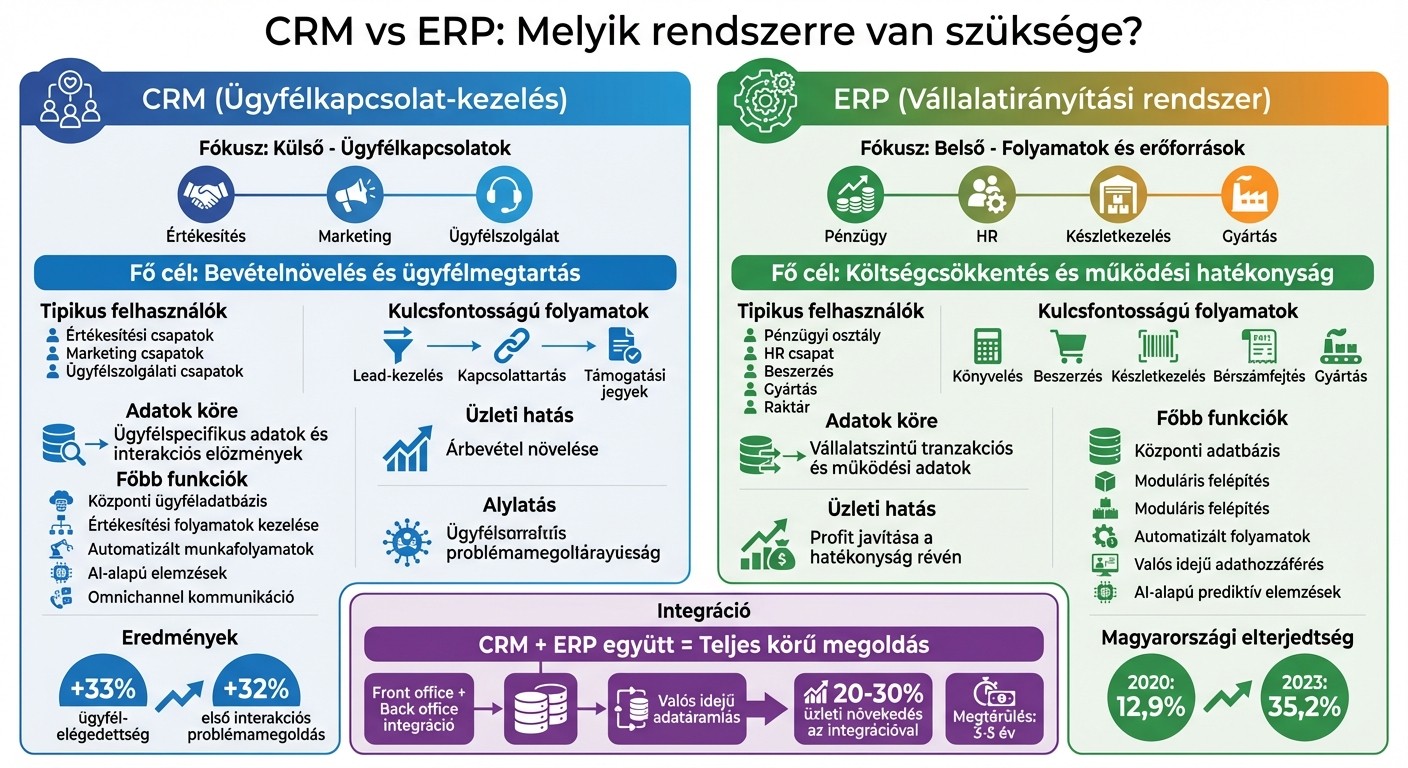
Comparison of CRM and ERP systems: main differences and areas of application
The main differences between CRM and ERP
What does each system do?
CRM (Customer Relationship Management) and ERP (Enterprise Resource Planning) systems serve different purposes and focus on different areas. CRM supports the "front office" of the company, i.e., it focuses on customer relationship management. Its task is to assist sales and marketing activities and improve the customer experience, thereby increasing revenue. For example, CRM systems are capable of tracking customer contact history, purchasing habits, and support needs.
ERP, on the other hand, focuses on the back office, i.e., it integrates the company's internal processes. This includes finance, procurement, inventory management, HR, and manufacturing. The goal of ERP is to provide a single source of data in order to reduce costs and increase efficiency.
SAP puts it this way: "The ERP system acts as the central nervous system of the company, effectively helping to manage these critical processes and operations by connecting them in a single integrated system."
While CRM manages customer-related data, such as interaction history and customer-specific information, ERP covers transaction and operational data for the entire company.
CRM vs ERP comparison table
The table below helps to better understand the differences between the two systems:
Consideration | CRM (Customer Relationship Management) | ERP (Enterprise Resource Planning) |
Primary focus | External: sales, marketing, customer service | Internal: managing processes and resources |
Main objective | Increasing revenue, improving customer retention | Operational efficiency, cost reduction |
Typical users | Sales, marketing, and customer service teams | Finance, HR, procurement, manufacturing, warehousing, management |
Key processes | Lead management, contact management, support tickets | Accounting, procurement, inventory management, payroll accounting, manufacturing |
Scope of data | Customer-specific data and interaction history | Company-level transaction and operational data |
Business impact | Increasing sales revenue | Improving profits through efficiency |
It is worth mentioning that some ERP systems also include CRM modules that complement the basic functions. At the same time, dedicated CRM systems generally offer more detailed solutions to meet the needs of sales and marketing processes. Using the two systems together allows the company to get a complete picture of its operations, from customer relationships to financial reports.
What can a CRM system do?
Key CRM features
The essence of CRM systems is that they provide a central customer database that contains purchase history, order status, and customer interactions (such as phone calls, emails, chat conversations, or social media messages). This comprehensive customer profile enables sales, marketing, and customer service teams to always work with up-to-date information.
One key feature is lead and sales process management, which helps you see where a potential customer is in the sales funnel. The system not only tracks inquiries, but also automatically forwards them to the appropriate employee and makes accurate predictions for achieving sales targets. Automated workflows take the burden off teams: the system automatically records data, sends sales emails, and sets reminders for next steps.
Modern CRM solutions now also use artificial intelligence. This enables personalized product recommendations, real-time analysis based on customer data, and even round-the-clock customer service through autonomous AI agents. Omnichannel communication ensures that customers receive consistent and uniform service across all channels. These tools fundamentally help businesses operate more efficiently, which we will discuss in more detail in the next section.
How CRM helps your business
The above features not only offer technological advantages, but also result in tangible business impacts. For example, customer satisfaction can increase by up to 33%, while problem resolution during the first interaction can become 32% more efficient.
"CRM technology helps companies stay connected to customers, streamline processes, and improve profitability," says Salesforce.
The system reduces administrative burdens, allowing sales teams to spend more time building relationships. Mobile access is particularly useful for field staff, who can update customer data in real time from any device. Integrated reports and analyses help with data-driven decision-making, which can ensure stable growth in the long term.
What can an ERP system do?
Key ERP functions
ERP systems connect financial, HR, manufacturing, and supply chain processes with their central database. This not only eliminates data silos, but also provides a unified and easily accessible data source for all employees.
Thanks to the modular structure of the system, companies can select the modules that best suit their needs, such as inventory management, procurement, or financial functions.
Automated processes—such as payroll, invoicing, or approvals—not only reduce the chance of human error, but also significantly reduce administrative burdens.
Real-time data access is particularly beneficial for managers, as it provides immediate insight into operational processes. This enables them to make informed decisions more quickly and respond more flexibly to market changes.
"An ERP software system acts as an enterprise's central nervous system, helping efficiently manage all these crucial processes and operations by connecting them together in an integrated system." – SAP
Modern ERP systems now include artificial intelligence, which supports business administration and enables predictive analytics.
Cloud-based solutions are also growing in popularity, as they offer better security, higher availability, and real-time mobile access.
It is worth mentioning that today's ERP systems—such as Dyntell —can cover up to 80–95% of industry-specific processes without the need for custom development.
ERP systems therefore represent not only technological progress, but also offer numerous practical business advantages.
How ERP helps your business
ERP systems offer tangible benefits for various departments. For example, the finance department can close its books faster, prepare more accurate financial reports, and gain complete visibility into tax liabilities and transaction histories.
"The shift to an ERP system can transform operations, creating faster, more accurate processes which can upgrade the role of tax professionals from compliance managers to strategic advisors." – Thomson Reuters
Beyond financial benefits, ERP also improves logistics and procurement processes. The logistics team can ensure that the right products and services arrive on time, while the procurement department can manage supplier relationships and goods procurement more efficiently.
For manufacturers, ERP provides the opportunity to better utilize assets and reduce overtime costs, while wholesalers can experience increased inventory turnover and shorter order cycles.
ERP also plays a prominent role in supply chain optimization. Real-time inventory updates and more efficient warehouse management reduce storage costs.
Integrated reporting and visual data presentation enable faster, fact-based strategic decisions.
CRM vs ERP: What’s the Difference? A Comparison for 2026
https://youtu.be/u3dOut9f9Cw
When does your business need CRM?
The introduction of a CRM system becomes truly necessary when a company loses transparency in its communication with customers. If contact history, contracts, or service requests are scattered across different departments and systems, the fragmentation of customer data can cause serious efficiency problems. In Hungary, more and more companies are recognizing that centralized customer management not only facilitates day-to-day operations, but also improves the quality of customer relationships in the long term. This is especially true for companies that work with complex sales processes or maintain long-term customer relationships.
A CRM system not only simplifies customer data management, but also allows the company to focus more on building customer relationships and making sales processes more efficient.
Best Use Cases for CRM
When scattered customer data hinders a company's operations, implementing CRM can be particularly important. This becomes indispensable in complex B2B sales cycles. Companies working on long projects that require multiple specialists and stakeholders find it difficult to track business processes from initial contact to final agreement without CRM.
"B2B marketing targets existing customers." – Opteamus
If members of the sales team spend too much time manually preparing offers and quotes instead of actively selling, a CRM system that offers automated document generation can quickly pay for itself. Furthermore, when an employee leaves, customer relationship history and business information are lost, but a centralized system can help minimize this loss of knowledge.
Service-oriented industries such as IT services, high-tech manufacturing, and media can benefit greatly from using CRM. In these sectors, ongoing maintenance, helpdesk support, and error reporting are required even after the initial sale. In addition, if salespeople in the field cannot immediately access database information, contracts, or customer history from their mobile devices, this is a clear sign that a mobile CRM system is needed.
When does your business need ERP?
The introduction of ERP systems becomes truly necessary when a company's internal processes become opaque. For example, if management cannot quickly answer questions such as which product line generates the most revenue, how many returns were received in the past month, or how much inventory is available, then it is time to move beyond the limitations of Excel spreadsheets and basic accounting systems. In Hungary, the use of ERP systems increased significantly between 2020 and 2023: their prevalence among businesses rose from 12.9% to 35.2%, which shows that more and more companies are recognizing their benefits.
A clear sign that ERP is needed is when there is a lack of data integration between different departments, and manual data entry leads to errors and wasted time. For example, if the finance, sales, and operations departments use different software, this can result in duplicate data entry and time-consuming report reconciliation. Employees who struggle with data export and import on a daily basis can see a quick return on investment by implementing an integrated ERP system.
"ERP systems have become essential to remaining competitive in today's Amazon-transformed marketplace, regardless of industry." – Lisa Anderson, supply chain expert
ERP is particularly important when a company is growing and processes become unmanageable. For example, if deliveries are delayed due to inaccurate inventory management or costs increase due to low utilization of production capacity, a centralized system can bring together finance, HR, production, procurement, and logistics. Experience shows that the costs of implementing ERP are usually recouped within 3-5 years through more efficient operations and fewer errors.
Best Use Cases for ERP
ERP systems work particularly well in industries where complex processes and data integration are required.
Manufacturing: ERP systems can manage up to 14 different production levels, supporting production scheduling, material requirements planning (MRP), and real-time quality assurance.
Wholesale and distribution: Integrated logistics modules can reduce distribution costs, increase inventory turnover, and shorten order cycles.
Retail: Companies that sell through multiple channels—such as those that operate both physical stores and online stores—can get a unified view of their inventory and shipments.
Service sector: For accounting firms, engineering companies, and law firms, ERP can help balance project profitability and resource utilization.
Construction: ERP systems enable subcontractor scheduling, material delivery tracking, and cost management on a single platform.
ERP systems are also particularly useful when a company operates in a strictly regulated environment or faces frequent tax changes. Automated tax calculations and audit trails make administration easier. In Hungary, the introduction of ERP can be particularly beneficial for small and medium-sized enterprises, as GINOP+ programs and other subsidies can cover up to 50-70% of the costs.
Using CRM and ERP together
Many businesses mistakenly believe that they must choose between CRM and ERP systems, even though integrating them can significantly improve operations. By connecting the two systems, the front office (sales, marketing, customer service) and back office (finance, inventory management, procurement) work from a single database. This not only solves the problem of data silos, but also ensures that all departments see the same accurate information in real time.
The benefits of integration are immediately apparent. For example, salespeople can check customer credit limits and outstanding invoices in the CRM based on ERP data, enabling them to provide more accurate quotes. The finance department can automatically calculate sales commissions from CRM data.
"CRM integration with other internal applications brought productivity increases across sales, service, and operations and a 20 to 30 percent growth in business." – Nucleus Research
How CRM and ERP integration works
The technical implementation of integration can be done in two ways: through a direct data connection, where the two systems communicate directly with each other, or on a unified platform, where CRM and ERP are based on the same data model. The latter solution enables real-time updates and does not require third-party data transfer software.
An example of this is when a customer pays online, the revenue is immediately recorded in the general ledger, so no orders or revenues are left out of the reports. The quote-to-order (CPQ) process is particularly effective in an integrated system, as it combines product information and prices from the ERP with customer-specific conditions stored in the CRM.
Advantages of interconnected systems
Integration brings practical benefits, not just technical advances. Eliminating duplicate data entry and manual data management significantly reduces the risk of errors. For example, Blue Shield of California saved $500,000 in operating costs by switching to a cloud-based integrated system. Another example is Wanadis Ltd., which achieved real-time visibility into the customer lifecycle by connecting its manufacturing, sales, and inventory management processes.
The customer experience also improves, as customers do not have to repeatedly provide their details to different departments. For example, when a customer calls customer service, the agent can immediately see if they have any outstanding bills or deliveries, enabling them to provide faster and more personalized service. Managers also gain a comprehensive view of customer profitability and lifetime value, which helps with more accurate forecasting and KPI management.
Function | The benefits of integration |
Order history | Salespeople can check previous purchases and credit status in CRM |
Stock levels | CRM users see ERP inventory data in real time |
Financial reports | The finance team forecasts revenue more accurately based on CRM data |
Customer service | Support staff identify important customers based on ERP data. |
Choosing the right system
Before making a decision, it is worth carefully considering what goals your business wants to achieve. If the focus is on increasing sales, improving customer relationships, or enhancing marketing efficiency, then a CRM system may be the ideal choice. However, if your priority is to simplify financial processes, make inventory management more transparent, or reduce operating costs, then an ERP system may be the right solution. Therefore, the decision always depends on the current challenges and needs of your business.
However, it is important to note that choosing one system does not exclude the other. Most growing businesses will eventually implement both, as both front office (sales, marketing) and back office (finance, inventory management) areas are critical to business success. This clearly illustrates how digitization accelerates business operations.
In practice, it makes sense to start with the system that solves the biggest problem. For example, if the sales team has difficulty tracking leads or financial closing processes take too long, these factors can help determine priorities.
As Barney Beal, Director of Content at NetSuite, put it:
"The fundamental difference between ERP and CRM is that ERP primarily relates to financial data and the finance department, while CRM uses customer data for the sales and customer service departments."
When making the right decision, it is not only the type of system that matters, but also its ability to work with other systems. It is worth checking whether the chosen solution has an open API or pre-built integration connectors. This is particularly important, as integrating the CRM system with other internal applications can result in business growth of up to 20-30%.
Finally, involve the sales, finance, and IT departments in the decision-making process. This will ensure that the selected system truly supports the strategic goals of the business.
Frequently Asked Questions
What are the advantages of connecting CRM and ERP systems?
Linking CRM (Customer Relationship Management) and ERP (Enterprise Resource Planning) systems offers numerous advantages for businesses. Integration allows data and processes to work in harmony, so that all departments—whether sales, marketing, finance, or manufacturing—use the same data. This not only reduces data duplication, but also minimizes the chance of human error.
The integrated system results in faster and more accurate data management, which directly contributes to better decision-making and more efficient business processes. For example, sales data can automatically update financial or inventory management modules, thereby increasing the company's adaptability to market changes.
In addition, the system also improves the customer experience. Unified data makes administration faster and more efficient, which not only increases customer satisfaction but also contributes to long-term growth and competitiveness. Such integration therefore not only streamlines internal processes, but also provides tangible benefits for customers.
When is the right time for a business to implement a CRM system?
The introduction of a CRM system can be truly beneficial for a business if customer relationship management requires more efficient solutions, or if sales and marketing processes need to be made more transparent and effective. This is particularly relevant when the company is growing and manual data management methods are no longer able to keep up with the volume and complexity of customer data.
A well-functioning CRM system allows customer data to be stored in one place, customer needs to be understood more accurately, and personalized offers and services to be developed. This not only strengthens customer loyalty, but also improves sales results, while automating a number of processes, such as communication and customer relationship management. Overall, the introduction of a CRM system becomes truly justified when customer-centric operations come to the fore and increasing business efficiency becomes essential.
How can an ERP system reduce business costs?
The ERP system helps make the company's operations more transparent and streamlined by automating and centralizing various processes. This eliminates the use of separate systems, reduces administrative burdens, and eliminates repetitive workflows. Unified data management not only enables faster and more accurate decision-making, but also reduces the costs associated with errors.
ERP systems automate everyday tasks such as inventory management, invoicing, and financial transactions, reducing the time and energy required to perform them. Cloud-based solutions allow data to be accessed from anywhere, while reducing the costs of maintaining IT infrastructure. Together, these benefits help businesses operate more cost-effectively and become more competitive.