Slow corporate governance: DevOps solutions in 2026
Other
January 30, 2026

Hungarian companies are facing serious challenges today: slow internal processes and outdated systems pose significant obstacles to rapid market adaptation. Meanwhile, companies that have already implemented DevOps practices deliver faster, make fewer mistakes, and are more competitive.
Main problems:
Outdated systems: Manual processes and old IT solutions slow down operations.
Fragmented teams: Poor communication and non-integrated tools hinder collaboration.
Technical debt: High costs and talent shortages hamper modernization.
Advantages of DevOps:
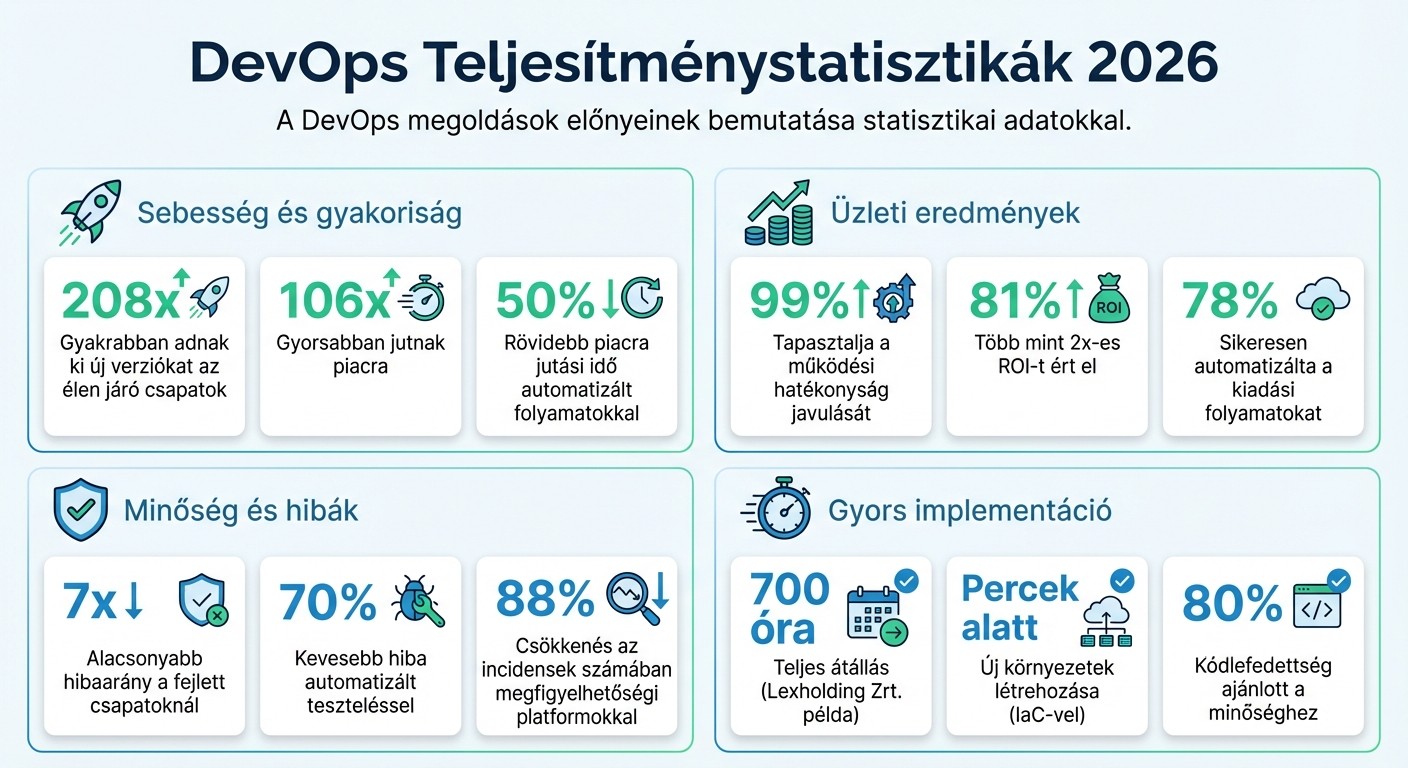
Faster development cycles: Automated processes reduce time to market by up to 50%.
Fewer mistakes: The error rate is 7 times lower than that of advanced teams.
Real-time monitoring: Immediate response and predictive error correction.
The example of Lexholding Zrt. clearly shows that change is possible: in just 700 hours, they switched to fully automated DevOps processes, significantly improving their operations.
Why is this important now?
In the market environment of 2026, where MNB regulations and rapid development expectations are becoming increasingly stringent, DevOps is no longer a matter of choice. If you don't act in time, your competitors will leave you behind.
Solutions:
CI/CD pipelines: Automated software releases, faster bug fixes.
Infrastructure as Code (IaC): New environments can be created in minutes.
Real-time monitoring: Predictive systems, fewer downtimes.
Green DevOps: Energy-efficient operation for sustainability.
DevOps is not only a technological shift, but also a change in mindset: teams work toward common goals, breaking down internal barriers. The question is not whether you will implement it, but when.
Benefits of DevOps in 2026: Statistics and Performance Metrics
DevOps in practice with Kubernetes – live demo
https://youtu.be/_c_oRjq-n4c
The problem: What slows down corporate governance
There are three main factors behind the slowness of companies' operations and decision-making. These problems not only hinder day-to-day operations, but also slow down the digital transition. Let's take a closer look at why they cause problems.
Outdated systems and manual work processes
Many companies still rely on paper-based processes and manual labor, especially in areas such as professional services or the public sector. Outdated systems, such as SAP R/3, are incapable of real-time data integration and therefore hinder data-driven decision-making.
In traditional DevOps environments, manual configurations and reactive troubleshooting also slow down software delivery while increasing the chance of human error. In Hungary, it is particularly common for companies to struggle to allocate their internal IT resources effectively, which often leads to missed deadlines for critical applications.
Fragmented teams and poor communication
Organizational silos often lead to so-called "Tool Zoo" fragmentation, where teams use different, non-integrated tools for coding, testing, and monitoring. This fragments data and makes it difficult for AI-based systems to optimize the entire process.
András Wolf, Sales Director at BlackBelt Technology, highlighted the importance of device integration:
"A development project is not complete when all the code has been written, but only when the application has been successfully deployed, is running smoothly, is fully functional, and is adapted to all local systems."
This approach clearly highlights the need for DevOps solutions that can make communication and collaboration more efficient.
Technical debt and market competition
Maintaining technical debt incurs significant costs while also reducing companies' competitiveness. Although the Hungarian business services sector accounts for 3% of GDP, wage inflation has prompted some companies to relocate their transaction services to cheaper regions.
According to Eszter Lukács, Director of Deloitte Hungary BSC Advisory, the key to the future does not lie in cost reduction:
"Hungary's future success depends not on cost savings, but on value creation, digital leadership, and deeper integration into the global knowledge economy."
Modernization is further slowed by a shortage of talent, particularly in the areas of AI, automation, cybersecurity, and analytics. This poses a serious disadvantage for companies that are unable to adapt quickly to the changing market environment.
DevOps solutions in 2026: Faster digital transformation
We have already discussed the factors that slow down digital transformation. Now let's look at how DevOps methodologies can accelerate this process.
DevOps tools and practices drastically shorten software development cycles while eliminating bottlenecks caused by manual processes. For example, leading teams release new versions 208 times more frequently and 106 times faster than their less advanced competitors. The results are not just about speed: the error rate for these teams is 7 times lower. In the following subsections, we will examine the role of CI/CD pipelines, IaC, and agile collaboration in detail.
CI/CD pipelines: The foundation of automated software releases
Continuous integration and delivery (CI/CD) systems automate code integration and deployment into the production environment. According to Volodymyr Paslavskyy, Head of R&D at ELITEX:
"Product teams are able to achieve this rapid pace because they follow a well-defined DevOps lifecycle that thoroughly covers every stage of the software development process."
The "Shift Left" approach incorporates automated testing, including unit, integration, and security tests, early in the development process. This allows developers to fix bugs immediately while the code is still fresh. Such testing practices reduce the number of bugs by 70%, while full DevOps automation shortens time to market by 50 %. According to experts, achieving 80% code coverage is essential for maintaining software quality.
Infrastructure automation and the role of IaC
Infrastructure as Code (IaC) enables teams to manage cloud-based resources with declarative scripts. Atlassian puts it this way:
"IaC is one of the greatest discoveries of DevOps."
A GitOps is the next generation of IaC, where Git serves as the single source of truth for infrastructure. Pull requests automatically synchronize the infrastructure. As a result, new environments that previously took hours or days to create can now be created in minutes. Version control allows us to revert to a previous, stable state at any time if a new configuration proves to be faulty.
The power of agile collaboration
In addition to automation, agile collaboration is also key to fast and stable software development. The DevOps culture builds multidisciplinary teams where developers and operators collaborate throughout the entire product lifecycle. The "4-6 eyes principle" ensures that pull requests are reviewed and approved by multiple team members before they go live.
More and more global companies are creating "Centers of Excellence" (CoE), which initially perform transactional tasks but eventually evolve into complex strategic hubs.
Real-time monitoring: Full system visibility
In addition to automating DevOps systems, real-time monitoring creates new opportunities for system transparency. Modern enterprise systems are so complex that the amount of data they generate each day exceeds human processing capacity. Real-time monitoring and observability have become fundamental requirements, especially by 2026. Traditional, reactive approaches have been replaced by predictive artificial intelligence, which can anticipate system behavior and errors before they cause actual problems.
According to a survey, 88% of large enterprise users experienced a reduction in incidents after implementing advanced observability platforms. What's more, 81% of organizations achieved more than a twofold return on these investments. By the end of 2026, at least 40% of organizations operating larger cloud-based systems are expected to use autonomous observability systems that resolve low-risk issues without human intervention.
AIOps: Automated troubleshooting taken to a new level
By 2026, AIOps (artificial intelligence-powered IT operations) will include autonomous, agent-based systems capable of diagnosing, making decisions, and automatically implementing the necessary fixes. According to Baha Azarmi, Head of Elastic Observability:
"In 2026, observability will shift to an agent-centric model... enabling autonomous agents to make decisions by leveraging unified signals across logs, metrics, and traces."
AI-based tools analyze logs, metrics, and trace data in real time to identify patterns and causes behind failures. According to Ensar Seker, CISO at SOCRadar, AIOps marks a new direction that focuses on true predictive observability rather than reactive log correlation, understanding the reasons behind anomalies.
Unified dashboards: Everything in one place
Unified dashboards enable data integration across the entire infrastructure—from physical and virtual systems to microservices to the end-user experience. This broad visibility helps IT teams quickly identify bottlenecks and effectively manage incidents.
67% of organizations consider transparency in distributed IT environments a priority. OpenTelemetry standard has made significant progress, as it standardizes the collection and export of telemetry data, facilitating integration between devices. Dashboards offer advanced analytics and visualization that help managers make data-driven decisions.
Automated alerts and responses
Automated response systems can routinely detect and resolve problems, allowing DevOps teams to focus their attention on strategic developments. 71% of organizations use observability data to improve automation decisions, while 78% have successfully automated their release validation processes.
For example, GitOps operators continuously monitor the status of systems and automatically apply necessary changes when they detect discrepancies. Atlassian has dramatically reduced the time it takes to investigate anomalies from days to minutes with Amazon CodeGuru's machine learning tool. Automated rollback features immediately restore the system to a previous version if performance issues arise after a new release.
In addition to real-time monitoring and automated systems, energy efficiency is also becoming increasingly important in DevOps practices.
Green DevOps practices for environmental goals
Energy efficiency now plays a key role in DevOps practices. By 2026, sustainability has become a fundamental principle in every stage of the software development lifecycle. The SusDevOps framework reflects this approach and integrates environmental considerations into DevOps processes.
According to some surveys, 99% of organizations have found that DevOps practices improve operational efficiency. Optimized resource utilization not only saves energy, but also reduces consumption by idle systems and energy use due to failed deployments. Let's take a closer look at energy-efficient resource management, carbon dioxide emissions tracking, and software development optimization.
Energy-efficient use of resources
Automated systems make resource use more efficient, thereby reducing energy consumption. According to the principle of energy proportionality, systems should only use as much energy as is necessary to perform their actual tasks. Technologies such as autoscaling, serverless architectures, and virtual machine scaling help minimize the waste of unused resources.
Cloud-native architectures —such as microservices and containerized solutions like Kubernetes—provide better scalability and resource management. Infrastructure as Code (IaC) tools, such as Terraform, enable automated and consistent resource allocation, reducing the risk of manual errors while ensuring optimal utilization.
Monitoring carbon dioxide emissions
It is not enough to focus on energy efficiency – measuring carbon emissions is also essential. Modern DevOps dashboards offer tools that measure and report emissions in real time. The Carbon-Aware SDK , for example, allows applications to modify their behavior based on the carbon intensity of the local energy grid. The Azure GreenAI Carbon-Intensity API provides real-time data on the environmental impact of AI and computational workloads.
Running time-flexible workloads —for example, using Spot VMs —can be done when energy is greener or cheaper. In addition, modern monitoring platforms such as Datadog, Dynatrace, and New Relic monitor not only performance but also the resource efficiency of cloud-based environments.
Energy-efficient software development
The goal of energy-efficient software development processes is to minimize energy and resource consumption. It is important to consider during the design phase that certain programming languages require significantly more CPU cycles and energy to perform the same tasks.
Network optimization, such as using edge devices, implementing CDNs, and applying efficient caching policies, significantly reduces the energy consumption of network infrastructure. Data lifecycle management —such as compressing rarely used data or deleting redundant information—also contributes to reducing energy and storage requirements. Furthermore, automatically shutting down development and testing environments outside of working hours eliminates unnecessary energy consumption.
Conclusion: DevOps for faster corporate management
Slow enterprise management processes will no longer be acceptable in 2026. DevOps is now essential for maintaining competitiveness. Automated CI/CD pipelines, Infrastructure as Code tools, and real-time monitoring systems together significantly accelerate application delivery, as proven in practice.
However, success does not depend solely on technological innovations. Organizational transformation is also necessary, in which cultural change plays just as important a role as technological developments. DevOps is not just a job title, but a mindset that emphasizes collaboration. Developers and operators work together to achieve common goals. Breaking down organizational silos, increasing transparency, and automated documentation all contribute to faster and more informed decision-making.
Growing IT demands also confirm that change is inevitable. A 74% increase in market demand clearly points the way forward. Companies that invest in DevOps practices now—including solutions that focus on sustainability—will not only be faster, but also more cost-effective and sustainable in the long term. Adopting the DevOps mindset is key to gaining a competitive advantage in the future.
Frequently Asked Questions
Why should Hungarian companies implement DevOps solutions by 2026?
The application of DevOps may increasingly play a central role in the operations of Hungarian companies, especially in adapting to rapidly changing market demands. Automated solutions such as CI/CD pipelines or infrastructure management can not only result in cost efficiency, but also create greater security and business value.
The essence of DevOps is to establish closer cooperation between business and technology teams, which can be particularly important for Hungarian companies involved in digital transformation. Through agile methodologies and faster development cycles, companies can not only become more efficient, but also gain a competitive advantage. This approach can contribute to economic growth, job creation, and a more stable market position in the long term.
How can DevOps help reduce technical debt and modernize your business?
The DevOps approach is essential when it comes to reducing technical debt and modernizing systems. This methodology transforms software development and operations processes through automation and optimization. Automated CI/CD pipelines, for example, enable code to be deployed faster and with fewer errors, reducing problems caused by manual errors.
Infrastructure automation is also key. Containerization and cloud-based solutions not only increase system flexibility, but also enable faster scaling and development.
Innovation and continuous development
One of the biggest advantages of DevOps is the possibility of continuous feedback and rapid bug fixing. This helps development teams to deal with the root causes of technical debt more effectively. Modern approaches such as treating infrastructure as code, introducing microservices, and automated testing all contribute to the improvement of the technological environment.
These tools and practices not only speed up processes, but also make companies more competitive in the long term, while ensuring more sustainable operations. Overall, DevOps is an approach that supports both innovation and stability, while reducing technical debt.
How do DevOps practices help energy efficiency?
Energy efficiency is now a key factor in DevOps practices, especially in the areas of automation and infrastructure management. Solutions such as continuous integration and delivery (CI/CD) and infrastructure automation help to make better use of resources. These methods reduce unnecessary energy consumption while also lowering operating costs.
AI-based systems for efficiency
AI-based DevOps systems further increase energy efficiency. For example, they can automatically scale servers and cloud-based resources according to current demand. This approach not only supports sustainability, but also significantly reduces costs. It also contributes to the success of companies' digital transformation, which is expected to be one of the most important strategic objectives by 2026.