Digitalization in 2026: where to start?
Digitalization
Digitalization 2026: where to start? | Syneo
How to choose your first digitization project in 2026? Compliance, data and integration basics, 90-day pilots, e-invoicing, CRM and ERP prioritization.
digitalization, AI, e-invoicing, CRM, ERP, DevOps, document digitization, compliance, 90-day pilot
February 1, 2026
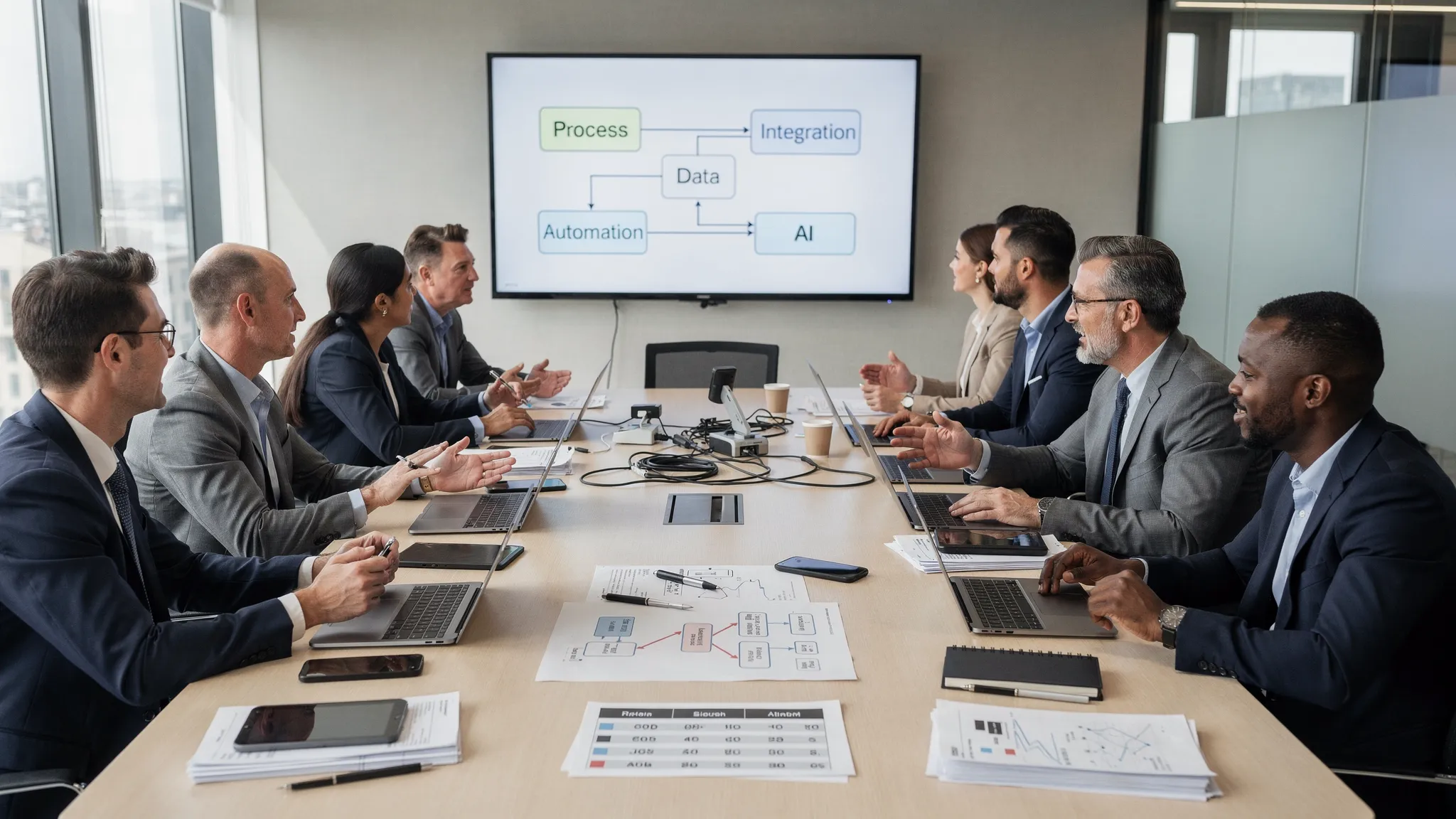
In 2026, digitalization will no longer be (just) about moving from paper to the cloud. The challenge today is how quickly a company can adapt to new rules (such as e-invoicing), supply chain changes, customer expectations, and ensuring that AI delivers real business value, not just a "smart" demo.
The good news: you don't have to do everything at once. The bad news: if you start in the wrong order, digitization can easily become an expensive "tool purchase" without any real results. In this article, you will learn where to start in 2026 and how to choose your first project.
What does digitalization mean in 2026 (and why is it different from three years ago)?
In the early 2020s, for many companies, digitalization was synonymous with remote working, the cloud, and basic automation. In 2026, three things are typically driving real transformation:
Regulation and compliance: e-invoicing, electronic storage, industry compliance, cybersecurity requirements.
Data and integration: multiple systems, multiple data sources, greater demand for a unified view.
AI and automation in action: customer service, back office, analysis, prediction, decision support.
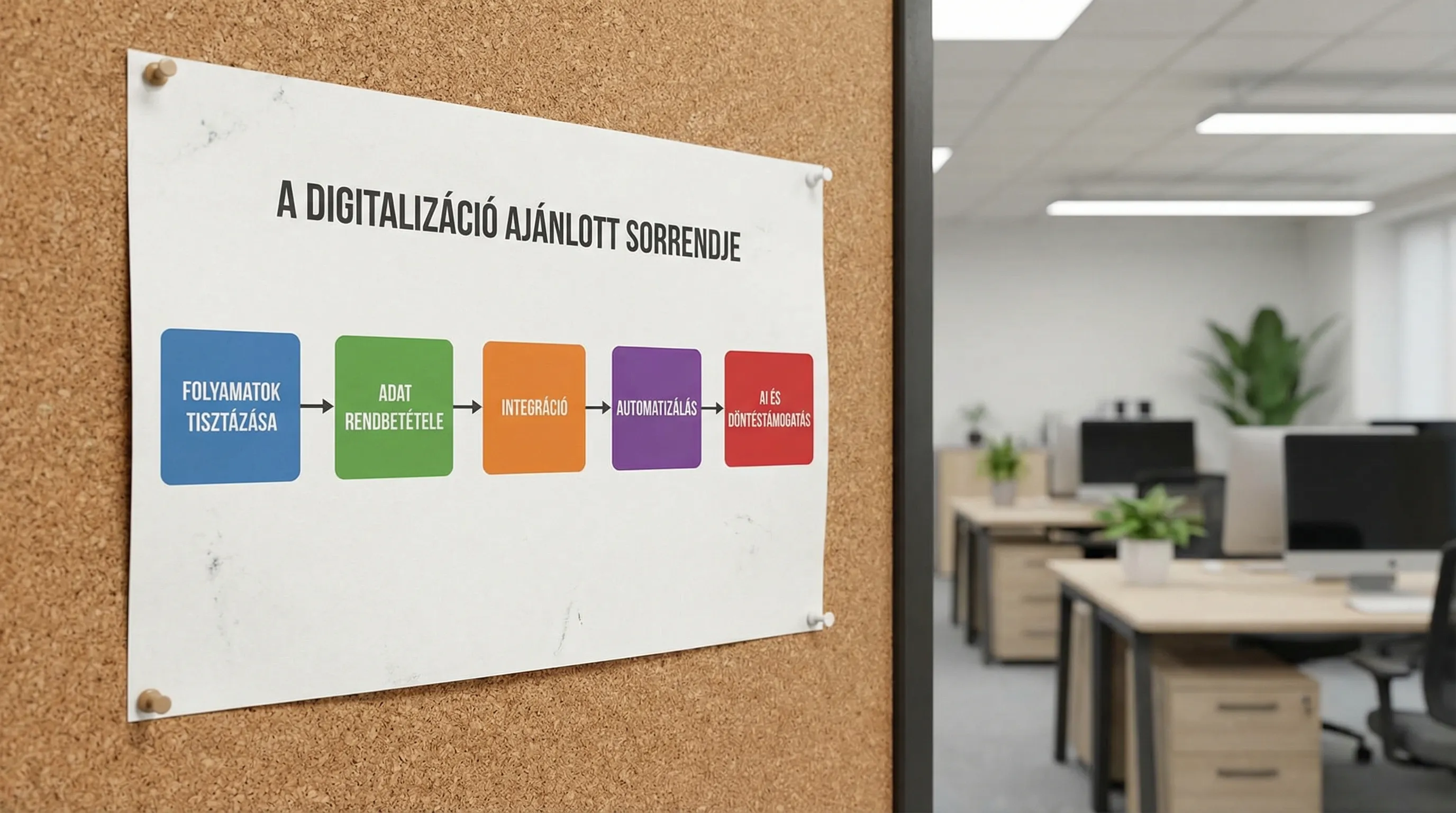
If you put AI on top of "system chaos," it usually just results in faster chaos. The starting point for 2026 is therefore almost always: process + data + security, and AI can be built on top of that.
Three questions that determine the best starter project
Before choosing ERP, CRM, document management, or AI, answer these three questions. They will quickly show you what your first step should be.
1) What hurts the most, and can it be measured?
The best starter project is one where the following are all true at the same time:
high time loss or error rate,
many people are involved in it,
you can assign measurable KPIs.
Example: "3 days to submit a quote," "4% invoice complaints," "6 hours of machine downtime per week," "800 customer service backlog tickets."
2) Is there a 2026 compliance deadline that you can "wait for"? (actually, no)
It is common for companies to start digitization "next year," and then have to rush due to new requirements. In the Hungarian environment, it is particularly worth looking at the timing of e-invoicing and related archiving, data reporting, and format changes. If you are affected, this is often the best first project because the goal and deadline are clear.
Related reading: E-invoicing 2026: new rules and tasks
3) What is the biggest technical obstacle: data, integration, or operation?
There are three typical "digital brakes":
Data quality (duplicates, missing master data, Excel islands)
Lack of integration (CRM, ERP, webshop, manufacturing, and support do not communicate with each other)
Slow delivery and operation (infrequent releases, manual installation, unstable production environment)
A starter project is good if it definitely releases a brake.
The 2026 priority map: where should we start?
The table below will help you quickly "classify" your situation. It is not industry-specific, but it works for most SMEs and large enterprise divisions.
Starting position | Typical symptom | Best starting point in 2026 | Why this? | First metric (example) |
Compliance pressure | e-invoice transition, archiving issues, audit burdens | E-invoicing and document flow digitization | Time-bound, well-defined, fast ROI | processing time, error rate, audit time |
Fragmented customer management | Excel + email, opaque pipeline | CRM organization, processes, and data model | Revenue impact quickly visible | lead-to-win time, conversion |
Operating loss | Inventory inaccuracies, delays, many manual steps | ERP or ERP optimization, integration | A stable foundation for scaling and automation | lead time, OTD, inventory variance |
Many documents, little knowledge | Unfindable PDFs, slow information retrieval | Document digitization + search (OCR, NLP) | “Liberating” knowledge prepares the ground for AI | search time, find rate |
Slow development and frequent errors | rare release, lots of firefighting | DevOps/DevSecOps fundamentals, CI/CD, monitoring | The speed of IT delivery will be a competitive advantage | release frequency, MTTR |
If you are unsure, start where compliance meets measurable business benefits. This is typically one of the bottlenecks in finance (invoicing), sales (CRM), or operations (ERP).
Related articles:
The safest start: the 90-day “first win” model
A typical risk of digitization is that it bites off more than it can chew: a "let's implement everything" type of program is launched, which then consumes costs and organizational energy. In 2026, the well-functioning model is more likely to be the 90-day first win:
Choose a process, not a software
Instead of "we are introducing a CRM," say "we are reducing the quotation time from 3 days to 1 day." The software is just a tool.
Have a data source that you organize
Most projects are delayed because the basic data (customer, product, item number, contract, authorization) is not defined. A good pilot designates:
which is the "golden record" (the true data source),
who is responsible for the data,
how it will be validated and updated.
Integration at a "minimum functional" level
You don't need to build ESB or enterprise iPaaS in the first round. But you need to be clear about how data gets from A to B and what the error path is. The reality in 2026: without integration, there is no automation, and without automation, AI is just an isolated solution.
Measure little, but measure well
Two or three KPIs are sufficient, but they should be indisputable. Examples of KPI packages:
Area | 2-3 good KPIs that are worth measuring in a pilot project |
E-invoicing / finance | processing time, error rate, number of manual steps |
Customer service | first response time, resolution time, percentage of automated solutions |
Sales (CRM) | pipeline transparency, conversion, sales cycle length |
Operation (ERP) | inventory accuracy, lead time, complaint rate |
IT/DevOps | release frequency, number of incidents, MTTR |
If you want to quickly go through this: Digital switchover checklist for SMEs
Focus for 2026: AI only works well where the foundation is “AI-ready”
Many companies will slip up here in 2026: they will buy an AI tool and expect it to "put the company together." In reality, introducing AI requires:
interpretable and accessible data (with permissions)
reproducible process
logging and quality control
risk management and compliance
In the EU environment, the risk-based approach to AI systems is defined by the EU AI Act (detailed rules and deadlines are activity-dependent). This does not mean that "AI should not be used," but rather that corporate AI should be managed in the same way as any critical system.
Practical starting point: Introducing artificial intelligence: frequently asked questions
The most common mistakes when starting digitization in the wrong place
Most failures are not about technology, but about sequence and focus.
1) Purchasing equipment instead of developing a strategy. If the goal is to "have a system," then you will have a system, but no business profit.
2) No pilot, just a big launch right away. The pilot is about reducing risk, not slowing down.
3) Neglecting integration. Individually, these are good systems, but together they do not add value.
4) Security after the fact. In 2026, authorization, logging, backup, and access management will not be "extras" but rather the norm. The NIST Cybersecurity Framework is a good, easy-to-understand framework for planning.
How to choose your first digitization project in 2026? (A quick decision-making model)
If you had to make a decision proposal in 30 minutes at a management workshop, this model would work:
If you have a compliance deadline, start with that (e.g., e-invoicing and related document flow).
If revenue is the main pressure, CRM and sales processes come first.
If cost and lead time are the main pressures, operations and ERP (or ERP reorganisation + integration).
If knowledge is scattered across documents, document digitization and search, then AI built on top of that.
If IT delivery is the bottleneck, DevOps/DevSecOps stabilization.
This decision should be supported by a brief, factual assessment: process interviews, quick checks of data samples, and 1-2 system integration "trial runs."

How can Syneo help with this?
If your question is "what should be the first step," it is usually not another software catalog that will help, but a partner who thinks in terms of processes, data, and implementation.
Syneo typically approaches digitization from an end-to-end perspective: IT consulting, custom software, support for systems (ERP/CMS/CRM), AI solutions, as well as DevOps and an operational approach. If you are looking for inspiration on what results can be achieved with a well-chosen initial project, it is worth taking a look at the related case studies:
If you want a short, practical starting point (what process, what KPIs, what order), the best next step is usually to conduct a targeted survey and put together a 90-day pilot plan, which will yield measurable results in the first quarter.