IT solutions for SMEs: quick profits in 90 days
Digitalization
IT solutions for SMEs — Quick profits in 90 days | Syneo
A practical 90-day plan for SMEs to achieve quick IT gains — CRM hygiene, automation, e-invoice preparation, and basic cybersecurity (MFA, backup). Measurable, quick results.
SMEs, digitalization, AI services, custom software development, CRM, e-invoicing, cybersecurity, MFA, automation, integration, DevOps
February 3, 2026

For most SMEs, IT developments are not delayed because of a lack of ideas, but because the stakes are too high and there is too little time: day-to-day operations take up all their energy, while everyone wants a "system" with quick results. The good news is that spectacular, measurable gains can be achieved in IT solutions in less than 90 days if the focus is not on "everything at once" type digitization, but on eliminating the biggest leaks.
This article provides a 90-day, SME-friendly approach: what to stabilize first, where the quick automation benefits come in, and how to prepare your data and systems for the next level (ERP, CRM, AI) without unnecessary redesign.
What does "quick profit" mean in IT for SMEs?
Quick profits can be defined as:
Measurably reduces costs, lead times, or error rates within 90 days.
Can be launched with minimal intervention (configuration, simple integration, process cleaning).
It does not cement bad decisions, meaning it can be scaled and expanded later.
Typical quick wins for SMEs:
Organizing sales and customer management data (CRM, quotes, inquiries)
Acceleration of billing and document processes (especially in preparation for e-billing compliance in 2026)
Simple but robust security fundamentals (MFA, backup, permissions)
system connections (CRM, ERP, webshop, invoicing, ticketing) instead of manual copying
Week 0 (1–2 days): rapid assessment of the situation to avoid wasting money
Before you start anything, you need to do a quick "reality check." Not a multi-week audit, but a targeted assessment to help you make decisions.
Questions that can be clarified within 1–2 days:
Where does most manual work occur (copying Excel files, searching through emails, double entry)?
Which three processes are most critical to revenue (lead management, quoting, billing, shipping)?
Where is the greatest risk (data loss, unauthorized access, downtime)?
Is there a "single source of truth" for customer and product data?
If you need a more detailed checklist, Syneo's article is a good place to start: Digital transition checklist for SMEs.
Quick priority matrix (benefit vs. cost)
Topic | Business impact | Translation | Typical results in 90 days |
CRM organization + lead process | High | Low-medium | more closed deals, shorter response times |
Invoicing, preparing for e-invoicing | High | Medium | fewer errors, faster payment receipt |
Permissions + MFA + backup | High | Low | lower risk of incidents, faster recovery |
Integrations (CRM-ERP-invoicing) | High | Medium | less duplication, more accurate data |
Reports and KPIs | Medium | Low | management transparency, faster decision-making |
90-day plan for SMEs: 3 phases, optimized for quick wins
90 days is realistic if the goal is not to build a "new world," but rather to stabilize, simplify, automate, and then scale based on these foundations.
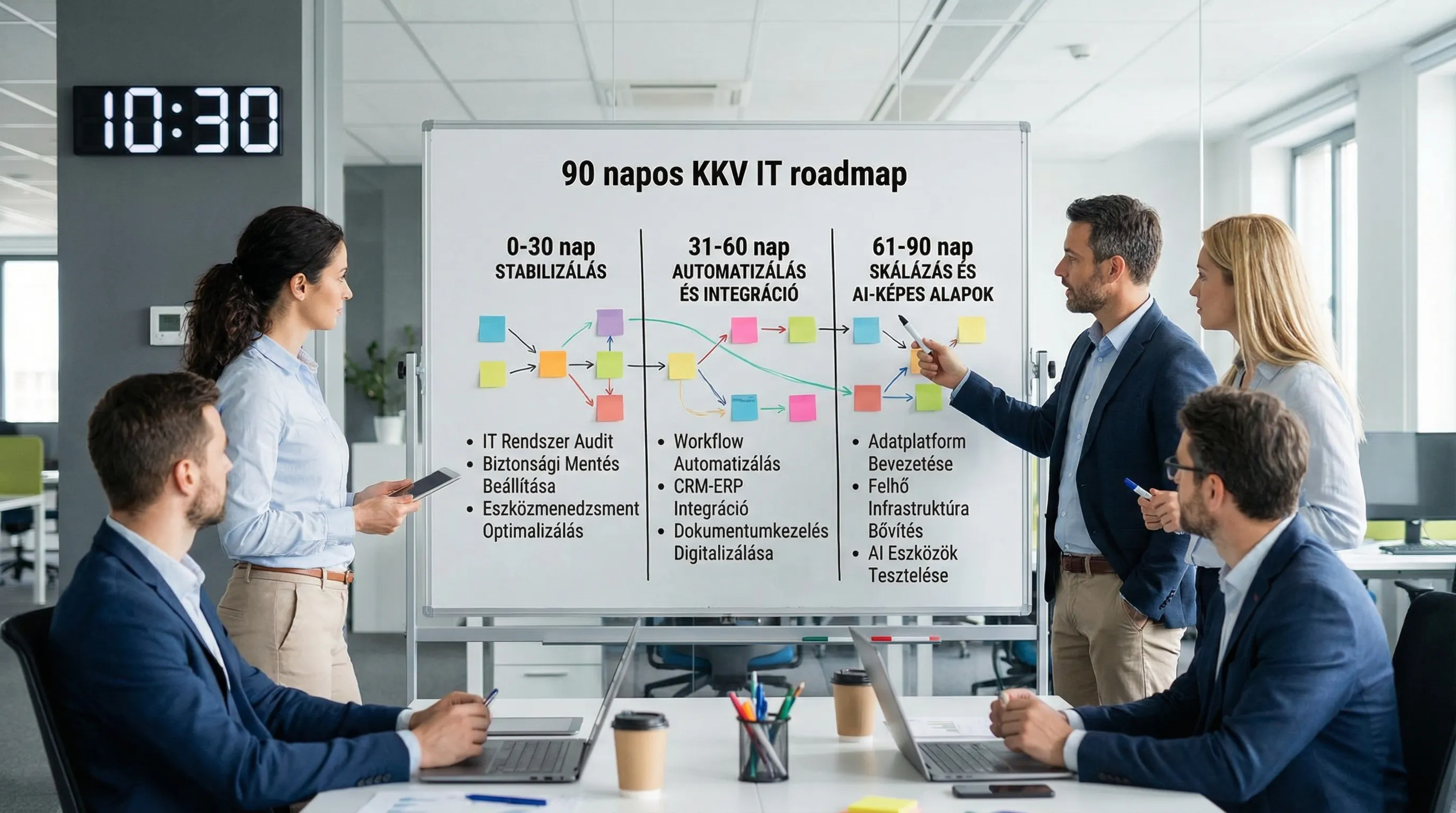
Phase 1 (0–30 days): stable foundations and immediate time savings
At this stage, the goal is fewer dropouts, less manual work, and more transparency.
The most common, quick steps:
Access management: roles, blocking access for those who leave, minimizing admin accounts.
Introduction of MFA (multi-factor authentication) for all critical systems.
Backup strategy: what is backed up, where, for how long, and can it be restored (without tested restore, there is no backup).
Basic logging and alerting: at least for critical systems, there should be a record of logins and errors.
CRM "hygiene": duplicates, mandatory fields, statuses, pipeline steps, automatic reminders.
Quick review of the billing process: where manual data entry occurs, where invoices are delayed, where approvals fail.
Useful for clarifying the roles of CRM and ERP: CRM vs. ERP: which system do you need?
Why is this important in 2026? In Hungary and the EU, structured e-invoicing and standard formats are becoming increasingly important. If you are affected, it is worth preparing separately (e.g., EN 16931). As a starting point: E-invoicing 2026: what every business needs to know.
Phase 2 (31–60 days): automation and integration, where money flows away
This is where the most spectacular results of the "unnecessary laps have really disappeared" type come in.
Typical SME integration quick wins:
CRM → invoicing/quotation → order: don't store your most important data in emails and Excel files.
Web forms → CRM lead: every inquiry is immediately entered, with the person responsible and a deadline.
Ticketing/customer service → customer data: all previous events should be visible for each customer.
Automatic reports (weekly pipeline, outstanding receivables, sales revenue, conversion) instead of manual consolidation by managers.
If you are considering cloud computing (common cost and flexibility gains), here is some useful context: How does cloud-based software reduce costs?
Quick automation ideas (with SME reality)
You don't need to start with a "big" RPA or custom development right away. Often, all you need is to clarify the process and create a simple connection.
Type of automation | Example | What do you gain from it? |
Data transfer between systems | New customer transferred from CRM to billing | fewer typing errors, faster invoicing |
Reminders and SLAs | Monitoring of lead recalls within 24 hours | more answers, more closures |
Approval workflow | approval of offers according to fixed rules | faster turnaround, auditability |
Report automation | weekly management summary automatically | less "Excel work" |
Phase 3 (61–90 days): scaling and "AI-enabled" foundations
At this stage, the goal is not only to make the company faster, but also to learn from its operations. This is where data quality, standardization, and the question of what is worth developing individually come into play.
AI-enabled foundations at the SME level (not overdesigned):
Uniform master data (customer, product, service, pricing): if it appears in different ways in different places, AI will also give the wrong answer.
Structuring documents: contracts, orders, delivery notes, minutes, which can later be automated.
Knowledge base and searchability: internal process descriptions, common errors, customer questions.
Here, it is worth thinking carefully but purposefully about AI. The best 90-day AI goal is usually not an "all-encompassing" system, but rather:
1 well-defined task (e.g., customer service response suggestion, document classification)
clean data sources
measurable quality (accuracy, turnaround time, reduced human workload)
A more detailed framework on the pitfalls of AI implementation and good first steps: Implementing artificial intelligence: frequently asked questions.
Boxed system or custom development with a 90-day cooling-off period?
Instead of asking "which is better," it is worth asking: what needs to be stabilized within 90 days, and what should be made unique later, based on business evidence?
Decision-making criteria | Boxed (SaaS) is preferable if... | Custom development is preferable if... |
Time | immediate action required | the market advantage lies in its own logic |
Special feature | your process is industry standard | the process is your company's "secret weapon" |
Integration | there is a ready connection to your systems | special systems need to be discussed |
Data and compliance | the manufacturer covers the necessary compliance | unique audit, authorization, data rule required |
Cost | subscription is included and scalable | ownership is important in the long term |
If you want to gain a deeper understanding of the business logic and return on investment of custom development: Why do successful companies spend money on custom software development?
Cybersecurity for SMEs: the minimum package in 90 days
One of the best ROIs for quick wins is often in the "no harm done" category. For an SME, ransomware or account hacking is not an IT problem, but a business interruption.
The NIST Cybersecurity Framework (CSF) provides a good, practical framework for thinking about this, breaking the task down into five simple areas (identification, protection, detection, response, and recovery).
Funds typically available within 90 days
Control | What does it protect? | What gives it real value? |
MFA on critical systems | account takeover | All admin and remote access requires MFA |
Backup and restore test | data loss, blackmail | documented restore test, responsible person designated |
Authorizations and roles | internal risk | regular review (especially for those leaving) |
Update routine | known vulnerabilities | fixed patch day, inventory |
Basic logging | incident detection | who, when, what was achieved, should be traceable |
For web systems, it is worth reviewing at least the OWASP Top 10 risks (this is not an audit, but a quick list of "where they usually go wrong").
What should you measure to see the results after 90 days? (KPIs for SMEs)
The 90-day program works when it is measurable. You don't need 30 KPIs, but rather 5-8 numbers that everyone involved understands.
KPI | What does it show? | What counts as a quick profit? |
Lead response time | how long until the first response | From 24 hours to 1 hour (or 1 working day) |
Offer turnaround time | from inquiry to offer | 30–50% reduction |
Invoicing error rate | correction invoices, complaints | noticeable reduction, less follow-up work |
Days outstanding | receipt of payment | acceleration (measured per process) |
Time for double data entry | manual copying | several hours of free time per week |
Incidents / Access Issues | "everyone sees everything" type of errors | decreasing eligibility issues |
Outage due to system failure | operational risk | shorter recovery time |
Typical pitfalls that nullify the momentum of the 90 days
1) Too broad a scope at the outset. If you want ERP, CRM, a new web shop, BI, and AI all at once, 60 days of the 90 will be spent on coordination.
2) The process is not written down, only "in your head." Even the best software will perform poorly if the decision points and responsible parties are not clear.
3) No data owner. If no one is responsible for the quality of customer and product data, every integration will synchronize "garbage."
4) Security only at the end. Authorization and backup are not extras. They are part of the operation.
5) There is no implementation support. Users are not "resistant," they just haven't received simple, role-specific training.
Frequently Asked Questions (FAQ)
What IT solutions bring the fastest results for SMEs? Generally speaking, organizing CRM, simplifying the invoicing process, basic integration between systems, and minimum security (MFA, backup) bring the fastest returns.
Is it realistic to automate processes in 90 days without development? In many cases, yes, because quick wins often come from configuration, workflows, and simple connections. Custom development is needed when business logic cannot be standardized.
When should I implement ERP if I want quick results? When finances, inventory, manufacturing, or procurement can no longer be reliably managed in separate tables. If even lead and quotation processes are not working properly, it is worth stabilizing front-office processes first.
How can I prepare for the changes to e-invoicing in 2026? As a first step, assess what format and data flow your partners expect, what system you use for invoicing, and where manual data entry is required. Based on this, you can decide whether to upgrade, replace your system, or integrate.
What are the minimum cybersecurity measures required for an SME? MFA for critical systems, regular and recovery-tested backups, access management, update routines, and basic logging. Without these, an incident poses a business risk.
Next step: Assessing 90 days of quick wins with Syneo
If you want to achieve measurable results in 90 days, it is worth starting with a short, targeted assessment: where is the most manual work, where is the greatest risk, and which three improvements will have the greatest business impact?
The Syneo team helps SMEs make rapid, secure progress with unique IT and AI solutions, implementation and consulting support. Contact us on the Syneo website and let's see together which IT solutions will bring the best quick wins for your business.