Why Do Successful Companies Invest in Custom Software Development? The Surprising Truth
Other
Jan. 27, 2026

Custom software development means creating solutions that are precisely tailored to the company's operations. Off-the-shelf software often does not meet specific needs, especially if the company wants to grow in the market.
The true value of custom development lies not only in its functionality. Customizability means that every element serves the company's goals. Custom processes give you a competitive advantage over those who use standard solutions. Custom software development costs are higher initially, but they pay off in the long run. A custom software development contract clarifies who gets what and what they are committing to.
Now we'll show you why successful businesses invest in custom software development. We'll look at the real costs, payback periods, and hidden benefits that make this investment worthwhile.
Why do successful companies choose custom software development?
Successful companies know that IT solutions determine their competitive position. But not all software is the same when it comes to business results.
Limitations of boxed solutions
Boxed software rarely fits perfectly with a company's operations. These off-the-shelf products are full of features that the company will never use. At the same time, the capabilities that are really needed are often missing. The end result: the company has to adapt to the software, not the other way around.
Another problem with boxed solutions is their inflexibility. They are difficult or impossible to integrate with existing systems. What's more, widely used software is a favorite target for cyber attackers, which poses an additional risk.
For custom software development companies: targeted solutions
Every element of the custom development is tailored to the specific characteristics of the company. The functions, workflows, and user interface are all designed to fit perfectly with the company's operations. There are no compromises—the software adapts to the company.
Custom software only includes the features that are truly necessary for smooth operation. This simplifies use and increases efficiency. Business processes can be managed uniformly and optimally, while data and sensitive information receive a higher level of protection.
Gaining a competitive edge through customization
Custom software development enables features that are not available elsewhere. These distinguishing features help you stand out in the market.
Industry-specific features are a distinct advantage because they solve problems unique to that sector. Companies with custom software can introduce new features faster than their competitors using off-the-shelf software.
Automated processes reduce manual work, increase productivity, and free up time for strategic tasks. This results in more efficient operations and cost reductions, which provide significant returns in the long term.
The business benefits that matter
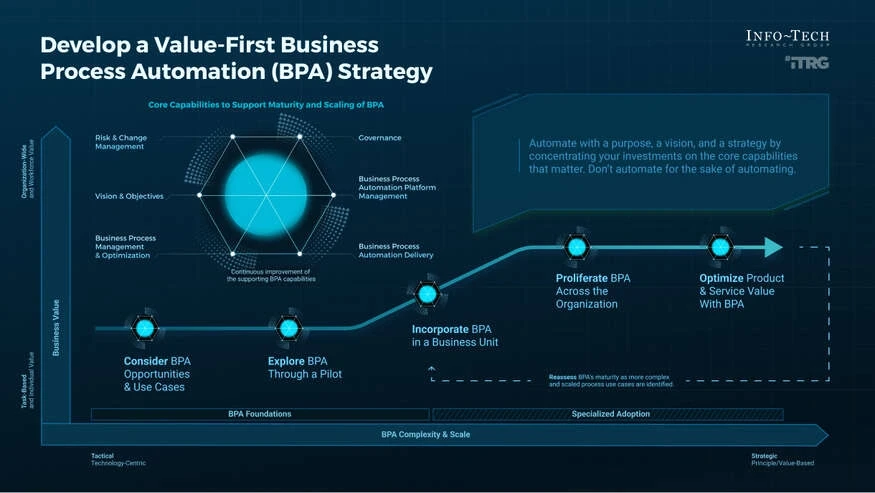
Image Source: Info-Tech
Good IT infrastructure is crucial to a company's performance. Custom software development provides specific business advantages that go beyond the usual operational framework.
Automation and increasing efficiency
AI-based customized solutions significantly increase business efficiency. Automated processes and optimized workflows ensure faster, more accurate operation. The risk of human error is reduced as robotic systems follow predefined tasks precisely.
According to a study by Deloitte, the investment cost of introducing a software robot can be recouped within 12 months. For simpler routine tasks, this time is reduced to 4-9 months.
Automation frees employees from monotonous, repetitive tasks. This allows them to focus on value-adding activities.
Support for data-driven decisions
Custom software development enables companies to perform real-time data analysis. Data-driven decision-making increases operational and decision-making efficiency.
With advanced analytical tools and customizable visualization solutions, businesses can better understand their current situation. They can also anticipate market changes.
They can respond to changes faster and more accurately. Data-driven strategic planning optimizes their processes.
Integration with existing systems
Custom-developed software can be easily integrated with existing systems. Separate systems are transformed into a unified, automated, reliable IT ecosystem that effectively serves business objectives.
System integration makes the flow of information more continuous and faster. It speeds up the company's operations. Centralized data storage and automatic updates minimize the need for manual data entry.
Scalability and future-proofing
Well-designed custom software systems adapt flexibly to changes in business objectives. They always serve the most up-to-date needs. Their scalability allows them to expand in parallel with the growth of the business. The company does not "outgrow" the system.
The application of modern technologies and keeping up with the latest developments offers a future-proof solution in the long term. Businesses not only solve their current problems, but also prepare for future challenges.
The Reality of Costs
Many people are initially intimidated by the cost of custom software development. However, there is more to it than meets the eye. Let's take a look at why this solution can be more cost-effective in the long run.
Custom Software Development Prices and Hourly Rates
The cost of custom software development depends on the complexity of the project. In Hungary, developer hourly rates range from 7,000 to 16,000 HUF + VAT. Simple projects start at 200,000 to 500,000 HUF. Complex corporate systems cost over HUF 1,500,000. Large, multilingual web shops or complex business management systems cost between HUF 3 and 15 million.
According to Mikrum, custom software development starts at €30,000. Other sources mention an average of €5,000-100,000. Payment usually begins with an advance payment of 30-50% of the total fee.
Why is it worthwhile in the long term?
The initial investment is higher than for boxed software. However, the return on investment can be quick. Automated processes result in significant labor savings. A real-life example: if a software reduces the work of five people to two, that's a monthly savings of $2,000. The cost of an average development can thus be recouped in five months.
The return on investment depends on the complexity of the project, its lifespan, and the increase in efficiency. Maintenance, support, and upgrade costs must also be taken into account.
Avoiding License Fees and Hidden Costs
Custom software development does not require a license-based environment. This represents significant cost savings. There are no annual license fees, which can increase year after year.
According to a public procurement document, the purchase cost of a software license management fee was HUF 663,347—and that is only the purchase fee, not the actual license fee. Purchase fees and flat-rate collection costs can also be avoided.
Development and Maintenance Control
With custom development, the customer has complete control. Cooperation and consultation take place from the very beginning of development. The software can be tailored precisely to the customer's needs. It can be supplemented or further developed later as required.
This control allows the company to decide on development directions and priorities. It also determines the schedule and extent of maintenance. The customer retains full ownership of the custom-developed software. This provides assurance for future use and development.
Security, Ownership, and Flexibility
Security and control issues are important for every business. Custom software development offers advantages over off-the-shelf solutions in these areas.
Data Security with Custom Solutions
Widely used software often becomes the target of cyber attacks, while unique systems are more difficult to attack because they are not publicly available. Custom software allows data and sensitive information to enjoy a high level of protection. Security features can be customized according to the specific requirements and data protection obligations of the business. Built-in security features and compliance tools protect confidential business data.
Advantages of a Custom Software Development Agreement
A well-drafted written contract is the starting point for any software development project. It is advisable to specify the rights and obligations in the contract, with particular regard to copyright, which may take the form of a license or a full transfer of rights. It is also important to stipulate the fate of the source codes, as according to a court ruling, their transfer is only mandatory if expressly provided for in the contract.
Full Ownership and Independence
The customer is the owner of the software delivered as a result of custom development, so there are no license fees or restrictions on its use. You can also resell the software based on a custom contract. This ensures complete independence, as the company can decide on the future of the software itself, without depending on external service providers.
Flexibility for Changing Business Needs
Custom software can be easily expanded and developed to suit the needs of the company. Flexible and scalable systems allow you to adapt to business needs and growth. As businesses grow and evolve, the software scales to meet those needs. A timeless architecture helps ensure that organizations can adapt their operations to changing business needs and remain agile and competitive.
What Does Reality Show?
The value of custom software development lies in the numbers. Higher initial costs are offset by long-term returns. Unlike off-the-shelf software, there are no compromises here—every feature serves the company's goals.
Successful businesses choose this path for a reason. Automation increases efficiency, and real-time data leads to better decisions. Integration with existing systems ensures smooth operation.
It is also advantageous from a security perspective. Custom software is more difficult to attack because it is not public. With the right contract, you have full ownership rights, which means independence.
The end result: cost savings and competitive advantage at the same time. No license fees, unlimited scalability, customized features. This value far exceeds the investment.
Custom software development is a practical choice for businesses planning growth and innovation. The question is not whether it is worth it, but when to start.
FAQ
Q1. Why is it worth developing custom software instead of using off-the-shelf solutions? Custom software can be tailored precisely to the needs of the company, increasing efficiency and providing a competitive advantage. Unnecessary features can be avoided, while missing capabilities can be built in, so the company is not forced to compromise.
Q2. How much does custom software development cost in Hungary? The costs of custom software development vary. Simpler projects start at HUF 200,000-500,000, while more complex enterprise systems can cost as much as HUF 3-15 million. Developer hourly rates generally range from HUF 7,000 to HUF 16,000 + VAT.
Q3. How does the investment in custom software development pay off? Although the initial cost is higher, processes automated by custom software can result in significant labor savings. For example, if a piece of software reduces the work of five people to two, the savings can pay for the development cost in as little as five months.
Q4. What are the security advantages of custom-developed software? Custom software is more difficult to attack because it is not publicly available. Security features can be tailored to the specific needs of the company, providing a higher level of protection for data and sensitive information.
Q5. How does custom software development ensure flexibility in response to changing business needs? Custom software can be easily expanded and upgraded as your company grows. Flexible and scalable systems allow companies to quickly adapt to new business needs, enabling them to remain competitive in a changing market environment.