IT consulting: when is it needed and what do you get for it?
Other
IT consulting: when is it needed and what do you get for it? | Syneo
When is it worth seeking IT consulting services? A practical guide to typical situations, tangible deliverables, cost models, and choosing a consultant — Syneo.
IT consulting, ERP/CRM, system integration, DevOps, information security, NIS2, AI, risk management, TCO, selection framework
February 8, 2026

Many companies only start dealing with IT problems when it's already too late: ERP implementation is delayed, reporting is slow, operating costs are rising, or suddenly everyone wants to make the systems "secure" before an audit. This is where IT consulting comes in: not just another software "push," but expert work focused on business goals that helps you make decisions, prioritize, reduce risk, and keep implementation under control.
What is IT consulting (and what is it not)?
The goal of IT consulting is to link technology to business results. A good consultant not only "makes suggestions," but also explores the current situation, puts together options, quantifies compromises (time, cost, risk), and then helps control implementation.
What typically fits:
situation assessment (system, process, data, security)
target architecture and implementation plan
software selection (ERP/CRM/CMS) and procurement support
project rescue, PMO-type support, risk management
DevOps and improving operational efficiency
information security and compliance training (e.g., NIS2 compliance)
What is not good IT consulting:
only tool recommendations without business context
"One size fits all" templates without your company's data and processes
document production without implementation reality (resources, schedule, responsible persons)
When is it needed? 10 typical situations where it can pay off very quickly
1) Disparity between systems and manual labor everywhere
If teams "integrate" in Excel, record duplicate data, and reports take days to complete, then it is likely that what is missing is not a new tool, but a system-level reorganization (data model, integration, process).
2) You are about to implement ERP/CRM and are afraid of making the wrong decision
There is often little difference in functionality between boxed systems, but the risk of implementation is high. Here, the value of consulting lies in the requirements system (what the system needs to know), the selection framework, and the implementation plan (data, migration, training, change).
3) The project is already underway, but it is behind schedule and becoming more expensive.
The cause of slippage is often not "the developer," but rather the scope, decision-making mechanisms, poor backlog, or missing metrics. An outside, experienced eye can help quickly identify bottlenecks and get things back on track.
4) You will be under pressure to ensure safety and compliance
In the case of audits, customer questionnaires, tenders, and industry requirements (such as the supply chain affected by NIS2), simply saying "we'll buy a security tool" is rarely enough. In such cases, a control-based approach and an acceptable schedule become more important. A useful reference is the NIST Cybersecurity Framework (an internationally recognized framework) used by many organizations for the structured development of security capabilities.
5) Operating costs are rising, yet the system remains unstable
Common symptoms: too much manual intervention, no monitoring, difficulty rolling back a release, unknown capacity limits. Here, consulting typically involves DevOps and operational audits, followed by a prioritized remediation plan.
6) You want to introduce AI, but you don't have the basics
Most AI projects fail not because of the model, but because of data access, data quality, integration, and access control. IT consulting lays the "AI-ready" foundations here: data flows, responsibilities, risks, and measurability.
7) Two carriers pointing at each other
"Integration is the other party's fault," "the specifications were wrong," "we're ready." In an advisory role, independent technical and project management clarification is very valuable: what are the facts, what is the measurable readiness, what is the next decision.
8) Rapid growth, new locations, new processes
When scaling, old "custom-built" solutions quickly become stretched thin. Here, consulting typically involves standardization, a minimal corporate platform, and a phased implementation plan.
9) No internal capacity for "system-level thinking"
Many IT teams are constantly putting out fires, which prevents them from focusing on strategic tasks. Consulting can temporarily bring in the expertise that is lacking internally.
10) A decision must be made, but the business case is missing
Moving to the cloud, new CRM, document digitization, automation. One of the greatest values of consulting is quantifiable decision preparation: what you gain, in how much time, and at what risk.
What do you get in return? Tangible results (not just "smart advice")
Deliverables vary from company to company, but well-structured consulting work generally produces the following useful outputs.
Situation | What do you get? | What is it good for in business? |
General chaos, little insight | IT and process assessment, system map, risk list | It shows where time and money are being wasted and what the critical risks are. |
ERP/CRM/CMS selection | Requirements list, evaluation matrix, vendor questionnaire | Reduces the chance of making the wrong choice, speeds up decision-making |
Sliding implementation | Redesigned scope and schedule, decision-making process, risk management | Stabilizes the project and cost control |
Security audit, tender | Gap analysis, improvement plan, controls, and responsibilities | Transparent compliance, less reputational and financial risk |
Operational problems | DevOps proposal package, monitoring and release process plan | Fewer downtimes, faster changes, lower operating costs |
AI goals | AI readiness assessment, data and integration roadmap, KPI plan | Realistic, measurable AI implementation, fewer dead ends |
Important: good consulting is not a "PowerPoint project." It is valuable when the outputs can be directly incorporated into implementation (backlog, responsible parties, schedule, metrics, decision points).

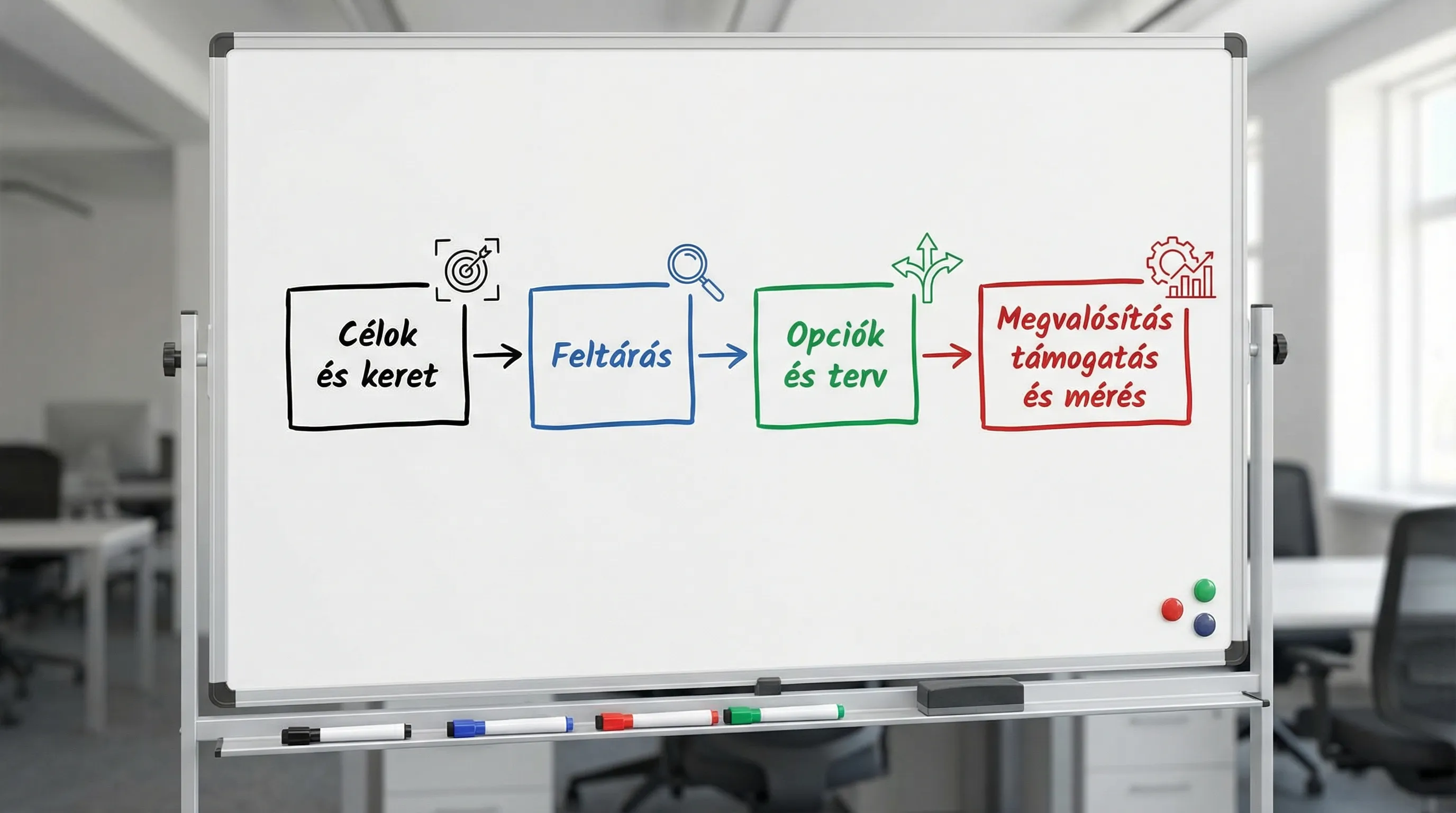
How does good IT consulting work in practice?
1) Clarification of objectives and framework
This is where we decide what we call success. For example: "ERP selection decision within 30 days" or "stable release process and 30 percent fewer incidents within 90 days." The framework also includes who decides, who provides data, and what restrictions there are.
2) Exploration (interviews, data, systems)
Not just stakeholder interviews, but wherever possible: log data, process samples, license and cost data, access images, incident and change management data. The more facts there are, the less opinion there is.
3) Options and decision preparation
This is where we evaluate the alternatives (e.g., boxed system vs. custom development, cloud vs. hybrid), create a risk-benefit map, and make a recommendation that fits your company's maturity level.
4) Implementation support and measurement
Consulting is successful when there are measurements: baseline, KPIs, and simple follow-up. Often, it is already a big step forward if the scope and decision-making process of a project are clear and it is unambiguous what "finished" means.
Costs: how should you think about them to avoid surprises?
Instead of a specific price, it is worth understanding the cost logic, because it helps you request and compare offers effectively.
Common remuneration models
Hourly or daily rate: flexible, quick start, but scope and control are important.
Fixed scope, fixed fee: good when the outputs can be defined very precisely (e.g., selection documentation).
Retainer (monthly fee): ongoing advisory "presence" for decision-making and governance.
What influences effort the most?
The biggest multipliers are usually: the number and integration of systems, data quality, internal accessibility (who provides information), and how clear the decision-making process is.
How to choose an IT consultant? Questions that can save you a lot of money
The following questions will help you filter out approaches that focus on "nice presentations and little responsibility":
What will be the tangible output of the project (documents, backlog, schedule, decision points), and which of these can be used for what?
What input do you need from us (interviews, access, reports), and how much time will it take from our team?
How do you manage risks (scope creep, data quality, vendor dependency)?
What did they measure at the end, and how can it be proven that it got better?
What industry experience do you have, and what have you learned from situations where things didn't go smoothly?
How does knowledge transfer work so that the "secret" does not remain with you?
Who will be the dedicated person in charge, and what will be the response time if the project gets stuck?
How do you build safety and compliance into the design (rather than after the fact)?
The often overlooked part: user acceptance and skills development
Many implementations slow down because teams are unsure about new processes or find it difficult to deal with customer and internal "resistance" (e.g., sales CRM discipline, customer service response quality, new ticketing rules).
In such cases, in addition to classic internal training, practice-oriented solutions such as AI role-playing training can also be used, where teams can simulate real-life situations (excuse handling, communication, standard processes) with immediate feedback. This does not replace IT consulting, but it can significantly accelerate adoption, which is ultimately the key to return on investment.
Common pitfalls (and how to avoid them)
"First we buy the tool, then we figure out what it's good for."
Purchasing software without a strategy often results in yet another isolated system. The better order is: goal, process, data, integration, and only then the tool.
Missing responsibilities and data controllers
If no one is designated as the "owner" of master data, reports, and permissions, the system will quickly break down at the operational level.
Safety after the fact
Authorization and logging principles, backup, incident management, and supplier risks are not add-ons, but fundamentals.
Without measurability, there is no management
Without a baseline and KPIs, all you're left with at the end of the project are feelings. Even a simple measurement plan can make a big difference (e.g., lead time, error rate, SLA, percentage of automated steps).
Frequently Asked Questions (FAQ)
How does IT consulting differ from development or operation? IT consulting is primarily about decision preparation, planning, risk management, and implementation control. Development and operation involve building and operating specific solutions.
How long does it take to see results? In many cases, results are visible within 2-6 weeks in the form of a clear scope, decision-making process, risk map, and prioritized plan. The impact of technical and organizational changes typically becomes measurable after 1-3 months.
Is it worth involving an IT consultant even as a small company? Yes, especially if you are facing a big decision (ERP/CRM selection, cloud, security preparation) or if you do not have the internal capacity for system-level planning. The goal in such cases is usually to make a quick decision without unnecessary detours.
What should I prepare for the first meeting? Business objectives (why now), key pain points, a list of current systems, and, if available, some basic figures (incidents, lead times, costs, licenses). If you don't have these, don't worry, just let us know.
What is the minimum I should ask from the consultant so that I don't just get "nice material"? Outputs that can be incorporated into implementation: prioritized backlog, schedule, responsible parties, measurement plan, and clear decision points.
Next step: request targeted, business-focused IT consulting
If you are about to implement ERP/CRM, launch an AI project, accelerate DevOps, integrate systems, or prepare for information security, it is worth starting with clear goals, plans, and measurability.
The Syneo team provides unique IT and AI solutions, as well as consulting and implementation support, from assessment to implementation. Check out the possibilities on the Syneo website and let's discuss how quickly you can achieve measurable results.