Custom software development vs. off-the-shelf software: when to choose which?
Other
Custom software development vs. off-the-shelf software — when to choose which? | Syneo
Practical decision-making framework: when to choose custom development and when to choose off-the-shelf software — integration, TCO, time to market, compliance, and hybrid options.
custom software development, boxed software, integration, TCO, hybrid solution, selection framework, IT consulting
February 7, 2026

The debate between "buying a ready-made system" and "developing your own" is usually not a technological issue, but a business decision. The right choice depends on how much the software affects your company's competitive advantage, how quickly you need to deliver results, how much integration you need to solve, and what compliance requirements you need to meet.
In this article, you will find a practical decision-making framework for comparing custom software development and off-the-shelf software, with specific considerations, typical pitfalls, and a "hybrid" option.
What do we call boxed software, and what do we call custom development?
Before making a decision, let's first clarify the concepts, because many misunderstandings arise from this.
Boxed (ready-made) software
We refer to any product that a manufacturer sells to many customers as boxed software. This includes both classic "installed" solutions and SaaS.
Typically license or subscription based.
Often highly configurable (fields, permissions, workflows within certain limits).
The development direction is determined by the product manufacturer's roadmap.
Custom software development
In the case of custom development, the system is tailored to your processes and goals, usually with the help of a development partner.
Functionality starts with your business needs.
Integrations, data models, and permissions can be adapted to real-world operations.
Responsibility and control (both technical and contractual) are typically greater, but so is the weight of decisions.
There is also an important transition between the two worlds: the "enhancement" of boxed products (plugins, custom modules, integration layer). In many cases, this is the best compromise.
The most important difference: configuration or customization?
Most boxed systems offer powerful configurability, but this is not the same as customization.
Configuration: settings within the limits permitted by the manufacturer (e.g., statuses, fields, reports, workflow templates).
Customization: substantive transformation of operational logic, new services, proprietary data model, integration rules, unique authorization and audit requirements.
If, at the beginning of the selection process, you feel that "the product is good, but its essence needs to be rewritten," this is usually a bad sign.
Decision-making framework: when is which one better?
Use the following criteria as a quick fit-gap analysis. If several points lean toward "unique," it is worth conducting at least a technical-business assessment before investing in licensing and implementation.
1) Is software part of your competitive advantage or a commodity function?
Boxed software is a good choice if your process is an industry standard (invoicing, basic CRM, HR administration, project management, helpdesk).
Custom development is powerful if the essence of your operations is unique (pricing, product configuration, manufacturing logic, complex service delivery, decision support based on your own data assets).
Practical question: if your competitor buys the same boxed system tomorrow, how much of your company's advantage will be lost?
2) Process maturity: Is your operation stable, or still developing?
If processes are still changing, introducing a boxed system often "cements" poor performance.
It is easier to iterate with custom development, but only if you control the scope (MVP, prioritization, measurable goals).
Here is a good compromise: first stabilize and make the process measurable (KPIs, responsible persons), then decide on the final system.
3) Integrations and data: how many systems need to be connected?
The real cost and risk often lie not in the software "box" but in the data and integrations.
The most common problems with boxed software: limited API, expensive connectors, forced export-import, data duplication.
In the case of custom development, integration can be planned as a first-class requirement (events, data quality, authorization, and audit considerations).
If ERP, CRM, warehouse, webshop, BI, customer service, and billing all play a role, then the "integration strategy" may be more important than the type of software.
4) Time to market: how urgent is the result?
Boxed: faster start if your process fits into the standard framework.
Unique: slower start, but fewer detours in the long run if the standard product needs to be supplemented with too many "tricks."
The real question is not when it will start, but when it will bring measurable business results.
5) Total cost of ownership (TCO): it's not just about the license
Many people base their decisions on license fees, even though TCO includes implementation, integration, training, support, development, and the hidden costs of "malfunctioning."
Cost component | Boxed software | Custom software |
Admission fee | Typically lower | Typically higher |
Introduction and change management | Often underestimated | Plannable, but demanding |
Integrations | Often a separate item, with restrictions | Part of the solution could be |
Scaling | License and package dependent | Architecture and operation dependent |
Customization | Limited or expensive | High control |
Vendor lock-in | It may be high | Can be reduced with a good contract and architecture |
The biggest difference: with boxed software, the cost is often a continuous subscription and ecosystem fee, while with custom software, part of the cost is built into your company's assets (knowledge, processes, code, data model).
6) Security and compliance: auditing, logging, data management
If you operate in a regulated industry (finance, healthcare, critical infrastructure, international supply chains), compliance is not an "extra" but a basic requirement.
With boxed software, it can be an advantage that many manufacturers have industry certifications and well-documented controls.
In custom development, controls can be designed specifically for this purpose, but this requires a DevSecOps approach, logging, authorization management, and documentation.
A separate category is when compliance work alone overloads the team. In this case, it is worth looking at compliance automation tools. For example, AI-based compliance automation can speed up processes such as risk assessment, remediation, and policy management, which in many organizations has a decisive influence on whether it is better to go for a boxed, hybrid, or customized solution.
7) Operation and support: who is responsible?
With boxed SaaS, the operational burden is lower, but the pace of change and product decisions come from outside.
With a custom system, the responsibility lies more on your side (or your partner's), but in return, the system's life cycle and quality are more controllable.
The right question: Do you have the operational capabilities in-house or with a partner that are necessary for critical systems (monitoring, incident management, patching, authorization auditing)?
8) Flexibility and "hidden constraints": how much should the company adapt?
A boxed implementation often involves process transformation. This is not a problem if the process can truly be standardized, but it is dangerous if it undermines the key to the company's operations.
In custom development, it's the other way around: the software adapts to the process, but there's a risk of scope creep (everyone wants "even more").
When making your decision, be honest with yourself:
how much internal coordination the organization can handle,
how strong change management is,
and how painful it will be if, in 6-12 months, it turns out that you built on the wrong foundation.
Quick comparison: boxed vs. custom (from a business perspective)
Consideration | Advantages of boxed software | Advantages of custom software development |
Starting speed | Fast go-live possible | Fast business learning with a focused MVP |
Unique processes | Restricted | Just right for this |
Integrations | Depends on the manufacturer's ecosystem | Own data and integration strategy |
Competitive advantage | Rarely gives | You can build on this specifically |
Compliance and audit | Frequent checks | Customized controls and logging |
Cost structure | Continuous subscription, modules | Development + operation, greater control |
Lock-in | It may be high | It can be reduced, but it must be planned consciously |
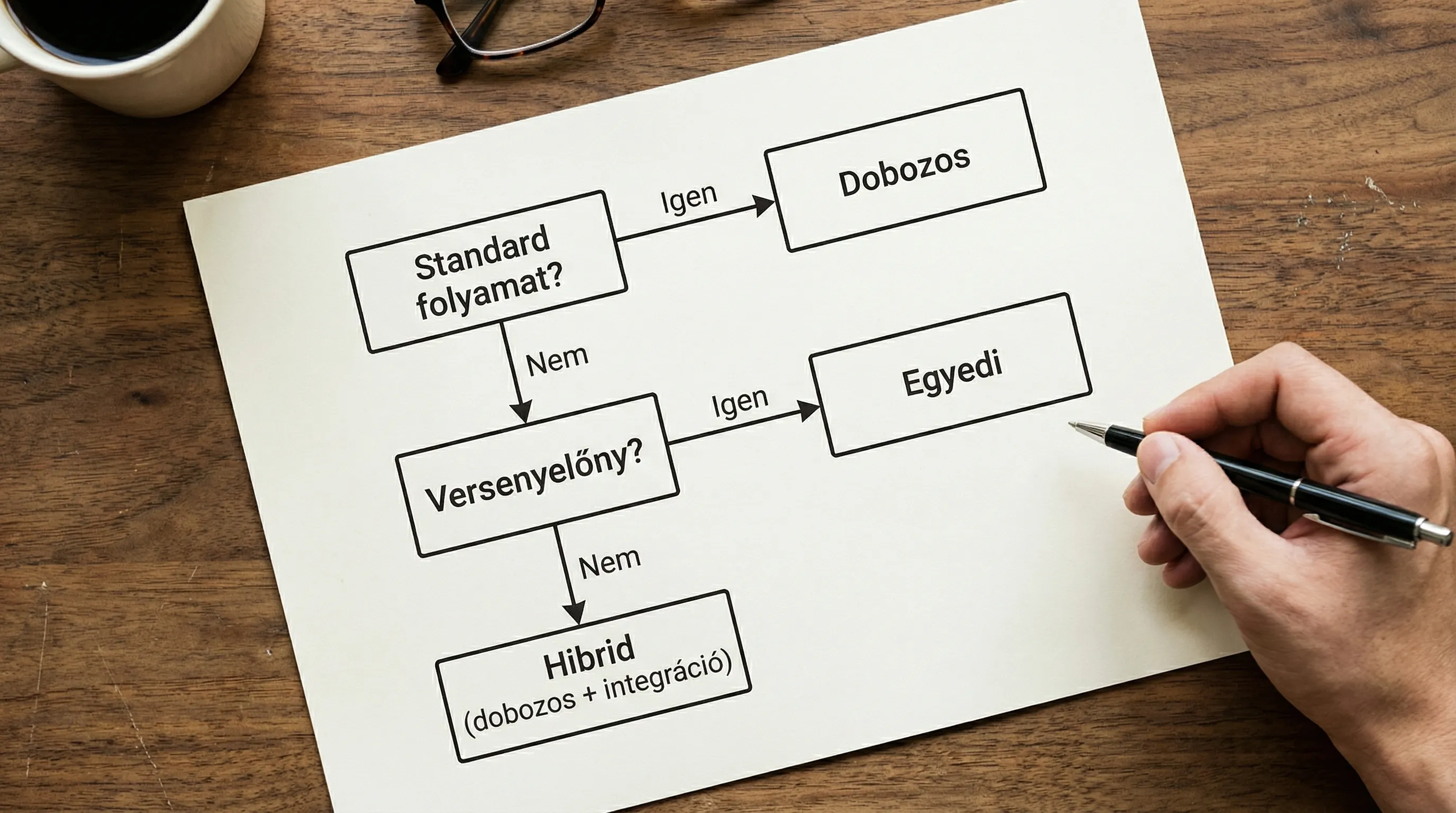
The third way: a hybrid approach (buy + build)
In practice, many projects are not "either/or" but "both/and." Examples:
boxed ERP or CRM, accompanied by a unique integration layer and reporting
boxed document management, accompanied by a unique approval workflow
boxed billing, accompanied by a unique customer portal
The hybrid model works well if you clearly define:
what you accept as standard,
what is your competitive advantage (and therefore unique),
and where is the "source of truth" (master data) for integration.
Typical decision-making mistakes that cost money
The most common problems are not technological, but rather errors in decision-making and management.
Deciding based on license without fit-gap: it later turns out that the critical process does not fit.
Too broad a scope for custom development: no MVP, no prioritization, time and budget slip away.
Dealing with integration after the fact: once all systems are "live," connecting them is more expensive and risky.
Ignoring data quality: bad data leads to bad automation, whether it's boxed or custom.
Lack of change management: without training, roles, and responsibilities, even the best software will meet with resistance.
Quick decision-making checklist (for managers)
The following questions will help you determine a good initial direction:
Is our process industry standard, and do we accept best practice operations?
Is the configuration sufficient for us, or is customization critical for business?
How many systems do we need to integrate, and do we have a data owner?
Are there any upcoming compliance deadlines, audits, or supplier requirements?
How big is the vendor lock-in risk for us?
Do we have the capacity for continuous development and operation, even with a partner?
If several of these answers are uncertain, a short, structured survey (needs, risks, TCO, architecture) usually pays for itself quickly.
What does a good selection process look like?
The goal is not to predict everything perfectly, but to reduce the cost of bad decisions.
For boxed software
The key to success is the fit-gap and integration plan.
business requirements and "must have" list
fit-gap workshop on real processes
pilot or trial period (especially for critical workflows)
data and integration plan (source systems, responsibilities)
introduction, training, change management
In the case of custom software development
The key to success is MVP, measurability, and quality fundamentals.
discovery: goals, KPIs, user journeys
MVP scope, prioritization, backlog
architecture and security fundamentals (authorization, logging, backup)
iterative development, continuous testing
operation and further development framework (SLA, release rhythm)
Frequently Asked Questions (FAQ)
What is the main difference between boxed and custom software? Boxed software is designed for standard requirements and is used by multiple customers, while custom software is based on your processes. The decision is mainly determined by customization needs, integrations, and long-term control.
When is it worth starting custom software development? When your process gives you a competitive advantage, does not fit reasonably into a boxed framework, requires a lot of integration, or compliance and audit requirements demand targeted controls.
Is it possible to switch from a boxed system to a custom one later on? Yes, but data migration, re-training processes, and system environment conversion can be costly. It is worth planning your exit options (data export, integration layer, contractual terms) right from the start.
What does a hybrid solution mean in practice? Typically, it means that the standard part is handled by a boxed system (e.g., ERP/CRM), while the unique competitive advantage is provided by proprietary modules and integrations. For many organizations, this provides a better balance between cost, speed, and flexibility.
How can I be sure that the project won't "go off the rails" during the boxed implementation? The best protection is a fit-gap analysis, a pilot based on critical processes, and a predefined integration and data quality plan. If these are missing, the risk is high.
Next step: preparing your decision without risk
When faced with a choice, the greatest value usually lies not in someone "telling you the answer," but in breaking down the risk, TCO, and integration reality along measurable criteria.
The Syneo team supports your decision from both a business and technical perspective, whether it's a fit-gap assessment prior to boxed implementation, integration planning, or the preparation and implementation of custom software development. For details, check out our services on the Syneo website, and let's discuss which direction will bring you a faster, more secure return on investment.