IT consulting companies: 12 questions to ask before choosing one
Other
IT consulting companies: 12 questions to ask before choosing one | Syneo
12 targeted questions to help you find the right IT consulting partner — measurable results, team, integration, security, and pricing considerations.
IT consulting, digitalization, IT partner, integration, information security, AI, ERP, CRM, DevOps, data management
February 9, 2026

A poorly chosen IT partner is rarely "just" more expensive. Typically, it results in delays, scope creep, security risks, and systems that the team doesn't like to use. The good news is that most risks can be filtered out before signing the contract if you ask targeted questions.
This article is specifically aimed at those who are choosing between IT consulting companies (SMEs, medium-sized companies, institutions) and want to see clearly who is a suitable strategic partner and who is "just" a supplier.
What does (and doesn't) an IT consulting firm do?
"IT consulting" can mean many things in Hungary, so before making your choice, it is worth clarifying what type of partner you need. Some provide audits and roadmaps, others implement systems, and still others operate them throughout their entire lifecycle.
Partner type | What is it typically used for? | What should you ask them for? | Risk if not clarified |
Strategic IT Consultant | IT audit, digitization plan, KPIs, alignment with business objectives | Audit report, priority list, schedule, measurement plan | Nice presentation, few feasible steps |
Implementation partner (ERP/CRM/CMS) | Implementation, integration, customization, migration | Project plan, integration plan, test plan, UAT process | License obtained, no value, slippage, data problems |
Custom developer / product engineering | Special requirements, automation, internal systems | Architecture, backlog, CI/CD, quality gates | Technical debt, undocumented knowledge |
DevOps/operations service provider | Stability, monitoring, incident management, scaling | SLA/SLO, runbook, monitoring, backup/DR plan | "Run while you can," then downtime and chaos |
Information Security Consultant | Risk management, regulations, compliance (e.g., ISO 27001) | Risk analysis, action plan, controls | After-the-fact firefighting, audit failure, data loss |
The following 12 questions will help you to accurately assess which of the above roles are relevant to you, rather than basing your decision on marketing materials.

IT consulting companies: 12 questions to ask before choosing one
1) What is the exact business goal, and how is it linked to technology?
A good consultant does not start with the tool (ERP, CRM, AI), but with the goal: reducing turnaround time, lowering error rates, faster reporting, increasing revenue, and compliance.
Look for this in the answer: target tree, baseline measurement, KPIs, and a short path from "now" to "measurable results."
Red flag: after the first meeting, they already "write up" a specific product without having seen any data, processes, or risks.
2) What does the survey (discovery) look like and what are its results?
The quality of discovery often predicts the quality of the entire project. It doesn't have to take months, but it should be structured.
Minimum outputs that are worth expecting:
current system and process map (high level)
Map of data sources and integrations
list of risks and dependencies
estimation approach (what they base their calculations on)
Red flag: a "we'll figure it out as we go" attitude.
3) What references do they have in your industry (or one of similar complexity)?
Not all industries are the same. A manufacturing company (MES, sensor data, maintenance) is completely different from a service provider (sales, customer journey) or an institution (regulation, documents, auditability).
Ask for specifics: what was the initial situation, what was the solution, what was the measurable result (time, quality, cost, risk).
Red flag: only logos are shown, but there are no stories, numbers, or lessons.
4) Who will be the actual team, and how stable are the key people involved in the project?
Most disappointments are not due to intentions, but to team composition. Sales and delivery are two separate worlds at many companies.
Ask:
who is the project manager (and how senior are they)
who is the lead architect / lead
how many parallel projects are running with the same key people
Red flag: "We'll assign someone," or they won't let you speak to the actual expert before making an offer.
5) What methodology do you use, and how do you handle scope changes?
Agile, hybrid, waterfall—any of these can be good if they fit the goal and the maturity of management.
Part of the correct answer:
what are the decision points (stage gate)
how change will be handled (change request, backlog grooming)
how prioritization happens (business value, risk, dependency)
Red flag: inflexible contract and change management close to zero, or even complete lack of control.
6) How do you plan to integrate (ERP/CRM/CMS, data, APIs, permissions)?
In 2026, most corporate projects are actually integration projects. Implementation "stalls" when it comes to connecting to surrounding systems.
Ask: what integration patterns they use (API gateway, ESB, event), how they handle identifiers and master data, and what will be the "single source of truth."
Red flag: integration is just one line in the proposal, with no details.
7) What is your approach to data management and information security?
If the consultant has access to systems and data, they are also a security partner. The minimum requirement is knowledge of and compliance with basic controls.
Good sign: if they talk about access management, logging, encryption, backup, and clarification of roles and responsibilities on their own.
Many organizations use the logic of the NIST Cybersecurity Framework (Identify, Protect, Detect, Respond, Recover) as a reference point for organizing controls and gaps.
Red flag: "it's just IT," "it's just a pilot," so security can wait until later.
8) If AI is involved: how do you address compliance, data quality, and human oversight?
The introduction of artificial intelligence typically fails in three areas: data quality, integration, and compliance. (If you are just starting out, it is worth reading a separate, targeted overview of AI implementation, for example on the Syneo blog: Introducing Artificial Intelligence: Frequently Asked Questions.)
Ask:
What data source does the model learn/work from?
how accuracy and bias are measured
What is the fallback process if the model is uncertain?
how decisions are logged (auditability)
Red flag: an uncontrolled promise of the "let's throw ChatGPT into the mix" variety.
9) How will success be measured, and when will it become apparent if the project is heading in the wrong direction?
A consulting firm is a good partner if it not only "delivers" but also helps make management decisions. This requires measurement.
Request a measurement plan: baseline, target value, measurement frequency, responsible persons. If the project is digitization-related, a KPI-focused framework may be useful, for example: Digitization project planning: goals, KPIs, risks.
Red flag: exclusively "features ready" status, without business metrics.
10) How is knowledge transfer and documentation handled, and what happens after go-live?
Success is not measured by go-live, but by the first 60-90 days after. That's when you find out if your team has taken control.
Ask:
Will there be a runbook, admin documentation, architecture description?
Is there training (admin, power user, end user)?
how incidents and error tickets are handled
Red flag: no explicit handover, just "we'll send you a PPT."
11) How is pricing structured, what does the offer include, and what will definitely be extra?
A transparent offer is not necessarily cheaper, but it is more predictable. The most common points of contention are integration, data migration, testing, licensing, and operation.
Request a breakdown of the offer: phases, resources (roles, expenditure), risk reserve, assumptions.
The table below can help you decide what to request separately in the offer:
Bid item | Why is it critical? | Typical misunderstanding |
Data migration and data quality improvement | Without migration, there is no practical use | "The old Excel will work somehow." |
Integrations (API, ETL, SSO) | The value of the system is determined here | "It's included in the basic package." |
Testing (UAT, regression) | Reducing errors and business risk | "Users will test it out." |
Safety requirements | Authorization, logging, auditing | "IT will sort it out anyway" |
Operation, SLA, monitoring | Stability and responsibility | "If there's a problem, send me an email." |
12) Does the partner fit in with your overall growth objectives (not just IT)?
More and more companies are finding that, at the end of their IT projects, the technology is ready, but the growth channels (lead generation, web conversion, measurement) are not in order. In such cases, you either look for a partner who thinks broadly, or you consciously build a partner ecosystem.
For example, if, in addition to the technical basics, you also focus on Google Ads, SEO, and conversion optimization, it is worth involving a team that specializes in performance marketing, such as the Realisma digital marketing agency.
Red flag: your partner "knows" everything, but in reality has no depth in any area.
Quick evaluation framework (so you don't just decide based on impressions)
When multiple bids are running in parallel, it is easy to get lost in the details. A simple, fillable evaluation sheet helps to score them consistently.
Evaluation criteria | What are you looking at? | Own points (1-5) |
Goal and KPI focus | Measurable business results, baseline, measurement plan | |
Team seniority | Team by name, contact details of key personnel | |
Methodology and control | Change management, decision points, reporting | |
Integration competence | API/data/SSO experience, design depth | |
Safety and compliance | Access, logging, auditing, risk management | |
Transparent offer | Breakdown, assumptions, risks, extra items | |
Knowledge transfer and support | Documentation, training, SLA/SLO, post-go-live plan |
Tip: Before scoring, write down in three sentences what "success" means to you in 90 days, 6 months, and 12 months. You will be surprised how many offers fall into this category.
Frequently Asked Questions (FAQ)
How long should I take to choose an IT consulting firm? For most companies, 2-6 weeks is realistic: 1-2 weeks to clarify requirements and scope, then requests for proposals, interviews, references, and finally the contract.
What should I ask for in addition to the offer in the first round? A brief description of the methodology, a plan broken down into phases, key personnel by name, and a list of risks and assumptions. Without these, the price alone is misleading.
Is a fixed price or T&M (time and materials) structure better? It depends on how clear the scope and risks are. For immature or changing requirements, T&M with control points is more workable. For mature, well-specified scopes, a fixed price can provide better predictability.
When is it worth choosing custom development over an off-the-shelf system? If your processes give you a competitive advantage and the off-the-shelf system forces too many compromises (or the cost of customization is already at a custom level). In this case, architecture and long-term operability are particularly important.
How can I tell if the consultant really understands security? They talk about specific controls (MFA, roles, logging, backup, authorization review) and incorporate them into the plan, rather than treating them as an afterthought.
Next step: ask for a targeted, measurable proposal
If you want more than just "a new system" and are looking for measurable efficiency, security, and scalability, then the 12 questions above will be your strongest filter when making your selection.
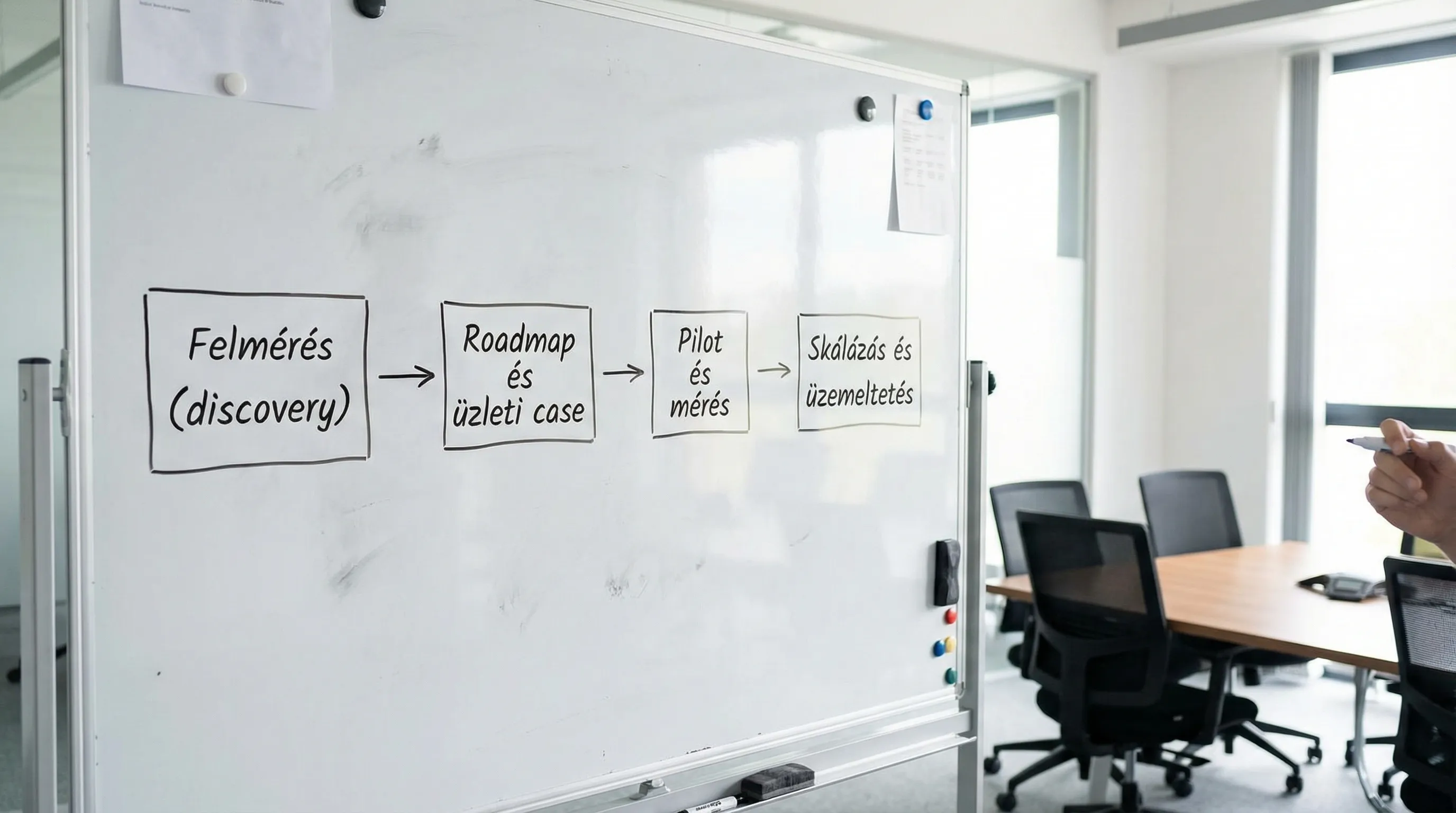
Syneo provides support in areas such as IT consulting, digitization, ERP/CRM/CMS projects, custom software development, DevOps, and AI solutions. If you would like to discuss the best next step for your company (audit, pilot, roadmap, or implementation), check out the options on the Syneo website and contact us to schedule a meeting.