Software license optimization: quick savings tips
Digitalization
Software license optimization: quick savings tips | Syneo
Quick, practical tips for optimizing software licenses: revoking inactive licenses, rightsizing, consolidation, and managing renewals for rapid cost reduction.
software licenses, license optimization, SaaS, rightsizing, SAM, FinOps, consolidation, IT consulting
February 27, 2026

Software licenses are rarely "visible" costs. They do not cause downtime (immediately), they are not spectacular, and they often consist of smaller subscriptions from multiple departments. This is precisely why they are one of the fastest items to optimize if you want to reduce costs in the short term without compromising operations.
In 2026, the challenge will no longer be simply "do we have an Office license," but rather how many overlapping SaaS tools are running in parallel, how much we are paying for AI tools per team, and how many users remain in the system after logging out.
What does software license optimization actually mean?
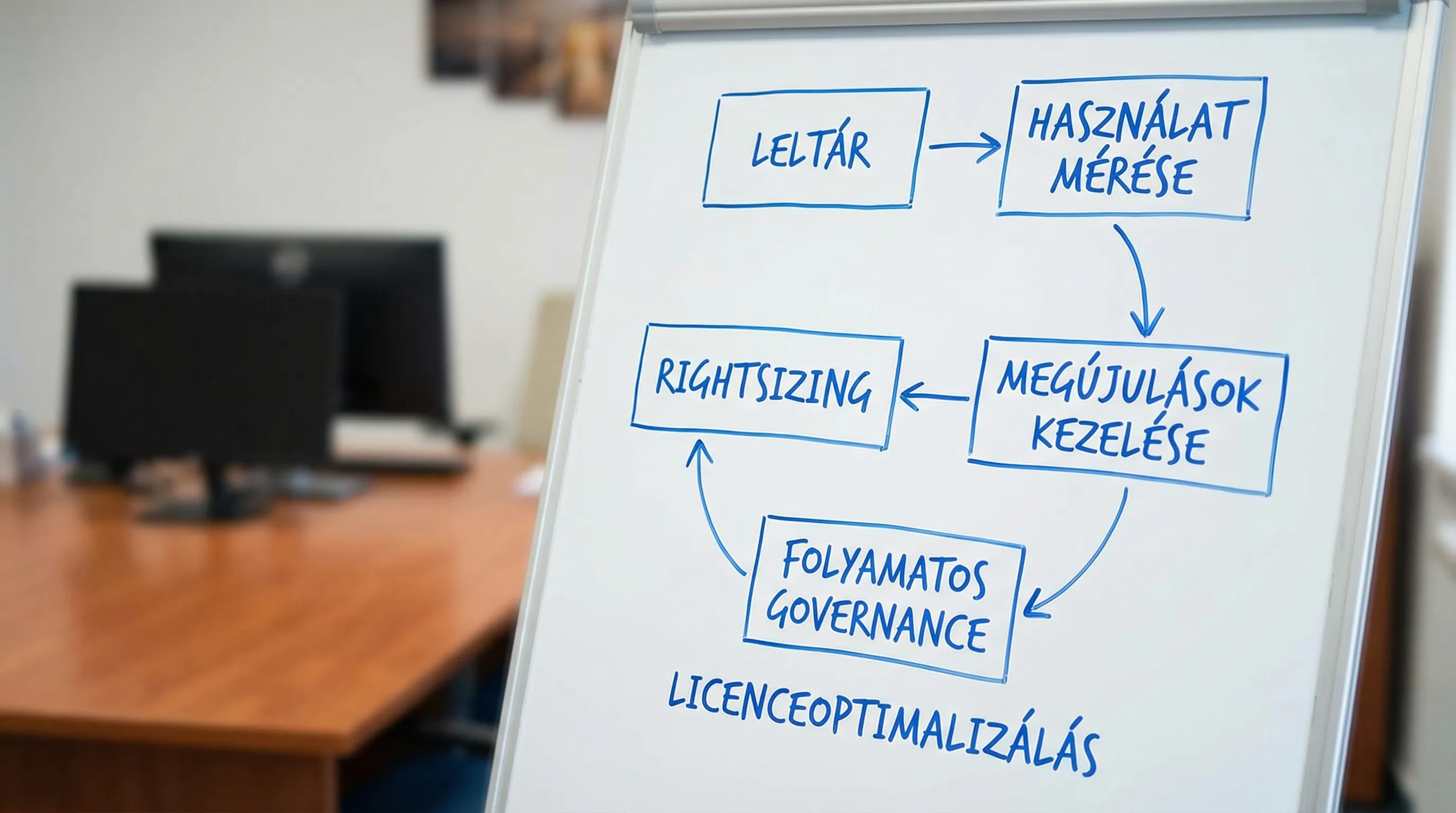
Software license optimization is a controlled process that aims to:
Pay only for the licenses you actually use.
the appropriate license type is assigned to the appropriate role (rightsizing),
reduce compliance and audit risk,
and it should be clear who decides on subscriptions, when, and based on what rules.
Important distinction: this does not mean "giving up everything that is expensive." If the reduction is done poorly, the business side will go into solution mode (shadow IT), security will deteriorate, audit risk will increase, and savings will remain only on paper.
Step 1: Quick license inventory (not perfect, but usable)
Most companies waste time searching for the "perfect" inventory. An 80 percent picture is enough for quick savings if the focus is on the top cost items.
Start by gathering your main systems and subscriptions, then assign everything to them:
owner (business or IT),
payment method (invoice, credit card, partner),
renewal date,
license quantity,
user list.
In the first round, the goal is not to find every item, but to get a realistic picture of the 10-20 largest items.
Data source | What can you quickly extract from it? | Why is it useful? |
Finance (bills, credit card statements) | Which vendor costs how much and when will it be renewed? | Instant "top spend" list |
IdP/SSO (e.g., Entra ID, Okta, Google) | Active users, logins, groups | Checking unused licenses and logouts |
Vendor admin portals | License types, allocation, activity reports | Rightsizing decisions based on |
HR (joiner, mover, leaver) | Who came when, who left when, role | Basis for automatic repurchase |
If possible, it is worth basing software asset management on some kind of SAM (Software Asset Management) approach, for example organized around ISO/IEC 19770. There is no need to launch a standards project right away, but the logic (inventory, authorization, measurement, audit trail) is very useful.
Step 2: The 7 fastest savings “quick wins”
Quick wins usually come from two places: eliminating unused licenses and downsizing oversized packages. Negotiation rounds and consolidation can be even bigger items later on, but these are typically where the first savings come from.
The tips below also work in sequence, because each one provides better data for the next one.
Revoke inactive licenses: Set a simple rule (e.g., 30 or 60 days of inactivity) and review the licenses assigned in the top systems. Always measure inactivity based on the specific product report, not just based on SSO login.
Rightsizing (tier downgrading): In many organizations, the "premium for everyone" reflex has become the norm. Based on actual usage, it often turns out that premium features are only needed by a small portion of users.
Filtering out duplicate tools: typical overlaps include project management, e-signature, screen recording, ticket management, and AI meeting note-taking. If two tools provide the same three main functions, there is usually potential for consolidation.
Joiner-leaver automatisms: "a colleague who has left the company still has a license for 3 months" is one of the most common sources of money leakage. SCIM provisioning and role-based group management often pay for themselves faster than any negotiation.
Renewal control (auto-renew stop): Saving money often starts with knowing when something is due for renewal. Set up 90-60-30 day reminders for large items.
SaaS procurement rule (card subscriptions): an internal rule that new SaaS can only be used with approval and SSO significantly reduces wasteful spending.
Organizing non-prod and "builder" licenses: developer, test, staging environments, and admin and power user roles are often over-licensed because they were obtained on a "better safe than sorry" basis.
Step 3: Rightsizing—how to do it without causing a business scandal?
Rightsizing fails when IT gives up something and the team cannot work the next day. This can be avoided with a simple, auditable process.
First, determine which features require the higher package (e.g., advanced reports, admin features, API access, compliance features). Then, check the vendor's reports to see who has actually used these features in the past.
Good practice is that the reduction is not permanent, but reversible, like a "parking lane":
You will be put back on a pilot basis for 2-4 weeks,
The team has a fast channel to signal when something is really needed.
and document the business reason for someone being moved back to a higher package.
This way, you avoid hidden costs: the team buying an alternative tool (with a card) or manually replacing what the license provided.
Step 4: Consolidation, when you are no longer just saving money, but simplifying your life
One "side effect" of license optimization is that it highlights the problem of tool sprawl. This is not only a cost issue, but also:
integration complexity,
authorization management chaos,
data security exposure (data leaks to multiple service providers),
and more difficult onboarding.
Consolidation does not mean forcing everything into one tool. The goal is to have 1-2 standards for a given task, and any deviation must be justified on business grounds.
Practical approach: select 2-3 areas where overlap is typical (e.g., project, document management, e-signature) and do a quick "fit-for-purpose" comparison of actual processes, not feature lists.
Step 5: Data providing a basis for negotiation – what should you bring to the renewal meeting?
One of the most expensive phrases in vendor negotiations is: "We don't have time to deal with this right now, let's renew as is." In contrast, the strongest position is given by 3 data points:
Active usage vs. purchased quantity (licenses allocated and actually used).
Role breakdown (who needs premium, who is satisfied with basic).
The reality of alternatives (not bluffing, but at least a Plan B, such as another package, another vendor, or replacing functionality with the existing stack).
Typical "quick win" requests in renewal negotiations, which are not just about price:
true-down right (be able to reduce, not just increase),
flexible user ramp (don't pay for the final state from day one),
price increase cap for several years,
Clarification of audit and compliance requirements (especially if the picture is a mixture of on-premises and cloud).
Step 6: Don't forget about "non-traditional" licenses
Many companies have digital services not only for IT subscriptions, but also for marketing, HR, training, wellbeing, and other areas. Savings will be sustainable if inventory and governance cover these areas as well.
For example, wellness-related subscriptions and purchases can easily become fragmented if there is no central framework or purchasing logic. For inspiration, it is worth looking at how a holistic approach to wellness is structured, for example in content organized around the latest holistic wellness approaches. The point here is not the specific product, but that it is worth placing these "non-IT" digital expenditures within the same transparency framework.
Step 7: Metrics and responsibilities to ensure that savings are not a one-off event
If optimization remains a one-time cost-cutting project, costs will rebound within 3-6 months. Sustainability is achieved through two things: simple KPIs and clear ownership.
There is no need to overcomplicate KPIs; four indicators that are commercially understandable are sufficient.
KPI | What are you measuring? | What is a good decision? |
Active user ratio | How many people actually use the licenses that have been allocated? | Quickly cut unused licenses |
Premium ratio by role | Who has the more expensive package, and why? | Rightsizing and policy |
Renewal coverage | How many of the top systems have a 90-day forecast? | Avoiding auto-renewal |
Deprovisioning turnaround time | How long does it take from withdrawal to license revocation? | Process improvement, automation |
In terms of responsibilities, the minimum requirement is to have a license manager (usually IT or procurement) and a business owner for each top system who understands why the tool is needed and what KPIs are expected from it.
When is it worth bringing in outside help?
License optimization typically gets stuck when:
There are dozens of SaaS and hybrid (on-premises plus cloud) licenses.
no unified SSO and authorization management,
financial and IT data do not match (there is an invoice but no user list),
or a major renewal is approaching, and a basis for negotiation is needed quickly.
In such cases, a short, focused assessment and an actionable plan often yield savings faster than lengthy tool selection processes.
Syneo can help with IT consulting and implementation support in situations like this, especially where there are entitlement management, integration, or operational issues behind the license costs. If you want a solid basis for your decisions, it is worth reviewing the tangible outputs (assessment, backlog, KPIs, implementation steps) that can be expected from an IT consulting partnership in the IT consulting summary.

Final thoughts
Optimizing software licenses is a rewarding area because it can quickly deliver measurable results while improving transparency and reducing security and compliance risks. The key is not just to "cut," but to measure, document, and build in a minimum of governance to prevent costs from creeping back up.