Project management in IT: how to make delivery predictable
Other
Project management in IT: how to make delivery predictable | Syneo
Practical guide: how to make an IT project predictable? Goals, scope, governance, risk management, DevOps, and metrics — a 30-day plan for slipping projects.
project management, IT, predictability, delivery, devops, governance, risk management, agile, waterfall, dora, IT consulting
March 1, 2026

Most IT projects fail not because "the developers are bad," but because delivery predictability has not been planned for. A typical symptom: work appears to be progressing for months, but in the end it turns out that go-live cannot be achieved due to integration, permissions, data quality, testing, or a lack of business decisions.
Good project management in IT is not administration. It is a decision-making process, a system of measurement and delivery in which risks are identified early on, scope remains under control, and the team can move forward without "reality collapsing" at the end.
What does predictable delivery mean in IT?
Delivery is predictable if the project has stable answers to these questions:
What is the exact business result (and how do we measure it), not just that "the system is ready."
What we consider complete (acceptance criteria, Definition of Done), and who signs off on it.
When can the next operational delivery be expected, and how reliable is this date?
What can change and at what cost (time, expense, functionality, risk).
Important: predictability does not mean that there are never any changes. It means that change has a process, an impact assessment, and a decision maker.
Why is shipping unpredictable? The 7 most common reasons
In IT projects, delays rarely result from a single error, but rather from several "small but regular" uncertainties.
1) Vague goals and success criteria
If the goal of the project is simply to "introduce a CRM" or "create a new portal," then the scope will naturally begin to grow. The team delivers, but it is unclear what constitutes success.
2) Scope creep without control
There will always be changes (legislation, business needs, new integrations). The problem starts when the change is not formally included in the backlog, there is no priority, and there is no impact assessment.
3) Late recognition of integrations and dependencies
ERP, CRM, BI, invoicing, SSO, authorization management, data market, email, document repository. "Minor" integrations often take up 20-40 percent of the project time, and this is often only apparent at the end.
Related guide: System integration: how to connect ERP, CRM, and BI?
4) Underestimating data quality and data migration
The business demo looks good as long as it contains test data. In real life, duplicates, missing master data, and incorrect coding appear, and the project suddenly becomes a data rescue operation.
If AI or automation is also a goal, this is even more critical. A good background for this: Data quality audit: why do AI projects fail?
5) Testing and acceptance "at the end"
The lack of acceptance criteria (what makes a feature good) typically leads to rework. In the end, it all adds up: UAT slips, a wave of bug fixes comes in, and the release is delayed.
6) Lack of decision-making procedures and responsibilities
If there is no clear product owner, no data manager, no security officer, the team waits and then is forced to guess. This may seem to speed things up, but in reality it leads to costly corrections later on.
7) Late involvement of operations, security, and compliance
Permissions, audit trail, backup and restore, monitoring, incident management, DevSecOps controls. If these are left to the end as "separate projects," go-live becomes unpredictable.
The 6 pillars of predictable IT delivery
The following pillars together form the system that ensures that the project not only "works," but also progresses in a predictable manner.
1) Goal, scope, and KPI right from the start
You don't need 30 KPIs. You need 2-5 that management takes seriously and that the team can influence.
A practical approach to goals and measurability: Planning a digitalization project: goals, KPIs, risks
The minimum that provides predictability:
clear description of what is and isn't included in the scope
Acceptance criteria for top functions
baseline schedule that has an owner
2) Realistic planning: smaller slices, early value
Instead of grandiose plans that "will come together in the end," predictability in IT is provided by:
We break down the work into small, independently testable chunks.
Each slice has a clear Definition of Done.
the sooner real integration and real-time data
This does not only work with agile teams. It is also possible to deliver iteratively with waterfall or hybrid methodologies if there are working, tested partial results at the end of each phase.
3) Governance: RACI, decision gates, change management
One of the quickest "gains" of predictability is a clear decision-making process.
Good minimum:
RACI (who is responsible, who decides, who should be involved, who should be informed)
weekly operational status, biweekly or monthly steering (for management decisions)
formal change request process (with impact assessment)
Area | Why does it matter when it comes to shipping? | Typical error |
RACI | No more waiting, clear decision-making authority | "Everyone is responsible," so no one decides |
Steering | Risks and scope decisions are made in a timely manner | Steering only happens when there is already a problem |
Change control | Scope creep becomes visible and priced | Changes are incorporated "silently" |
4) Risk management that really works
The risk list is not a document, but a working management tool.
Characteristics of a well-functioning risk register:
every risk has an owner
there is probability and impact (even on a simple scale)
there is mitigation and a deadline
The top 5 risks are on the agenda every day.
5) Quality and DevOps as delivery assurance
One of the most important technical aspects of predictable delivery is that release is not a "heroic" event, but a repeatable process.
DevOps practices also help at the project management level because they reduce hidden work (manual installation, manual testing, environment differences).
Related articles:
External, widely referenced measurement framework: DORA (Google Cloud) DevOps research links delivery performance to deployment frequency, change throughput, and recovery time, among other factors.
6) Transparency: a report that predicts
Statuses such as "we are 80 percent ready" are misleading. In IT, readiness is only real when it has been tested, integrated, and accepted.
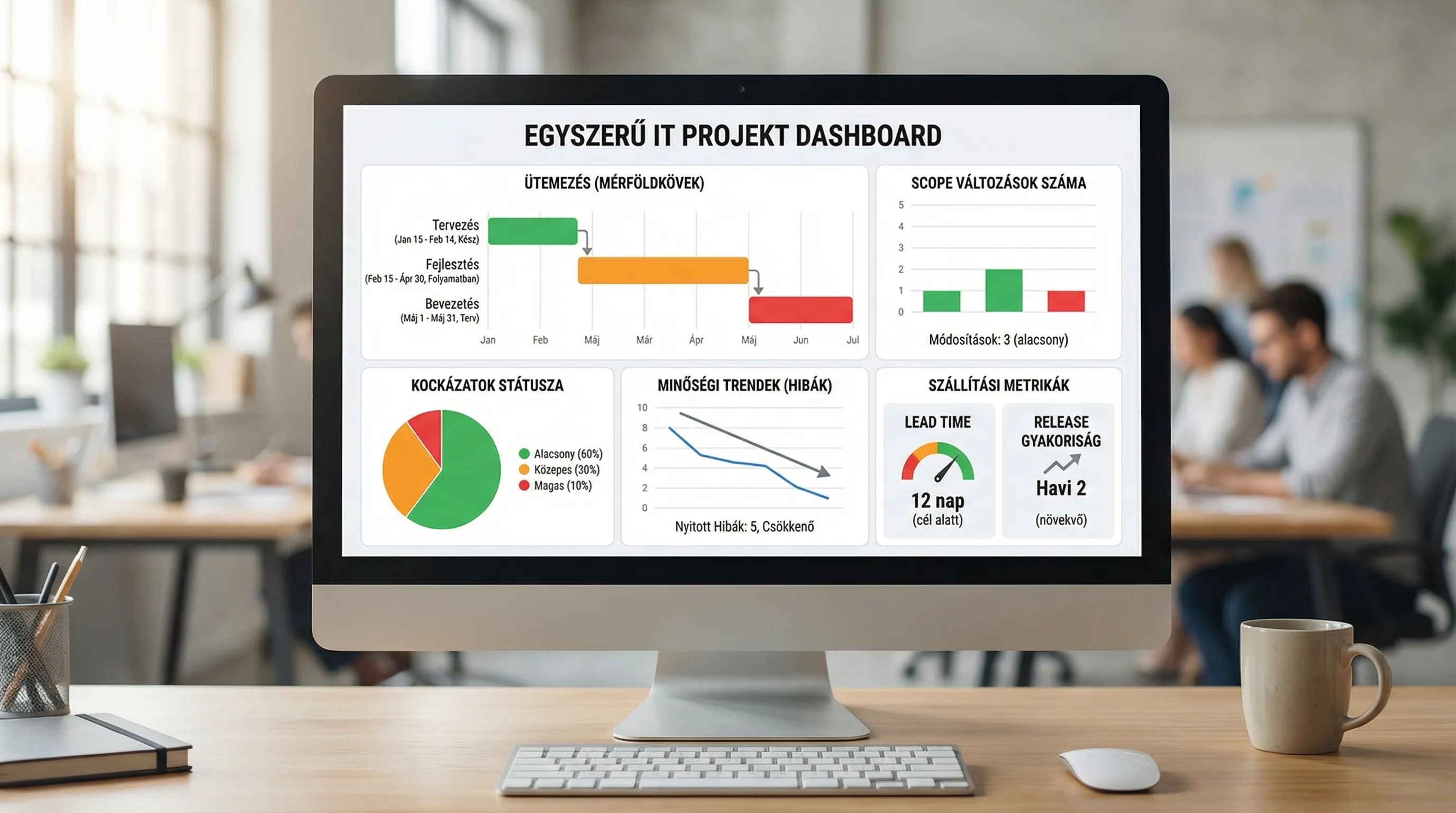
A good project report is both business-oriented and technical:
business: milestones achieved, impact of changes, cost and schedule
Technical: test coverage trend, defect trend, release readiness
Agile, waterfall, or hybrid? Predictability does not come from the name of the methodology.
Many organizations expect methodology to provide the solution, but predictability comes from discipline, measurement, and iterative validation.
Situation | What typically works | Why |
A lot of uncertainty, rapid learning, multiple iterations | Agile, strong product ownership | Quick feedback, early value |
Strong compliance, fixed external deadline, many external dependencies | Hybrid (phase gates + iterative delivery) | Governance is stable, delivery is flexible |
Stable requirements, little integration, simple scope | Structured waterfalls can also be effective | The cost of change is lower |
The practical lesson: whichever approach you choose, make sure it involves early integration, testable slicing, and visible risk.
Metrics that really help predict slippage
The purpose of the metrics is not to control the team, but to notice in time that the "predictability" of the system is deteriorating.
Metrics | What does it indicate? | What's worth watching in terms of trends? |
Lead time (from idea to launch) | How long will it take for the work to pay off? | Will the turnaround increase, where will it get stuck? |
Cycle time (from development to completion) | The team's average delivery speed | Is the spread increasing, are there any outliers? |
WIP (work in progress) | Load and focus | As WIP increases, so do parallelism and risk |
Defect trend and "escape" | Quality debt | If bugs increase, a wave of bug fixes will eventually follow. |
Change failure rate | Release risk | If there are more and more setbacks, the release process is immature. |
MTTR (mean time to repair) | Operability | As it grows, so does the go-live risk |
If you want an industry framework for delivery metrics, DORA research provides a good starting point (especially for DevOps and operations-related projects).
If the project is already behind schedule: 30-day "predictability restoration" plan
When a project falls behind schedule, the most common mistake is to try to "cram in" even more features and hold even more status meetings. Instead, the goal for the first 30 days is to get the project back on track.
Week 1: New baseline and stop-start decisions
First, we need to clarify what the new reality is.
scope cleaning (what gets removed, what gets postponed)
drawing up the critical path, including integrations
Clear go-live criteria and "non-negotiable" quality gates
Week 2: Integration and advancing testability
Most delayed projects continue to be delayed because the real problems only become apparent at the end.
In such cases, it is typically worthwhile to:
provide a production-like environment and test data
stabilize the top 3 integrations first
Don't leave UAT until the end, but break it down into partial deliveries
Week 3: Risk and decision "hardening"
If there is no decision, there is no delivery.
Risk register update, top 5 risk management plan
freezing changes or strict change control
RACI fine-tuning, designation of missing roles (data owner, PO, security)
Week 4: Controlled transportation and communication
The goal is to create a release plan that can be maintained.
functional release/cutover plan (who is responsible for what, and when)
hypercare plan (first 2-4 weeks, incidents, repair SLA)
management communication: what we are delivering now, what we will deliver later, and why
When it comes to large-scale enterprise resource planning ( ERP) implementation, it is worth reviewing the typical pitfalls: ERP implementation pitfalls: 9 mistakes that cost millions
Where does Syneo come into the picture (and when is it worth involving external support)?
External project management or IT consulting pays off most quickly when the organization has a business goal but delivery is not yet stable:
several suppliers and several internal teams are working in parallel
ERP/CMS/CRM implementation or large integration project underway
DevOps and operations are not prepared for the pace of delivery
information security or compliance requirements are imposed "after the fact"
Syneo can help with digitization and IT projects where the goal is predictable delivery: from clarifying the project and requirements, through implementation support, to governance, risk management, and delivery metrics. If your situation is more "already running and slipping," it still makes sense to do a targeted review and redesign.
Related decision support material: IT consulting: when is it needed and what do you get for it?
Final thoughts
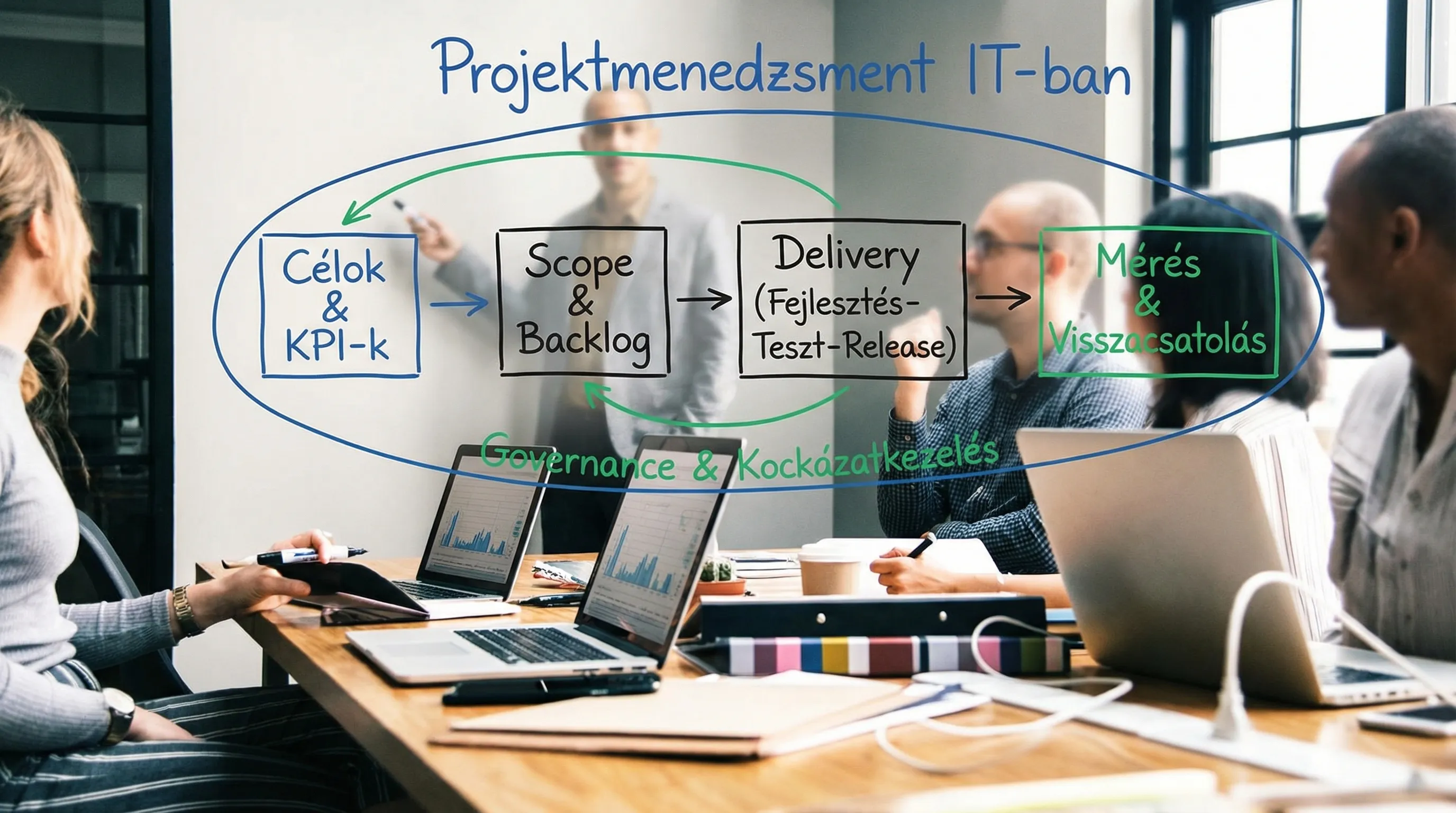
Predictable IT delivery is not a single methodology, but a system: clear goals, controlled change management, early integration and testability, effective governance, and metrics that provide timely feedback.
Once this system is in place, the project will not be fast because "everyone is working overtime," but because there is less hidden work, fewer reversals, and decisions are made in a timely manner.