AI in manufacturing: 6 use cases that quickly pay for themselves
AI
AI in manufacturing: 6 use cases that quickly pay for themselves | Syneo
6 fast-payback AI use cases in manufacturing: visual quality inspection, predictive maintenance, energy optimization, production scheduling, and inventory optimization — how to choose a pilot and measure ROI.
AI, manufacturing, computer vision, predictive maintenance, energy optimization, inventory optimization, OEE, pilot, MLOps, ROI, digitization
February 16, 2026
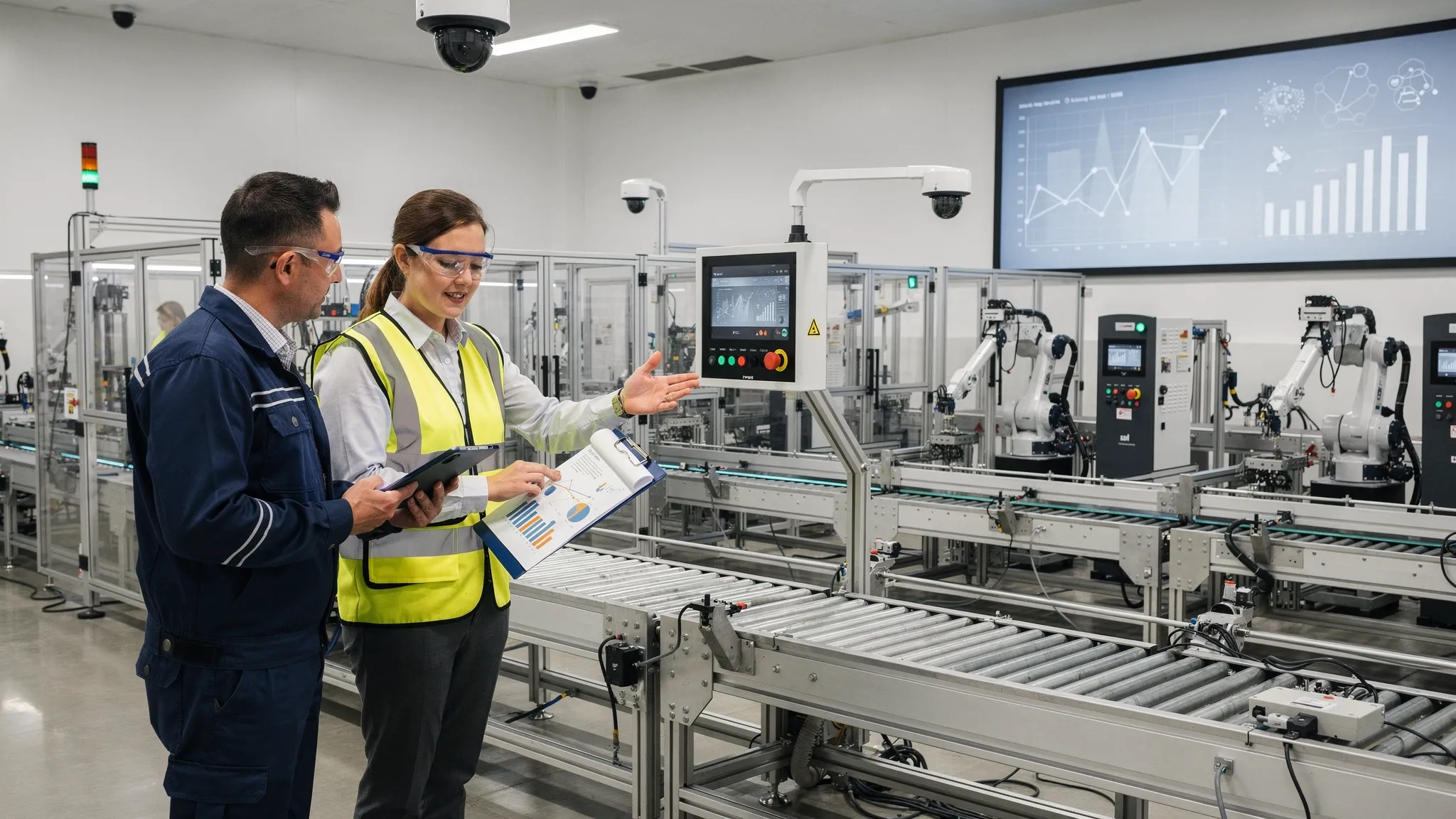
In manufacturing, AI pays off quickly when it does not start with a multi-year, disruptive transformation, but rather solves a well-defined, measurable, data-driven problem. Typical examples include reducing scrap, minimizing machine downtime, optimizing energy consumption, or improving production scheduling.
This article presents six AI use cases that have proven successful in practice and are likely to yield visible business results within three to nine months, provided that there is minimal data access and the organization actually completes a pilot.
What makes an AI project "quickly profitable" in manufacturing?
Fast ROI is not magic, but rather the right scope and measurement. In a manufacturing environment, the following three conditions are usually decisive:
A significant pain point with a measurable financial impact: scrap, rework, lost production time, overtime, peak energy charges, and late penalties.
Available (or quickly deployable) data path: PLC/SCADA/MES/ERP, sensors, camera, maintenance log, quality report.
Clear KPIs and baselines: Without AI, what are the scrap rates, average downtime, specific energy consumption, and scheduling stability?
Without these, the AI project will easily remain a "demo." If they are in place, AI typically pays for itself quickly because it makes the same process cheaper, faster, and more stable, rather than building something completely new.
The 6 fastest-payback AI use cases in manufacturing (summary)
Use case | Typical target | Typical data source | KPI example | Why is ROI fast? |
1) Visual quality control (CV) | Reduction of rejects and complaints | Camera image + tagged errors | PPM, scrap%, inspection time | Immediate quality improvement and less manual inspection |
2) Predictive maintenance | Reduction of unplanned downtime | Vibration/temperature/current + CMMS | MTBF/MTTR, downtime | Repairing a single critical machine costs a lot of money. |
3) Parameter and root analysis | More stable process, less rework | PLC parameters + quality | FPY, scrap reasons | Quick "top 3 reasons" exploration and targeted intervention |
4) Production scheduling and OEE forecasting | Better management of deadlines and capacity | MES/ERP, cycle times, changeovers | OTIF, OEE, delays | Less firefighting, less WIP, and less overtime |
5) Energy optimization | Specific energy and peak reduction | Gauges, machine status, shift data | kWh/unit, peak power | Short feedback cycle, fast control |
6) Inventory and spare parts optimization | Reducing tied-up capital and deficits | ERP, losses, lead time | stock days, shortage %, downtime | "Smarter ordering" quickly pays off financially |
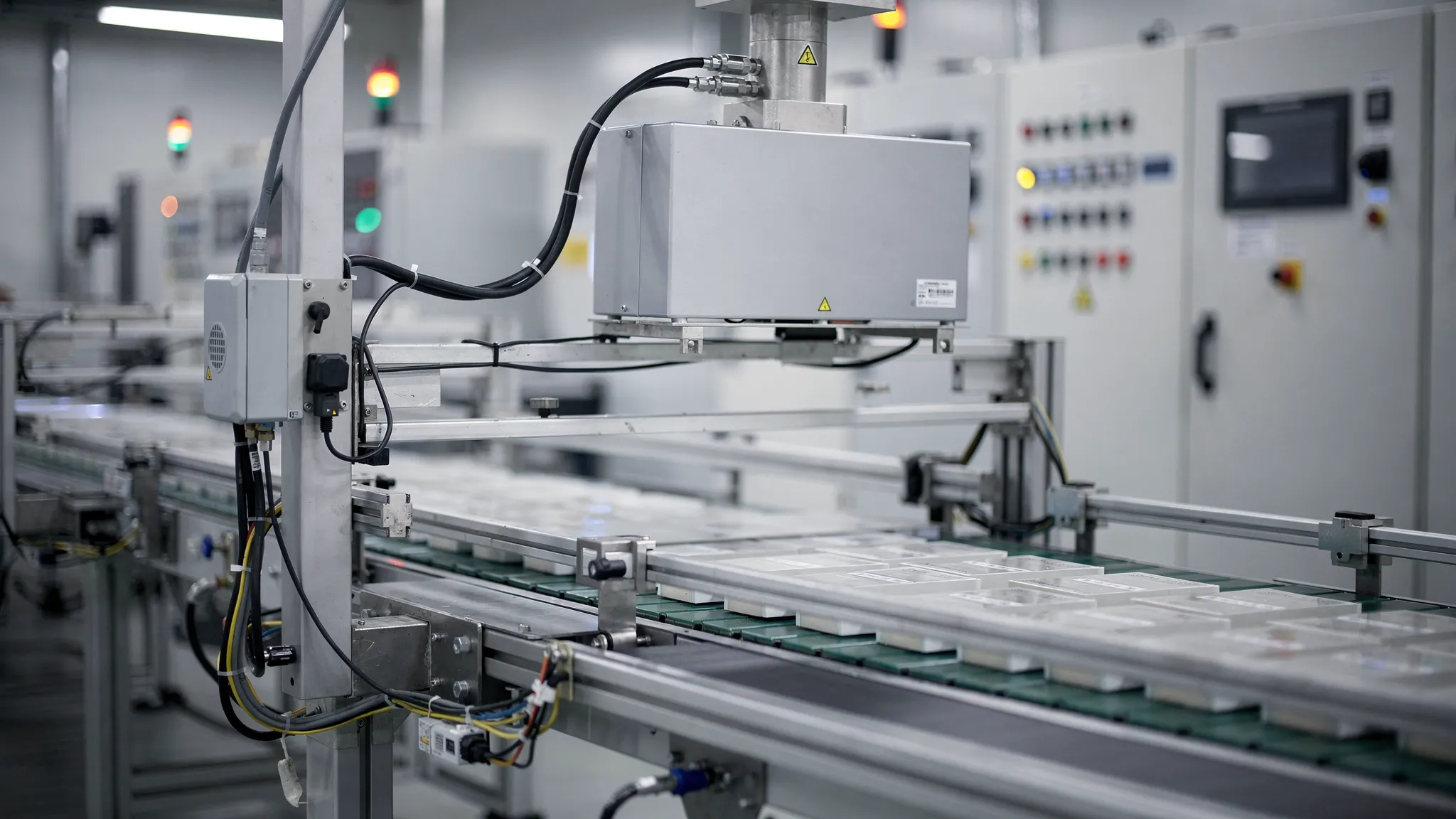
1) AI-based visual quality control (Computer Vision)
When is it worthwhile? When there are recurring types of defects (scratches, cracks, missing parts, incorrect labels, surface defects) and manual inspection is either expensive or unreliable.
How does it bring in quick money?
Visual inspection is often the "bottleneck" of quality. A well-configured computer vision solution:
reduce scrap and rework,
reduce complaints and return costs,
stabilize quality between shifts,
automate documentation (error image, error code, time).
What makes a pilot successful?
Most projects fail not because of the model, but because of labeling and process. For a quick return on investment:
select 1 product or 1 station,
define 1–3 error categories,
be the "gold standard" (who decides what is wrong),
Plan back to intervention (what happens if the system detects an error).
KPIs worth measuring: scrap rate, PPM, FPY (First Pass Yield), inspection time per piece, complaint rate.
2) Predictive maintenance for critical equipment
When is it worth it? If there are 1-2 machines whose downtime causes a domino effect (e.g., compressor, cooler, press, injection molding machine, packaging machine) and the downtime "really hurts."
What is the key to a quick ROI? You don't need to "smartify" your entire plant. All you need to do is:
1 critical machine,
1–2 measurable signals (vibration, temperature, current consumption),
Normalized log of maintenance events.
Typically, AI does this by flagging anomalies compared to normal operation or predicting the risk of certain failures. The quick return on investment comes from the fact that even a single prevented shutdown can cover a significant portion of the project's cost.
A common pitfall: if there is no CMMS/maintenance log with quality data (what broke down, when, how long it was down), it is more difficult to prove the impact. In such cases, it is worth first putting the event logging in order, even with simplified categories.
3) Root cause and process parameter analysis against scrap
When is it worth it? When there is data from production (PLC parameters, recipe, temperature, pressure, cycle time, status codes), but the causes of rejects are handled based on "gut feeling."
What is AI doing here?
Deep learning is not always necessary. Often, quick results are needed:
well-structured data model,
statistical analysis,
and targeted machine learning (e.g., classification: when does the probability of error increase)
The goal: to identify the top causes and show which parameter combinations increase the risk of scrap.
Why does it pay off quickly? Because we are not "building robots," but providing decision support to shift supervisors, technologists, and quality control. If targeted intervention is taken for the top 1-2 causes (adjustment, calibration, raw material supplier consultation, maintenance point), it will quickly show up on the FPY.
KPIs: FPY, scrap % per error code, rework time, material loss.
4) Production scheduling and OEE forecasting (realistic planning, less firefighting)
When is it worth it? If plans are frequently rewritten, delays occur, overtime is required, or there is too much WIP (work in progress) because the schedule looks good on paper but falls apart in reality.
What makes ROI fast?
When it comes to production scheduling, the first quick win is often not the "perfect optimization algorithm," but rather:
estimation of realistic cycle times and changeover times,
forecasting outages and bottlenecks,
and a plan that production can actually follow.
AI can help here, for example:
forecasting the risk of delays at order level,
predicting capacity conflicts,
and quickly running through "what if" scenarios.
KPIs: OTIF (On Time In Full), OEE, changeover times, overtime, WIP days.
5) Energy optimization based on machine status and production data
When is it worthwhile? When energy intensity is high, there are peak periods, or specific energy (kWh/unit) fluctuates greatly depending on the product and shift.
Why is it a quick return on investment?
Energy data provides rapid feedback. Even a pilot project can yield results if:
we correlate consumption with machine conditions,
identify "hidden" consumers (idling, incorrect parameters, leaks, oversizing),
and we introduce simple rules (e.g., start/stop logic, peak time avoidance, shift start optimization).
Here, machine learning is often needed for prediction and anomaly detection, not to "control" production. This makes implementation faster and safer.
KPIs: kWh/unit, peak power, idle time, energy cost/week.
6) Inventory and spare parts optimization (against shortages and tied-up capital)
When is it worthwhile? When there is too much stock (tied-up capital) at one time, and yet shortages occur (shutdowns, urgent purchases).
How does AI help in manufacturing?
demand and consumption forecasting,
dynamic fine-tuning of the safety stock,
for spare parts, taking into account failure patterns and lead times.
Why is ROI fast?
The result can easily be converted into money: fewer express purchases, fewer job losses due to shortages, and less waste. What's more, the data is often already available in the ERP, so there is no need to immediately install a new sensor park.
KPIs: days of inventory, downtime due to shortages, urgent order costs, turnover rate.
How to choose the "fastest" use case for your own operations?
If you want a decision-making framework, the following four questions are usually enough to create a good shortlist within one to two weeks:
1) What is the most expensive loss?
Rejects, downtime, energy, delays, working hours. Don't choose an "AI project," choose loss.
2) Where is the data, or where can it be obtained quickly?
A pilot project with a quick return on investment typically does not allow for months of data collection. It is advantageous to already have MES/ERP/SCADA, or at least logs.
3) Is there a clear point of intervention?
If AI flags something, who responds and how? If there is no process, there is no ROI.
4) Who is the owner of the production?
The most successful pilots have a production "owner" (shift supervisor, technologist, maintenance) who is involved on a daily basis.
Operation and scaling: what happens after the pilot?
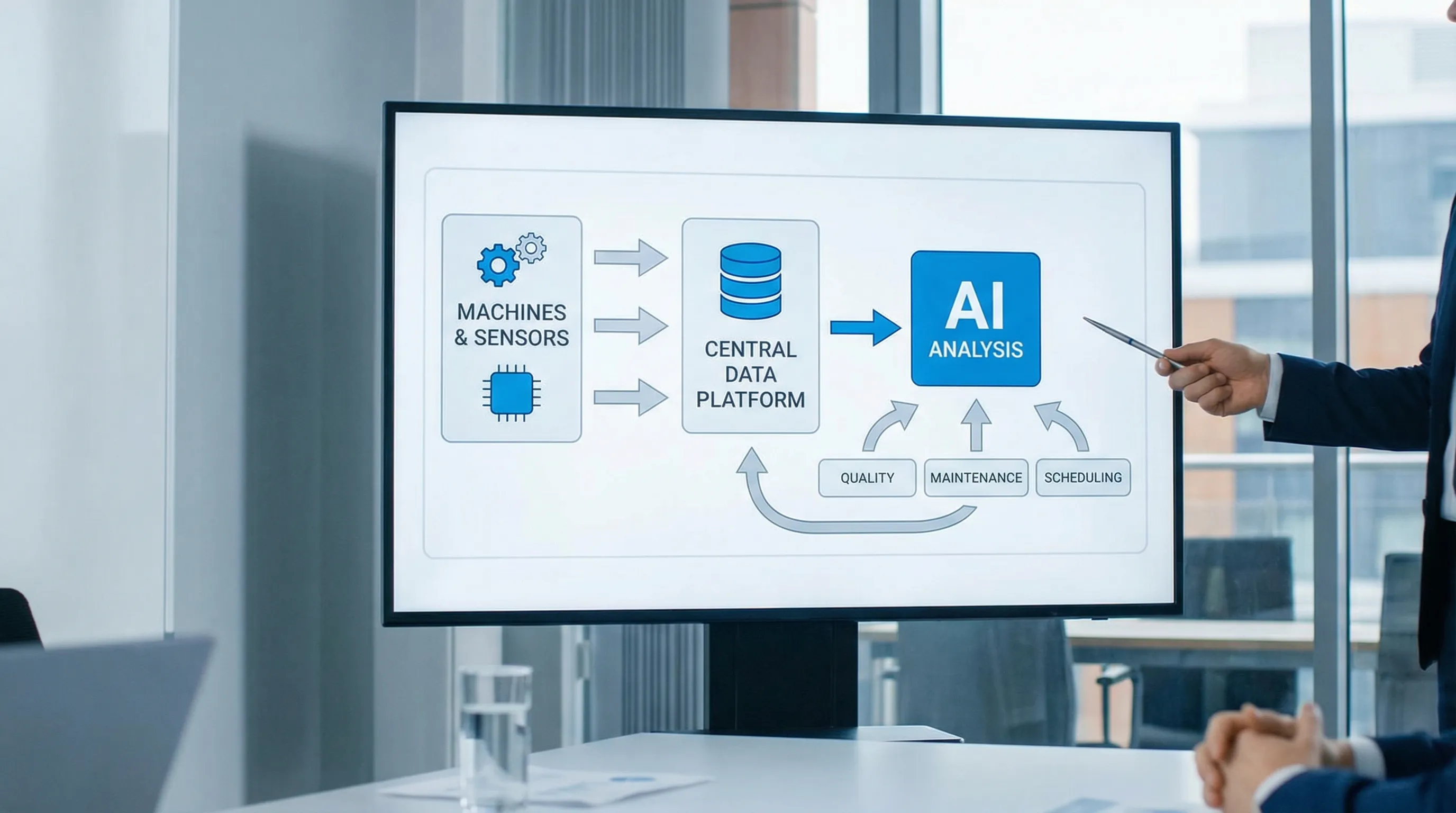
For use cases that deliver rapid ROI, the second critical issue is operation: model updates, monitoring, data quality, permissions, and incidents.
Many manufacturers therefore opt for a hybrid model: the internal team manages the process, while part of the technological operation is handled by a managed service. (A similar operating logic has proven successful in other areas, such as marketing operations. One example is a managed service approach, where continuous operation and coordination of specialists is provided as a service.)
In manufacturing, this idea is useful where AI solutions generate value, but it is not worth maintaining a dedicated, full-time MLOps team.
Quick checklist: what should you pay attention to ensure a truly fast return on investment?
Record the baseline before starting (otherwise you won't be able to prove ROI).
1 use case, 1 production line, 1 person in charge (too large a scope slows things down).
Integration planning (ERP/MES/SCADA, authorization, data quality).
Security and compliance (roles, logging, data management, supplier access).
Post-go-live "hypercare" (2–4 weeks of targeted support prevents many errors).
Frequently Asked Questions (FAQ)
How long does it take to find out if AI works in manufacturing? In most well-defined pilot projects, it takes 4–8 weeks to see if there is a signal in the noise. Business impact (KPI) can typically be measured more reliably after 8–12 weeks.
Does it require the cloud, or can it be done locally (on-prem)? Both are possible. Local processing (e.g., camera images) followed by transmission of aggregated data is common in manufacturing. The decision is usually determined by latency, data protection, and operational considerations.
What data is required for a quick return on investment project? It depends on the use case, but at a minimum you need a reliable identifier (product, item, machine, time), a target variable (error, position, consumption), and at least a few explanatory signs (parameters, states, images).
How do the EU AI Act and GDPR affect manufacturing AI projects? Typically, they affect projects if personal data is displayed (e.g., employees in camera images) or if the system's decision support is linked to employee evaluation. It is worth clarifying data management, access, and documentation as early as the pilot stage.
How many resources are needed on the manufacturing side? In rapid pilots, the bottleneck is often not development, but manufacturing time (workshop, validation, labeling, intervention process). A realistic expectation is a designated owner and a few hours of expert time per week.
Next step: choose one use case and turn it into a 90-day pilot
If you wish, the Syneo team can work with you to assess which of the six use cases above will bring you the fastest return on investment, what data path and integration is required (ERP/MES/SCADA), and how to structure the pilot so that it runs on measurable KPIs.
Check out the practical issues of implementing AI in your company in our related material: Implementing artificial intelligence: frequently asked questions, or start with a more structured, step-by-step approach to digitalization: Step-by-step corporate digitalization: a proven framework.