Outsourcing IT operations: what are the hidden costs?
Digitalization
Outsourcing IT operations: what are the hidden costs? | Syneo
What to expect when outsourcing IT operations: transition costs, scope gaps, licenses, cloud costs, and security. Practical tips for reducing real TCO and exit costs.
IT operations, outsourcing, TCO, DevOps, cloud, FinOps, SLA, security, licenses, vendor management
February 26, 2026
Outsourcing IT operations promises quick relief for many companies: less internal burden, more stable availability, and more predictable monthly fees. In reality, however, a significant portion of the costs do not appear in the "basic monthly fee" specified in the contract, but rather in the gaps in scope, transition, licensing, security requirements, and change management.
In this article, we will review the typical but often underestimated items that can easily increase the total cost of ownership (TCO) of an outsourcing project by 20-50% more than expected, and how you can control these before making a decision.
What exactly does IT outsourcing mean (and what does it not mean)?
This is where most misunderstandings start. "Outsourcing" is often a collective term, but it really matters whether the partner:
provides only helpdesk and end-user support,
takes over the operation of servers, networks, and cloud services (monitoring, patching, backups),
provides 24/7 on-call service and incident management,
manages the security layer (EDR, vulnerability management, log management),
or already enters the areas of release, CI/CD, and infrastructure as code in a DevOps manner.
The more areas you hand over, the more dependencies, entitlements, tools, and responsibilities need to be clarified. Hidden costs typically arise where there are "gray areas" that are not defined in the contract.
The most common hidden costs you need to factor in
1) Transition costs and knowledge transfer
The first 4–12 weeks are often more expensive than you might think, even if the operating fee is reasonable.
Typical items:
Lack of current system inventory (mapping of devices, integrations, licenses, accesses)
replacement of documentation (runbooks, backup procedures, network diagrams)
knowledge transfer from key personnel (who also perform day-to-day business tasks)
tidying up environments so that they can be taken over at all (e.g., outdated OS, manually configured servers)
The most unpleasant surprise is when, during the transition, it turns out that operations were actually running in "hero mode": with information stored in the heads of 1-2 people, without any automation.
2) Scope gaps and the phenomenon of "separate billing for every change"
Many service providers offer a fair basic package, but in reality, there are many "non-incident, non-request" types of tasks that arise:
adjustments due to business changes
new site, new tools, large numbers of new users
new integrations, API keys, firewall rules, VPN modifications
data reporting required for audits and partners
If the contract does not include a clear service catalog (what is included, in what quantity, with what turnaround time), then hourly billing for changes will quickly eat away at the planned savings.
3) Tooling and licenses: monitoring, backup, EDR, ticketing
Outsourcing is not just about human capacity. Operations require equipment, and this often comes with additional costs:
monitoring and alerting
backup solution and offsite storage
endpoint protection (EDR), email protection
vulnerability assessment, patch management
ticketing, knowledge base, asset management
The hidden part is that it is not always clear whether the service provider provides the license or you pay for it and they only operate it. It is also worth clarifying what happens if you change service providers: can configurations, reports, dashboards, and rules be transferred?
4) Cloud costs: “Operations are fixed, but cloud bills are not.”
In a cloudy environment, outsourcing operations often improves stability, but monthly cloud bills may still fluctuate.
Hidden cost sources:
No cost tagging, no showback/chargeback
oversized resources, forgotten dev environments
the disappearance of logging and observability costs
data transfer fees (especially for backup, DR, and multi-region)
If the partner does not receive explicit goals and authorization for FinOps-type optimization, then the cloud becomes "silently" more expensive, while the service provider's fee appears to be fixed. (It is also worth reading about the cost logic of cloud migration: cloud migration for SMEs.)
5) Security and compliance: auditing, logging, incident management
Outsourcing does not automatically reduce responsibility. In fact, in many cases it increases the coordination burden (data management, subcontractors, access, verifiability).
Common hidden items:
compilation of mandatory audits and reports
log retention, SIEM, or log management fees
authorization management (JML processes: joiner/mover/leaver)
incident management exercises, forensics, insurance requirements
A proven framework, such as the NIST Cybersecurity Framework, can be a useful reference point here, helping to structure controls and responsibilities.
If DevOps-type operations are also in place (CI/CD, containers, IaC), then the hidden cost is typically that security has to be built in "after the fact." Syneo's material on this topic can serve as a good guide: DevSecOps in practice.
6) Ambiguity of the SLA: what does “we will respond within 1 hour” mean?
SLAs are included in many contracts, but the details determine the cost:
what counts as an incident and what counts as a request
what counts as a solution (workaround or permanent fix)
how they measured (ticket statuses, monitoring, business hours)
Is there a maintenance window, and how will planned downtime be handled?
If these are unclear, the "hidden cost" is not only money, but also business losses: prolonged errors, internal escalations, lost revenue.
7) Vendor management: internal time does not disappear
Many managers mistakenly believe that outsourcing means they "don't have to deal with IT." The reality is that you still need an internal role that:
prioritizes and approves changes
translates between the business side and the service provider
controls reports, SLAs, quality
handles cost disputes and invoice audits
This isn't necessarily a full-time job, but if it's not assigned, the task will be scattered and valuable "management time" will be wasted.
8) Exit costs and lock-in: when to switch
We rarely plan for it, but one of the most important cost risks of outsourcing is exit:
transfer of data, configurations, and documentation
revocation of rights, key rotation
migration from tools (ticketing, monitoring)
transitional dual operation for 1–3 months
Without an exit plan and "hand-deliverable" documentation, the cost of switching will be so high that the organization will prefer to remain with a mediocre service.
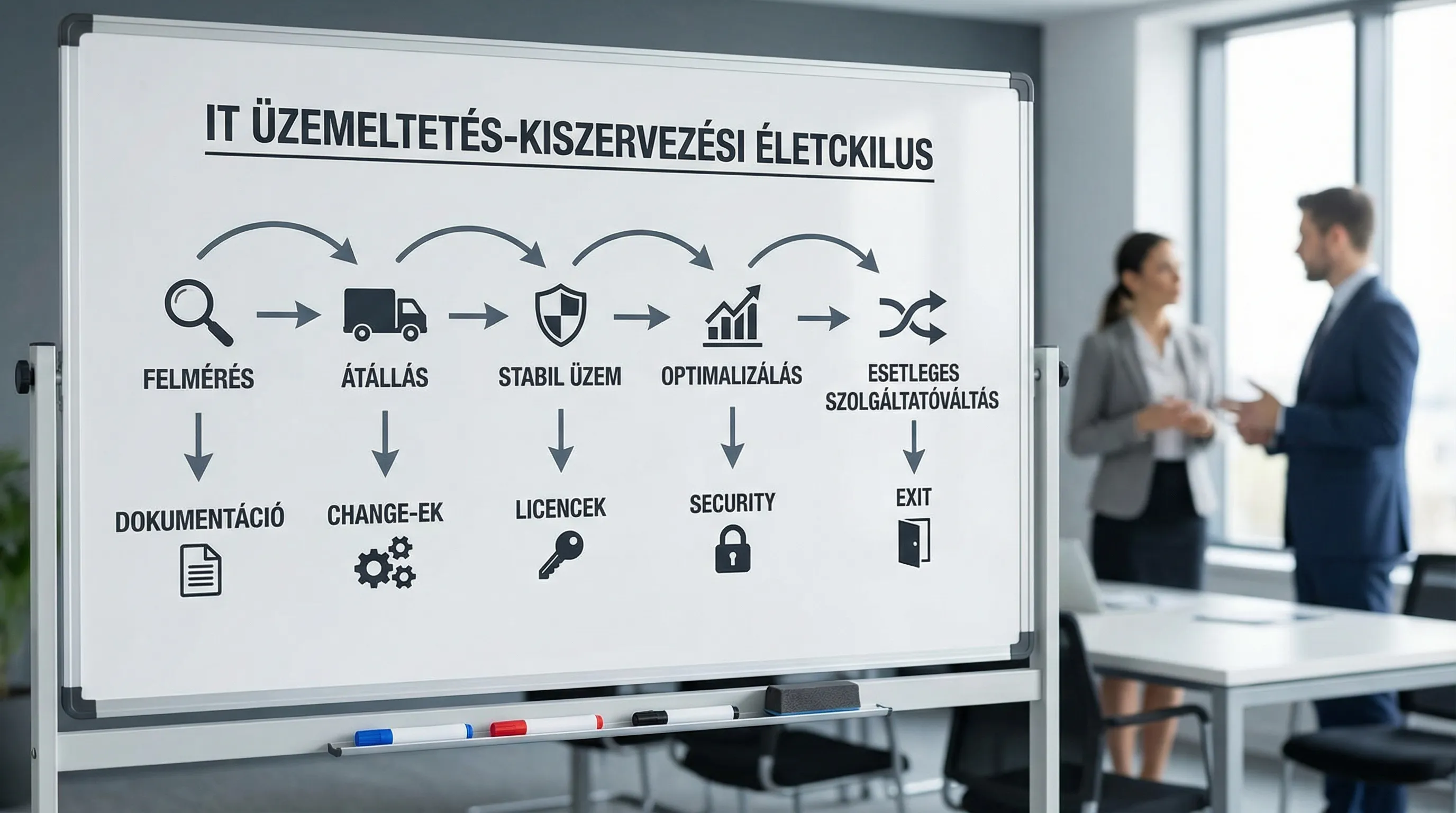
Map of hidden costs (quick overview table)
Cost area | What typically triggers it? | How can it be reduced? |
Transition and knowledge transfer | Incomplete inventory, documentation, knowledge "in the head" | Transition plan, inventory, runbooks, joint workshops |
Scope gaps and changes | Undefined service catalog, business changes | Catalog, quantity limits, change policy |
Tooling and licenses | Monitoring, backup, EDR, ticketing charged separately | Clarification of “Who issues the license?” and exportability |
Cloud costs | Lack of tagging, log costs, overconsumption | FinOps goals, budget alerts, regular rightsizing |
Security and audit | Log retention, reports, incidents | Checklist, responsibilities, access management |
SLA misunderstandings | Reaction vs. solution, measurement definitions | SLA definitions, KPIs, escalation policy |
Internal coordination | No service owner, no governance | RACI, monthly service provider review |
Exit and lock-in | Lack of documentation, tool dependency | Exit clause, handover package, access rotation |
How to calculate the true TCO before outsourcing?
The best defense against hidden costs is a brief but thorough TCO assessment. This does not necessarily require months of auditing, but the minimum requirements must be met.
1) Create a “current status” cost base
Don't just think about wages. Write down:
internal IT time spent (helpdesk, on-call duty, changes)
current licenses and subscriptions
hardware depreciation, hosting, cloud
business costs of incidents (lost production, downtime, rushing)
2) Demand data instead of estimates: tickets, incidents, changes
A service provider's pricing often depends on the load. If you don't have any data, you'll pay an overpriced "safety buffer."
Useful minimum metrics:
monthly ticket numbers and types
Top 10 recurring errors
average resolution times
Number of monthly changes (user, system, network)
3) Put “non-standard” items in a separate row.
Most of the hidden costs are here. For example:
application operation (not just infrastructure)
24/7 on-call service
DR (disaster recovery) and regular restore testing
compliance reports, audit support
4) Calculate exit costs right from the start
Most CFOs find this strange, but it is actually risk management: if you have to switch, how much will it cost? If you don't have an answer to this question, outsourcing will reduce your business flexibility.
Contractual points where costs are "hidden"
It is worth being very specific here, because uncertainty will lead to later billing issues.
Service catalog and quantitative limits
It should be clearly stated what exactly is included in the fee (e.g., how many devices, how many users, how many monthly requests) and what is priced separately.
RACI: Who decides, who executes, who approves?
Outsourcing works well when responsibilities are clearly defined. A clear RACI matrix prevents "it wasn't us" type arguments.
Minimum security requirements and access
Among other things, the following must be clarified:
what permissions the service provider receives (admin access, break-glass)
how logging and log access work
how quickly critical vulnerabilities need to be patched
what is the incident notification and handling process
Reporting and service provider review
Without a fixed monthly or biweekly review agenda, problems only become apparent when they are already costly (e.g., SLA slippage, cloud bill spikes).
Practical transition plan (30–60–90 day logic)
The structure of the transition is critical in terms of cost control.
0–30 days: mapping and stabilization. Inventory, accesses, monitoring basics, validation of backups, quick fixes for top errors.
31–60 days: standardization and automation. Runbooks, patch order, change management, escalation, reports. Where possible, IaC and automation.
61–90 days: optimization and cost control. Cloud rightsizing, fine-tuning log and backup costs, SLA refinement, DR practice.
If the transition is just a matter of "we'll take it and it'll work out somehow," hidden costs are almost guaranteed.
When is outsourcing worthwhile, and when is a hybrid model better?
It is generally a good sign for outsourcing if:
The internal IT team is small, and there are too many interruptions (tickets, firefighting).
requires 24/7 monitoring or a higher level of security
The company is growing rapidly and needs scalable operations.
A hybrid model usually works if:
the internal team would retain responsibility for architecture, roadmaps, and application-related decisions
while the partner would provide standard operation, supervision, and platform services.
The most expensive scenario is when no one feels responsible for the system and everyone just passes the buck.
What is the connection to custom development (and why could this also be a hidden cost)?
During operation, it often turns out that the root cause of problems is not the operational process, but an old application, a poorly scalable component, a missing admin interface, or a manual business workflow.
In such cases, there are two options:
temporary "folding" in operation (which generates ongoing costs),
or targeted modernization, which reduces operating and support costs in the long term.
If a critical system requires unique developer support, it is worth knowing a partner who can provide end-to-end assistance with stable, long-term solutions. For example, the custom software development teams at Wolf-Tech clearly demonstrate the process from discovery to support.
How can Syneo help with this (without “putting everything on you”)?
Hidden costs typically consist not of a single large item, but of many small ones. The easiest way to identify these is through a short, targeted survey, and then to negotiate a contract that makes the risks manageable.
In such situations, Syneo typically adds value in the following ways:
clarification of the scope of operations and service catalog (what you want to transfer and what you don't)
Developing SLAs, RACI, and governance to prevent internal time requirements from "leaking away"
Aligning DevOps and security expectations (especially with cloud and CI/CD)
Compilation of transition plan, risks, key performance indicators (KPIs), and TCO framework
If you are considering outsourcing, the best first step is not to request a quote, but to do some brief, data-based preparation: inventory, workload, expectations, and risks. This is the point where "hidden costs" can still be easily prevented.