IoT sensors in manufacturing: what to look out for before installation?
Digitalization
IoT sensors in manufacturing: what to look out for before installation? | Syneo
Practical checklist for manufacturers: what to consider before installing IoT sensors — data quality, power supply, communication, cybersecurity, and integration for measurable return on investment.
IoT, sensors, manufacturing, digitization, predictive maintenance, edge, data quality, cybersecurity, integration, pilot, power supply, OPC-UA, MQTT
February 26, 2026
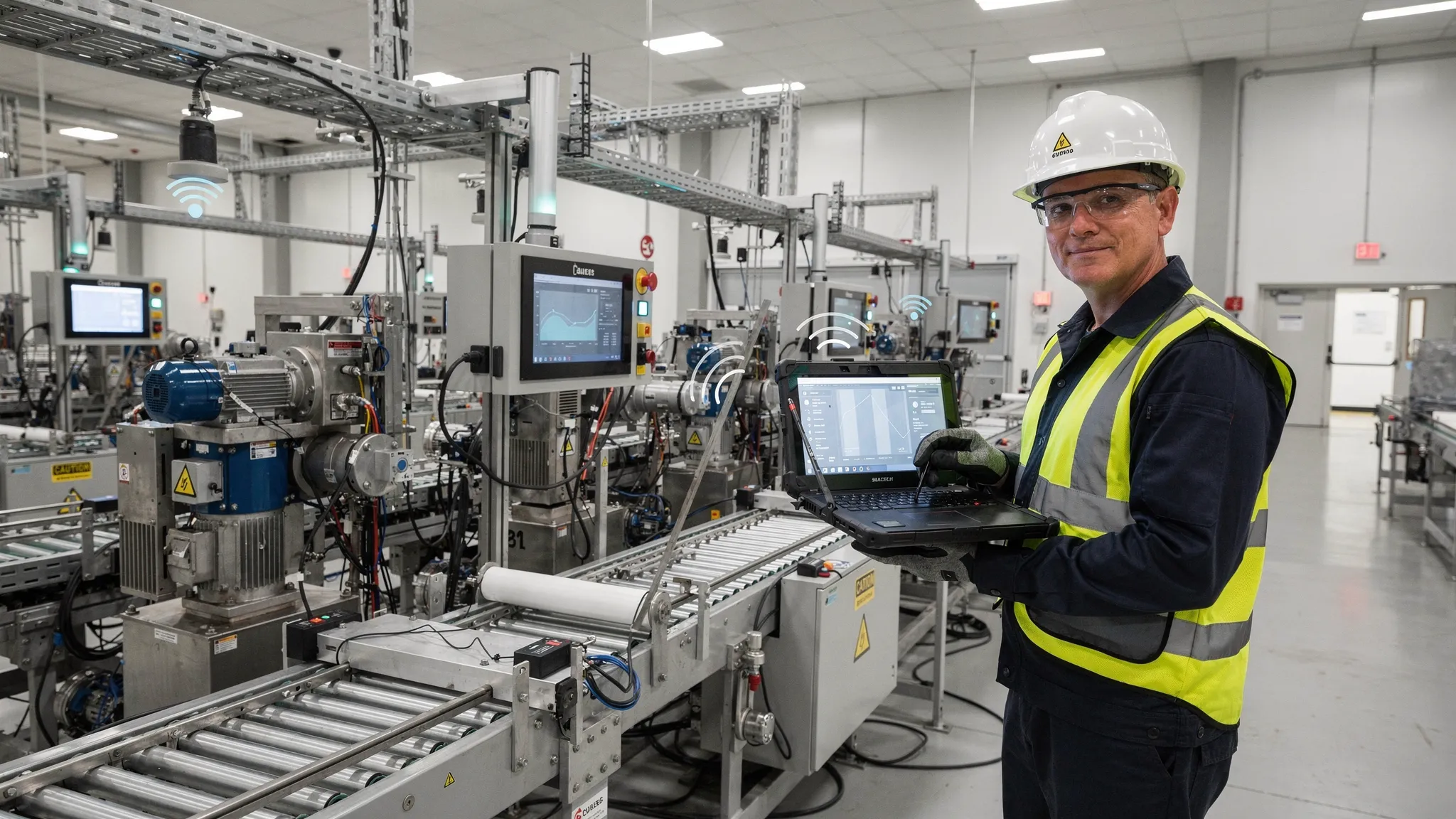
Most manufacturers today are no longer considering whether it is worth introducing IoT sensors, but rather how to install them in such a way that the data can actually be used and the project does not end up in a dead end of "just another dashboard." Decisions made prior to installation (purpose, environment, data path, cybersecurity, operation) have a much greater impact on return on investment than the brand of the sensor itself.
The following guide is a practical checklist tailored to a manufacturing environment: what to look for before deploying IoT sensors in manufacturing to build a stable data stream, scalable architecture, and measurable business results.
1) Start with a business goal, not a list of tools
IoT typically pays off quickly in manufacturing when you measure and fix a specific pain point. The sensor only measures; the value is what you do with the measured data in the form of decisions, alerts, or automated interventions.
Before installation, clarify:
Use case: for example, condition monitoring, predictive maintenance, quality, energy, OEE support.
Decision point: who receives the alert, on which channel, and what constitutes an "action."
KPI and baseline: what are you measuring today, and what is the current value (otherwise there is no ROI calculation).
If predictive maintenance is your goal, it is worth reviewing the entire thought process and pilot logic in this article: Predictive maintenance: how to reduce machine downtime?
Quick decision table: what makes a "good" IoT use case?
Question | Characteristics of a good answer | Typical red flag |
What is the goal? | Reduction of specific losses (downtime, scrap, energy) | “Let’s have our data” |
What is KPI? | Clear, measurable, and trackable over time | No baseline, no target value |
Who uses it? | Role identifiable by name (maintenance, shift supervisor) | "IT will look into it." |
What is the procedure? | Alert + process (ticket, CMMS, inspection) | Graph only |
Is it scalable? | Can be extended to multiple machines and locations | "This only works on this particular machine." |
2) On-site survey: the production line is not an office environment
The success of sensor selection and installation depends heavily on physical reality:
temperature fluctuations, humidity, dust, oil mist
vibration, shock, EMC interference
washing (CIP), chemicals
ATEX zones, occupational safety barriers
Before installation, prepare a site survey report that includes at least the following:
IP protection (e.g., splash, dust, wash)
temperature range and proximity to heat sources
fixing points (no drilling? gluing? magnetic base?)
cable routing and cable protection options
radio shielding (metal cabinets, machine covers)
3) Sensor type and measurement specifications: accuracy, sampling, calibration
The most common manufacturing IoT sensors:
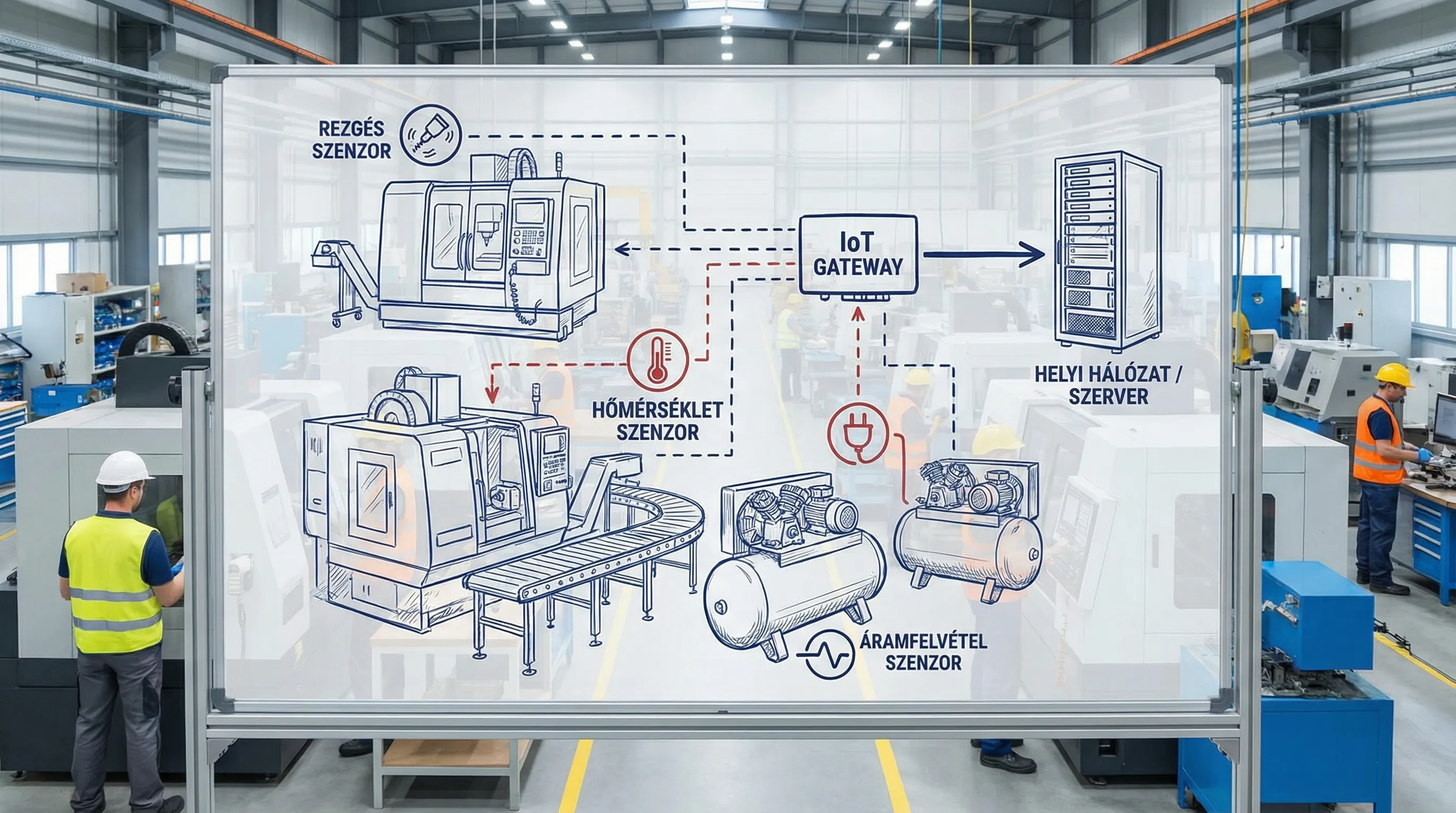
Vibration and acceleration (bearing, motor, drive condition)
Temperature (bearing housing, cabinet, process)
Current and voltage (motor load, energy)
Pressure and flow (pneumatics, hydraulics, fluids)
Environmental sensors (humidity, CO2, dust, VOC)
Before installation, record the minimum measurement specifications:
Accuracy and resolution: not just "measuring something," but whether it is sufficient for decision-making
sampling frequency: for example, it can be orders of magnitude higher for vibration than for temperature
calibration: is it necessary, how often, who performs it, what is the evidence (certificate, report)
drift and aging: how fast can measurements deteriorate (especially with cheap sensors)
Estimate the amount of data so that the network does not "teach" your limits
Simple approximation:
data volume (bytes/s) = sampling rate (Hz) × sample size (bytes) × number of channels
For example, if 1 sensor measures at 100 Hz, 4 bytes per sample, on 3 axes (XYZ), then:
100 × 4 × 3 = 1200 bytes/s, which is approximately 1.2 KB/s
This is not much on its own, but with 200 sensors, plus overhead, plus metadata, plus storage and retrieval, it becomes an architectural issue. Vibration spectrum and raw signal storage are even bigger leaps.
4) Power supply and maintainability: battery powered does not come free of charge
The power supply decision directly affects TCO (total cost of ownership) and operation.
Common options:
24V DC industrial power supply: stable, but wiring and protection are required.
PoE (Power over Ethernet): one cable for data and power, but not feasible everywhere.
Battery/batteries: quick installation, but operational burden (replacement, inventory, downtime).
Before installation, you should have answers to the following questions:
What is the expected battery life with actual sampling and radio environment?
Who replaces the battery and with what kind of SLA?
What happens if a sensor does not send data for two weeks (alarm, ticket, inspection)?
5) Communication and protocol: where most IoT projects "die quietly"
In manufacturing, the IoT data path is not just sensors and the cloud. Typical chain:
sensor → gateway → local network (OT/IT) → data platform → application (alerting, analytics, AI)
Wired vs. wireless
Wired (Ethernet, RS-485, industrial buses) connections offer the advantage of stability and predictability.
The advantage of wireless is quick installation, while the disadvantages are radio exposure and lack of determinism.
Protocols worth checking out
OPC UA for industrial integration (especially in PLC, SCADA, and MES). See: OPC Foundation.
MQTT is easy, pub-sub-based IoT data transmission. Useful overview: OASIS MQTT.
The protocol alone is not enough. The important question is: where will the "source of truth" be, and how will integration be auditable and scalable? A good basis for this: System integration: how to connect ERP, CRM, and BI?
6) Edge vs. cloud: latency, data protection, cost
In many manufacturing cases, edge (local processing) is not an "extra" but a necessity:
if you need a quick alert (within seconds)
if the network is unstable or the connection is expensive
if sending raw signals to the cloud is too expensive
Common pattern:
On Edge: pre-filtering, aggregation, simple anomaly detection
In-house/cloud: long-term trends, models, reports, comparison of multiple sites
7) Data model and data quality: AI is also decisive in IoT
The most common "invisible errors" in manufacturing IoT data:
missing time synchronization (incorrect timestamp, different time zone)
incorrect tagging (you don't know which sensor is on which machine)
variable sampling and "gapped" time series
mixing of units (Celsius vs Kelvin, bar vs kPa)
Before installation, it is advisable to set the minimum data standard:
Device and sensor identifiers (unique, non-reused ID)
asset hierarchy (site, line, machine, subsystem)
units of measurement and scaling
time synchronization (NTP/PTP, and who is responsible for it)
If the goal is future AI (e.g., prediction, anomaly detection), data quality audit logic is just as critical as it is for business systems. Related: Data quality audit: why do AI projects fail?
8) Cybersecurity (OT + IT): the sensor is also an entry point
Must be clarified before IoT installation:
which network zone it will be placed in (OT, IT, DMZ)
how it can be updated (firmware, patch), and who is responsible for it
how authentication takes place (certificates, keys)
what kind of encryption is used during data transfer and storage
What is the plan in the event of a compromised device (isolation, replacement, forensics)?
In industrial environments, the IEC 62443 standard family (security of industrial automation and control systems) provides a good basis. Overview: ISA/IEC 62443.
For more general security guidelines, the NIST Cybersecurity Framework is also a useful framework for thinking.
9) Integration with existing systems: PLC, SCADA, MES, CMMS, ERP
One typical pitfall of manufacturing IoT is that within a few weeks, a "separate IoT world" is created that is not connected to operations.
Before installation, decide where the event should appear:
CMMS (maintenance ticket, worksheet) if condition-based maintenance is the goal
MES (production context: shift, recipe, batch, product)
ERP (cost center, parts, inventory, downtime costs)
The goal is not to connect everything with everything else in the first week, but to have a clear integration map and a "next steps" plan. Useful for project planning logic: Planning a digitization project: goals, KPIs, risks
10) Implementation plan: pilot, acceptance criteria, documentation
The safest approach in manufacturing is pilot – measurement – scaling.
Before installing the pilot, make sure to:
precise scope (which machines, how many sensors, what kind of sampling)
data path (where it arrives, who sees it, how long you store it)
first version of alert rules
Acceptance criteria (what counts as success at 30-60-90 days)
Short, practical "go-live" checklist
Area | Check before installation | Definition of "ready" |
Mechanics | fastening, vibration transmission, cable protection | documented installation method + photo |
Network | coverage, VLAN/ports, firewall rules | approved network plan |
Time | NTP/PTP, time zone | Uniform timestamp on all devices |
Data | units, labels, asset mapping | traceable: sensor → machine → line |
Safety | password management, certificate, update policy | known patch and incident process |
Operation | monitoring, failure notification, replacement parts | there is a responsible person and an SLA |

11) Operation and life cycle: who owns the IoT system at "2 a.m."?
The first 4-8 weeks after installation will reveal how realistic the plan was. Before installation, mark:
monitors the online status of devices
who handles error tickets (IT, maintenance, integrator)
how firmware updates and version management work
How will sensor replacement be handled (new ID? recalibration? mapping update?)
This typically requires DevOps-style thinking (observability, incident, change). If this is new to your organization, it is worth building on the basics: DevOps basics: the path from zero to production in 2026.
12) Typical pitfalls you can avoid before installation
Stumbling block | Why does it hurt? | Prevention before installation |
Too much data, too few goals | Expensive storage, no decision | KPI + alarm logic + minimum required sampling |
Incorrect tagging | Cannot be connected to a machine | asset hierarchy, unique identifiers, mapping workflow |
Radio instability | Gap in time series, false alarms | site survey, gateway placement, redundancy plan |
Safety after the fact | Risk, audit problem | IEC 62443 approach, zones, update schedule |
Without operation | The system will expire after 3 months. | responsible, monitoring, replacement process, SLA |
How can Syneo help with this?
IoT sensors typically deliver quick results in manufacturing where technical installation is linked to processes, data paths, and security. Syneo's digital transformation and IT consulting practice typically adds value to such projects in the following areas:
survey and use case framing (KPI, measurability, pilot scope)
data path and system integration planning (OT and IT together)
data quality and AI preparation (so that subsequent analytics work)
incorporation of operational and security funds (stable, auditable operation)
If you would like a pilot plan tailored to your specific site and machine park, it is worth starting with a short survey. This case study, where sensor data collection and AI brought results together, may also be useful as related inspiration: Full digitization and AI integration (case study)