Corporate chatbot implementation: how to measure the true ROI?
AI
Introducing a corporate chatbot: how to measure the real ROI? | Syneo
How to measure the true return on investment of a chatbot: TCO, control group, monetizable KPIs (deflection, AHT, CSAT, conversion), and a 30–90-day measurement plan.
chatbot, corporate chatbot, ROI, TCO, deflection, containment, AHT, FCR, CSAT, conversion, AI, measurability, pilot, control group
February 22, 2026

The introduction of a corporate chatbot usually seems impressive at first: waiting times are reduced, the number of "handled conversations" increases, and the pilot demo provides answers to every question. However, the CFO's question is usually not about this, but rather what the real ROI is, when it will pay off, and what happens if the chatbot gives the wrong answer or cannot be properly integrated into your processes.
This article provides a practical measurement framework that allows you to evaluate chatbots not based on "feelings" but on business criteria: TCO (total cost of ownership), control groups or A/B testing, and KPIs that can actually be converted into money or risk.
1) What kind of chatbot are we talking about, and where does the benefit come from?
The "corporate chatbot" appears in three typical areas, and the ROI logic will be different for each:
Customer service chatbot (web, app, Messenger, WhatsApp, email triage): the goal is to reduce ticket load, improve SLA, increase CSAT, and reduce costs/solutions.
Internal (employee) chatbot (IT helpdesk, HR, procurement, internal knowledge base): the goal is to reduce internal turnaround times and "search time," as well as to minimize errors and interruptions.
Sales/marketing chatbot (lead qualification, quote requests, appointment scheduling): the goal is to increase conversion and revenue, and free up salespeople's time.
The real ROI tends to be misrepresented because the same 2-3 "vanity" metrics are looked at everywhere (e.g., number of conversations), while the benefits are generated elsewhere entirely: in ticket deflection, average handling time, conversion, error costs, or even risk reduction.
2) ROI, payback, NPV: which one does finance ask for?
It is worth considering the return on investment of a chatbot on three levels:
ROI (%): how much return on the amount invested.
Payback (payback period): how many months it takes for the investment to pay for itself.
NPV (net present value): most accurate for multi-year, ongoing costs and benefits (with discounting).
Basic formulas (simplified form):
The key here is to correctly determine the TCO and net profit.
3) The 6 KPIs of "true ROI" that can be measured almost anywhere
The following KPIs are useful because they can all be converted into money, SLAs, or risk. The best practice is to commit to only 2-3 primary KPIs in the pilot, along with 3-5 "guardian" indicators (quality and risk).
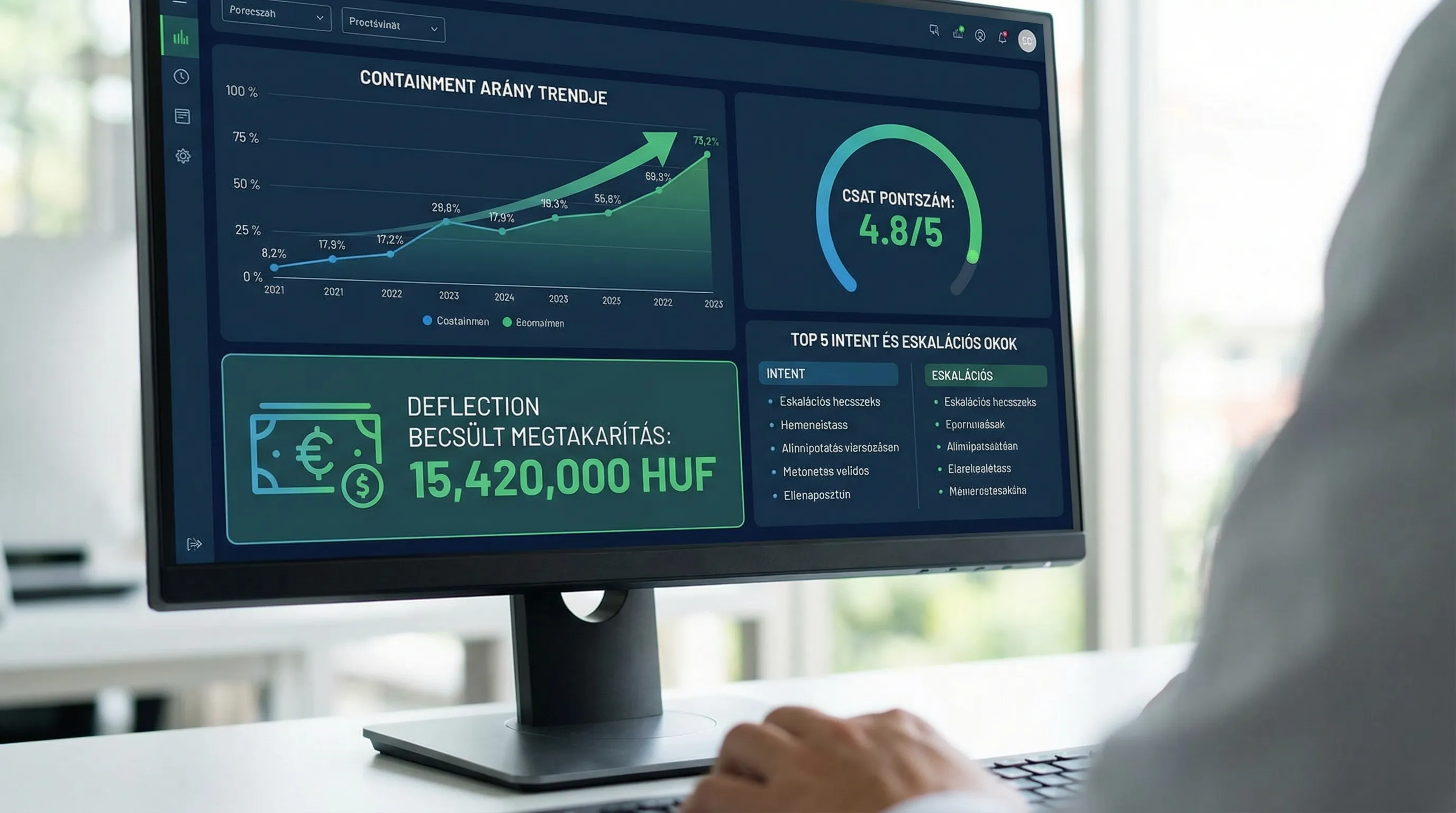
3.1 Deflection and containment
Deflection rate: the extent to which the chatbot reduces the number of tickets assigned to humans.
Containment rate: what percentage of conversations end without the need for human intervention (and the user accepts this).
Important: containment is only worthwhile if quality does not deteriorate in the process. This requires a quality-preserving KPI (see below).
3.2 Reduction in AHT (Average Handling Time)
Even if the chatbot doesn't close every deal, it often generates ROI by:
pre-screens the request (triage),
collects the necessary data,
proposes a solution to the agent.
The essence of the measurement: average handling time (on the agent side) in the period before and after the bot, or with a control group.
3.3 FCR / First Contact Resolution
Chatbots can also increase profits if the cases transferred to humans are "cleaner" and can be closed in fewer rounds.
3.4 CSAT (satisfaction) or quality proxy
The finance department rightly asks: "OK, we're saving money, but how much is dissatisfaction costing us?" Minimum measurement:
short, 1-question quiz at the end of the chat, or
"thumbs up/down" + text explanation, or
Proportion of complaints on chatbot channel.
3.5 Conversion (for sales chatbots)
For sales targets, the KPI is usually:
lead-to-meeting,
meeting-to-opportunity,
opportunity-to-win,
average basket value / cross-sell ratio.
3.6 Error cost and risk (the often overlooked item)
With generative AI-based chatbots, a "bad answer" can be not only a UX problem, but also a cost:
recalls due to incorrect information,
incorrect order / incorrect process initiation,
compliance incident,
reputational damage.
That's why it's worth measuring separately:
reasons for escalation (why did you request someone?),
correction ratio (agent corrects the bot),
cases suspected of being hallucinations (labeled according to policy),
policy violation events (e.g., prohibited data, prohibited promise).
4) KPI map: what to measure, where to find the data?
Goal | Recommended KPIs | Typical data source | Comment |
Reducing ticket load | Deflection, containment | Ticketing system, chat platform logos | The "no-stick" baseline is mandatory |
Speeding up administrative procedures | AHT, FCR | Contact center / ticketing report | AHT should be measured by category |
Improving customer experience | CSAT, complaint rate | CSAT questions, CRM, QA sampling | Cost reduction should not compromise CSAT |
Increasing revenue | Conversion steps | Web analytics, CRM pipeline | UTM, events, attribution required |
Quality and risk | Correction ratio, policy event | QA, audit log, security log | Particularly important for generative bots |
5) Calculating TCO (total cost of ownership) correctly: what is usually left out?
The ROI of chatbots is often "too good to be true" because only the license is considered, not the operation and change management.
5.1 One-off costs (CAPEX nature)
discovery, process and intent assessment
knowledge base preparation (content, owners)
integrations (CRM, ERP, ticketing, IAM, knowledge base)
security, data protection, legal consultations
testing (functional, security, prompt/KB tests)
5.2 Ongoing costs (OPEX nature)
model usage and infrastructure (especially for generative bots)
operation, monitoring, incident management
knowledge base maintenance (new products, changing rules)
analytics and reporting
QA sampling, "bot training," and fine-tuning
change management, training (agent, back office)
A summary that is easy to understand even at management level:
Cost category | One-time | Continuous | Typical "hidden" item |
Product/license | ✓ | ✓ | channel fees, seat-based expansion |
Integration | ✓ | data quality improvement, permissions | |
Knowledge base | ✓ | ✓ | content owner and review process |
Security and compliance | ✓ | ✓ | audit, logging, access management |
Operation | ✓ | SLOs, on-call, release process | |
Quality assurance | ✓ | ✓ | conversation sampling, policy tests |
If the chatbot handles customer data, logging, permissions, data retention, and supplier contract issues also become TCO items due to GDPR and security. On the AI compliance side, it is also worth considering the regulatory environment (EU AI Act). Source: European Commission, AI Act.
6) How to measure correctly: baseline, control group, seasonality
The "before and after implementation" comparison is often misleading because it changes over time:
the season (e.g., year-end peak),
product or price,
campaign,
team size,
SLA rules.
Three proven methods, with increasing accuracy:
6.1 Baseline + same time window
Minimum: comparison of time windows of equal length (e.g., 4 weeks vs. 4 weeks), broken down into identical categories (intent, case type).
6.2 Holdout (control group)
You deliberately do not give a chatbot to part of your traffic (e.g., 10-20%), so you can see the "what if there was no bot" curve.
6.3 A/B testing (especially for sales goals)
Best for sales chatbots: Version A without a bot, version B with a bot, and you track the conversion all the way to CRM.
7) Sample calculation (hypothetical): return on investment for support chatbot within 6-12 months
The numbers below are just examples to illustrate the logic. The key point is to assign a data source to each parameter.
Baseline:
12,000 tickets/month
The total cost of one ticket (wages + overhead) averages 2,500 HUF.
chatbot containment: 18%
AHT reduction by chatbot: 8% (for tickets prepared by the bot)
Estimated profit (monthly):
Deflection/containment savings: 12,000 × 18% × $2,500 = $5,400,000
AHT savings (only for remaining tickets, conservatively estimated at 50% of tickets): 12,000 × 82% × 50% × 8% × $2,500 = $984,000
Total gross profit: approx. 6,384,000 HUF/month
Costs (monthly net TCO, example):
model/license + operation + maintenance: 2,200,000 HUF/month
Net profit: approx. 4,184,000 HUF/month
If the one-time implementation cost (integration, knowledge base, security, testing) is, for example, $25,000, then the payback is:
25,000,000 / 4,184,000 ≈ 6 months
What makes this real:
You measure containment not by discussion, but by closed cases.
You view AHT by intent and agent group,
You build in a CSAT guard KPI (if it deteriorates, the savings will be "more expensive" in callbacks and churn).
8) 10 typical reasons why chatbot ROI looks good on paper but not in reality
There is no baseline, so there is nothing to measure against.
The chatbot solves the wrong problem (low volume, rare questions).
There is no integration, so it cannot initiate cases or query statuses, it only "talks."
The knowledge base has no owner, it becomes obsolete, and the bot makes more and more mistakes.
There is no clear escalation path, and the user gets stuck.
CSAT is not measured, only the cost side.
The decrease in Aht is recorded, while it is only transferred to another team.
Token/infrastructure costs are not under control (especially in the case of LLM).
There are no QA and policy tests, which increases error costs.
There is no governance, so each department reports different KPIs.
If the implementation involves AI, it is advisable to use a risk management framework (e.g., NIST AI RMF) and link it to metrics.
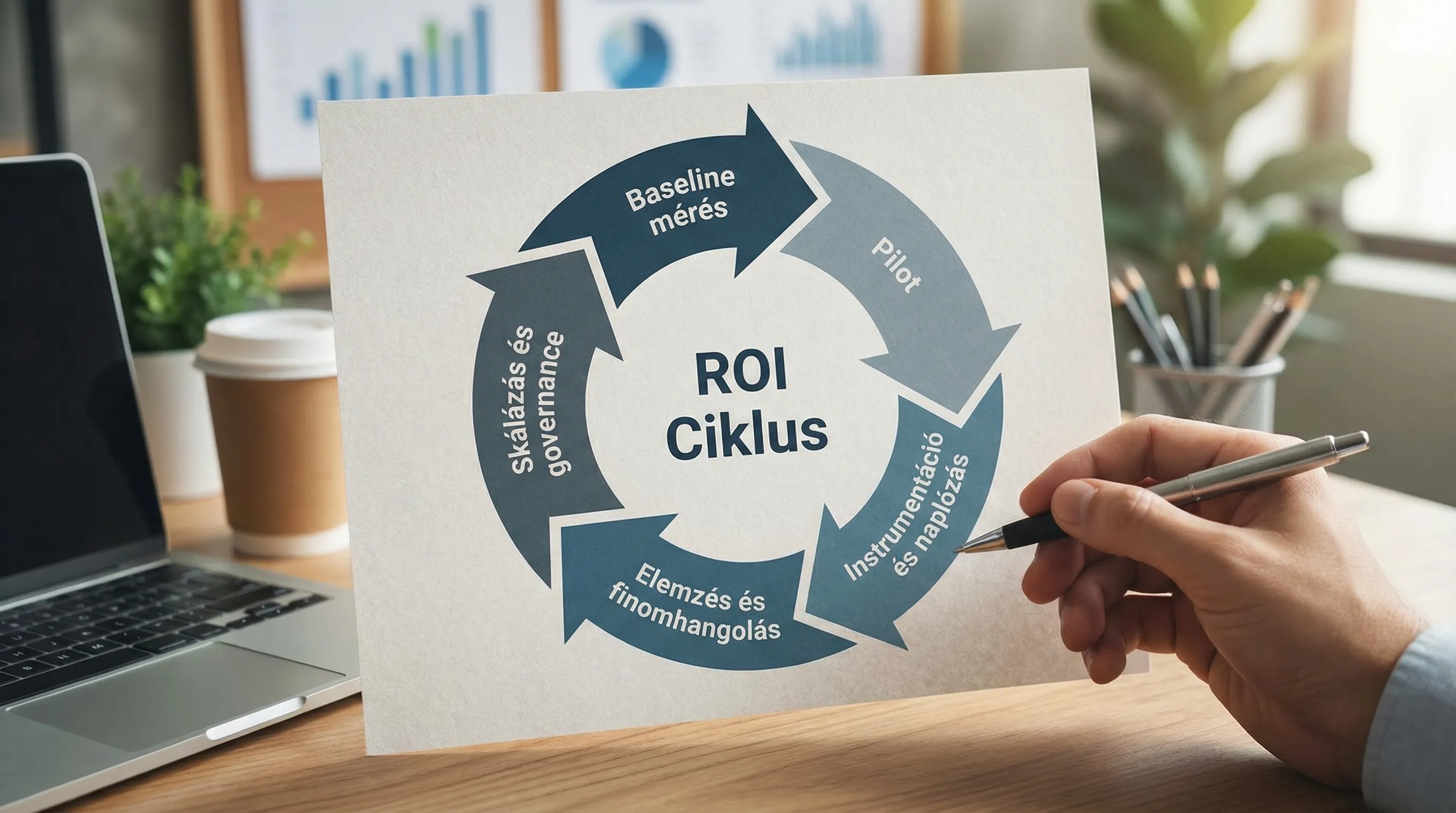
9) A 30-60-90 day ROI-focused implementation and measurement plan
The key to quick learning: measurability first, then smarts.
0-30 days: measurement basics and scope
Selection of 10-20 "top intents" based on volume and business value
baseline report: ticket count, AHT, FCR, CSAT, peak times
Closing data sources: ticketing, CRM, web analytics, logs
establishing definitions: what counts as containment, what counts as deflection
31-60 days: pilot and control
pilot launch with control group or holdout
dashboard: daily containment, escalation reasons, CSAT, "unknown intent" ratio
QA sampling: manual verification of conversations according to a predefined policy
61-90 days: fine-tuning and deciding on scaling
evaluating the top 3 KPIs and converting them into monetary terms
Cost control: model usage, channel load, operational SLO
scaling decision: new intents, new channels, deeper integrations
If you are interested in the general methodology of KPI planning (not just for chatbots), it is worth following this approach: Planning a digitalization project: goals, KPIs, risks.
10) Chatbot ROI will be stable when process and security are part of the equation
A corporate chatbot is not just a UI issue. For live operation, you typically need:
IAM and permission management (who can ask what, who can see what)
logging and auditability (incident tracking)
integrations (CRM/ERP/ticketing) so that the bot not only informs, but can also handle cases
DevOps/DevSecOps-style release and control (especially if the knowledge base changes frequently)
Related useful background: DevSecOps in practice: how to build secure CI/CD.
How can Syneo help you measure your return on investment?
Syneo focuses on corporate digitization and the implementation of AI solutions with measurable results. In chatbot projects, we can typically add the most value where ROI really matters:
use case and intent assessment (what are the 10-20 cases that really bring in money)
KPI and measurement plan with baseline, control, and dashboard requirements
integration planning and implementation (CRM/ERP/ticketing, process initiation)
security and compliance frameworks (data management, auditing, logging)
pilot approach and scaling decision support
If you are currently at the stage where "we want a chatbot, but management is asking for ROI," then it is worth starting the entire implementation as a measurable digitization project. A good starting point for this could be: Digitization in 2026: where to start? and typical questions about AI projects: Introducing artificial intelligence: frequently asked questions.