Agile or waterfall? Decisions on software development methodologies
Other
Agile or Waterfall? Choosing Software Development Methodologies | Syneo
A Guide for IT Leaders: When to Choose Waterfall, Agile, or Hybrid for ERP/CRM/AI and Integration Projects — Decision-Making Criteria, 7 Questions, and Practical Examples.
agile, waterfall, hybrid, software development, ERP, CRM, AI, project management, DORA, DevOps
March 10, 2026

The question “Which methodology should we choose?” is rarely a matter of religious debate. Rather, it is a risk management and decision-making framework: what do you know in advance, what don’t you know, how much will the change cost, and when must you deliver business value. In 2026, when ERPs, CRMs, AI components, and integrations come together within a single project, the reality is often that no single methodology prevails, but rather a deliberately designed hybrid.
The following guide will help you, as an IT manager, product manager, or procurement professional, make an informed decision between waterfall, agile (Scrum, Kanban), and hybrid approaches.
What is really at stake in this decision?
The choice of methodology has a direct impact on three areas:
Cost and scheduling: to what extent can you commit to a fixed deadline and a fixed scope?
Quality and compliance: To what extent must specifications, documentation, and validation be auditable?
Delivering business value: when you get a usable feature and how quickly you receive feedback.
Many organizations fall short because they adopt the methodology as a “package” (Scrum ceremonies, waterfall phases) without clarifying what should be fixed (time, scope, cost, quality) and what can change.
Waterfall: When Is It the Right Choice?
The waterfall model is the classic, phase-based approach: requirements, design, development, testing, and handover. It works well when the project is shaped by strong external constraints and change is costly.
Benefits of a Waterfall
A clearly communicated plan: it’s easier to agree on a fixed scope and milestones.
Documentation-focused: strong in audit, compliance, and supplier management.
It is easier to plan resources and costs when requirements are stable.
Common risks associated with waterfalls
Delayed feedback: Users often don’t realize what they’ve spent their money on until the very end.
Deterioration of alignment: the market, regulations, and business needs change over time.
Integration surprises: the actual system environment often doesn't become clear until it's too late.
Agile (Scrum, Kanban): When Is It the Right Choice?
The essence of the agile approach isn’t about having daily stand-ups and sprints, but about reducing risk through short cycles and measurable learning. It’s most effective when the problem is only partially understood and you want quick business feedback.
The Benefits of Agile
Early value extraction: usable parts are removed quickly.
Flexible scope: priorities may change based on learning.
Better product and UX alignment: user feedback is incorporated.
Typical risks of Agile
The "never finished" feeling: when there’s no good roadmap or Definition of Done.
Loss of control amid weak governance: when there are no limits on costs or scope.
Misunderstood agility: when an organization focuses on rituals but fails to prioritize.
To measure deployment capabilities, many teams use the DORA metrics (deployment frequency, lead time, MTTR, change failure rate); the DORA/Google Cloud State of DevOps report provides a good overview of this.
Agile vs Waterfall: A Quick Comparison
Consideration | Waterfall | Agile |
Requirements | Mostly upfront and stable | Gradual, learning-based |
Schedule | Can be planned in phases | Adaptive over iterations |
Change Management | Formal change request, more expensive | Backlog prioritization, more cost-effective |
Risk Assessment | Often, they don't come to light until it's too late | Early experiments, rapid feedback |
Documentation | Robust, scalable | Goal-oriented, “just what’s needed” |
Supplier Agreement | Lighter for a fixed scope | Easier on a T&M or outcome basis |
Ideal environment | Compliance, infrastructure, a well-known domain | Product development, changing needs, uncertainty |
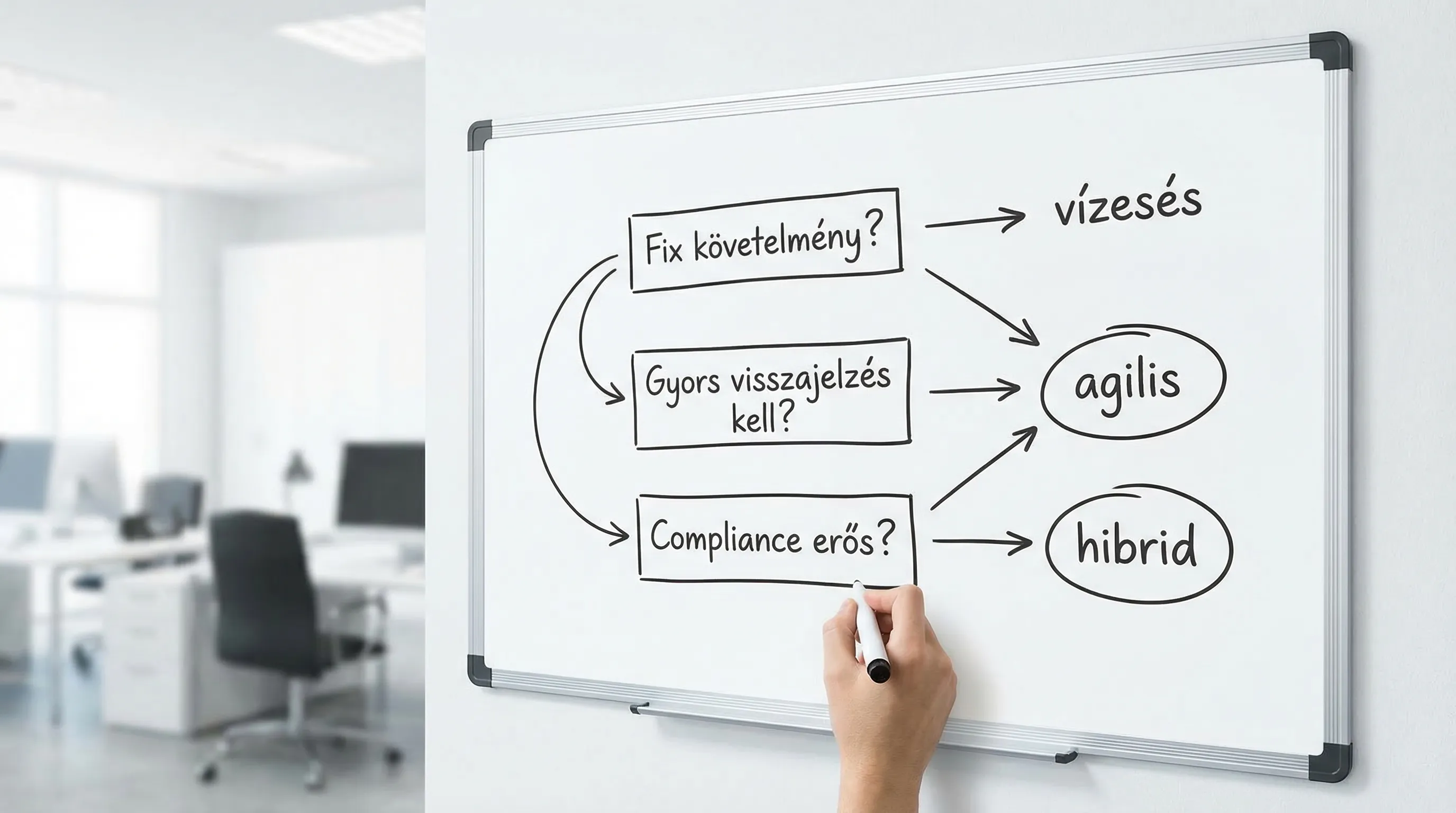
Decision-making framework: 7 questions that usually determine the outcome
The answers to the following questions almost always reveal which methodology (or combination) is the best fit.
1) How stable are the requirements over an 8–12 week period?
If there is a high probability that the direction will change within 2–3 months (due to new market demands, new management expectations, or a competitor’s move), an agile approach is preferable.
If requirements are stable and changes entail significant contractual or compliance costs, a waterfall or hybrid approach may be preferable.
2) What are the costs and risks associated with the change?
If a change involves "only" the UI and workflow, it is typically agile-friendly.
If the change affects the data model, interface, migration, or permissions, it will be costly. In such cases, it is advisable to incorporate more robust upfront planning and change control.
3) Can you effectively “break down” business value?
One of the keys to agile is whether the system can be built incrementally, delivering real value.
Example: It is easier to break down a web store (search, shopping cart, checkout, shipping) than a project where value is only created when “everything works together” (such as certain financial closing processes).
For an e-commerce business that works with seasonal content and collections, such as the Fabbrica Ski Sises online shop, iterative development delivers tangible business results because its impact can be quickly measured across campaigns, product pages, and checkout steps.
4) Are there strict compliance, audit, or validation requirements?
If so, that doesn’t mean “agile is off-limits.” Rather, it means:
There is a minimum documentation requirement,
testing and evidence (e.g., traceability) are not optional,
Releases must be managed in a controlled manner.
This is typically an agile + stage-gate or water-scrum-fall hybrid.
5) How accessible are the team and the stakeholders?
Agile doesn't work well without genuine product ownership decisions and rapid feedback.
If key stakeholders are only available once a month, a waterfall-style specification and formal handover are often more realistic, or at the very least, agile cycles should be spaced out.
6) Supplier arrangement: fixed scope or shared product liability?
Fixed scope, fixed price: waterfall or strictly scoped agile (strict change control).
Time and materials (T&M), outcome-based goals: more effective in an agile environment.
The key point is that the logic of the contract should not work against the methodology.
7) What is the biggest unknown?
If the greatest unknowns are technical in nature (integration, performance, data quality), then agile cycles such as prototypes, spikes, and pilots can mitigate the risk.
If the biggest unknown is the business side (whether the feature is actually needed and whether it will be used), then discovery and an early MVP are the way to go.
Typical scenarios in corporate projects
ERP, CRM, CMS: Implementation or Advanced Configuration
Such projects often require a hybrid approach:
upfront: processes, data model, integrations, access rights, clarification of minimum compliance requirements,
sprint/iteration: configuration and customization with incremental deliveries,
Go-live: waterfall-style cutover plan, hypercare, stabilization.
If you’re implementing a CRM system now, it’s worth keeping in mind that the methodology isn’t just a development issue, but also an adoption issue. (The CRM implementation checklist on the Syneo website may be helpful in this regard.)
AI components and data-driven features
With AI, uncertainty is typically higher (data quality, drift, measurability), so a simple waterfall plot is rarely ideal. Here’s where it works well:
short iterations,
measurement, baseline, guardrails,
controlled pilot.
If you're considering an AI pilot, Syneo has a detailed, practical guide to the 30-day roadmap: AI Pilot in 30 Days.
Infrastructure, Operations, DevOps Frameworks
If the goal is to build a platform, CI/CD, access control, logging, and security controls, waterfall-style upfront planning (architecture, policy, governance) is important, but the implementation is typically iterative.
"Hybrid" is not a compromise, but a design choice
In most corporate environments, the most useful question is this: which parts should be fixed in a waterfall-like manner, and which parts should be agile.
Common, functional hybrid models
Agile delivery + stage-gate: You deliver in sprints, but there are formal decision gates every quarter (budget, scope, compliance).
Dual-track (discovery + delivery): a separate focus on problem understanding and stable delivery.
Water-Scrum-Fall: upstream specification and downstream release control follow a waterfall model, while development is agile.
The hybrid works if you don't mix it "out of habit," but instead set it in advance:
what decisions are made and where,
what counts as finished,
what requires proof (test, document, approval),
how you handle change.
Minimum practical requirements for any methodology to work
Many projects fail not because of methodological issues, but because of a lack of common ground.
1) Clear objectives, metrics, and baseline
Regardless of the methodology, ask yourself: what constitutes success? Throughput? Error rate? Revenue? Customer service SLA?
A brief, executive-level measurement framework greatly improves the predictability of delivery. (Related Syneo article: Project Management in IT: How to Make Delivery Predictable.)
2) “Definition of Done” and quality gates
This is especially true for Agile, but a common minimum is also necessary for Waterfall:
The code review has been completed,
automated tests are running,
safety requirements are met,
The documentation has been updated (which is really necessary).
3) Integration and data at the beginning of the design process
Most of the "surprises" aren't in the UI, but in the data and the interfaces. Without an integration map and clear data ownership, both approaches will run into trouble.
Quick Decision-Making Chart for Managers
If that's true… | …then choose this |
Fixed deadline and rigorous audit; few changes are expected | Waterfall or stage-gate hybrid |
Product characteristics, rapid market learning, high uncertainty | Agile (Scrum/Kanban) |
ERP/CRM implementation with configuration and multiple integrations | Hybrid (upfront funding + iterative delivery) |
The biggest risk is data quality or integration | Agile risk-mitigation iterations, prototypes |
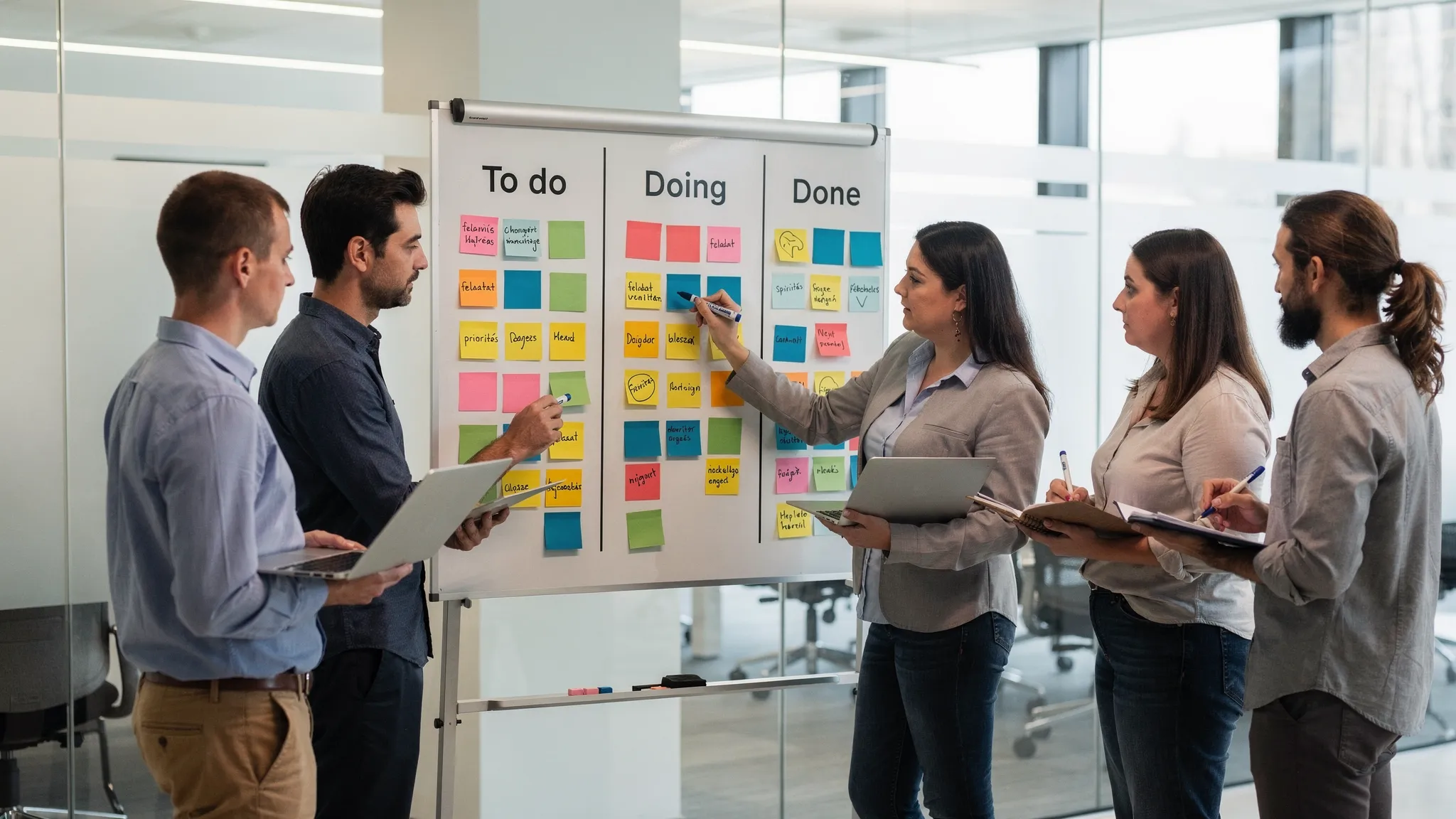
Frequently asked questions (FAQ)
Is Agile or Waterfall better? It depends on what the biggest risk is and how stable the requirements are. In a stable, audited environment, Waterfall or a hybrid approach is better; for uncertain product development, Agile is better.
Is it possible to run an agile project with a fixed budget? Yes, but usually only with strict parameters: a fixed timeline, priority rules, and formal change management are required; otherwise, the risk will be shifted “silently” between the parties.
Scrum or Kanban? If the work is more predictable, can be broken down into sprint goals, and maintaining a steady rhythm is important, Scrum is a good choice. If there are a lot of incoming tasks (such as support or development closely tied to operations), Kanban is often a more natural fit.
What usually causes agile implementations to fail? Most often, it’s due to a lack of decision-making authority (no true product owner), an overly broad scope, and the absence of quality gates. In such cases, technical debt quickly accumulates.
When should you choose a hybrid model? When you need both rapid iteration and formal governance (such as ERP/CRM, integrations, compliance, or go-live cutover), a hybrid approach is often the lowest-risk option.
Next step: a delivery system instead of a methodology
If your goal isn’t simply to “be agile,” but rather to deliver reliably (by balancing cost, deadlines, quality, and business value), then it’s worth tailoring the methodology to the contract, team operations, integrations, and compliance.
The Syneo team helps clarify objectives, governance, and delivery models (waterfall, agile, or hybrid) for IT and digital transformation projects, ensuring that the project is measurable and auditable. If you’d like a quick, practical assessment and recommendations for the lowest-risk approach, check out the options on the Syneo website or contact us for a consultation.