E-invoice storage: retention, access, audit trail
E-Invoice
E-invoice Storage: Retention, Access, Audit Trail | Syneo
Audit-compliant e-invoice storage: retention periods, metadata, integrity, access control, and audit trails to ensure quick verification during audits.
e-invoice, archiving, audit trail, retention, access management, RBAC, integrity, NAV, invoicing, digitization
April 11, 2026
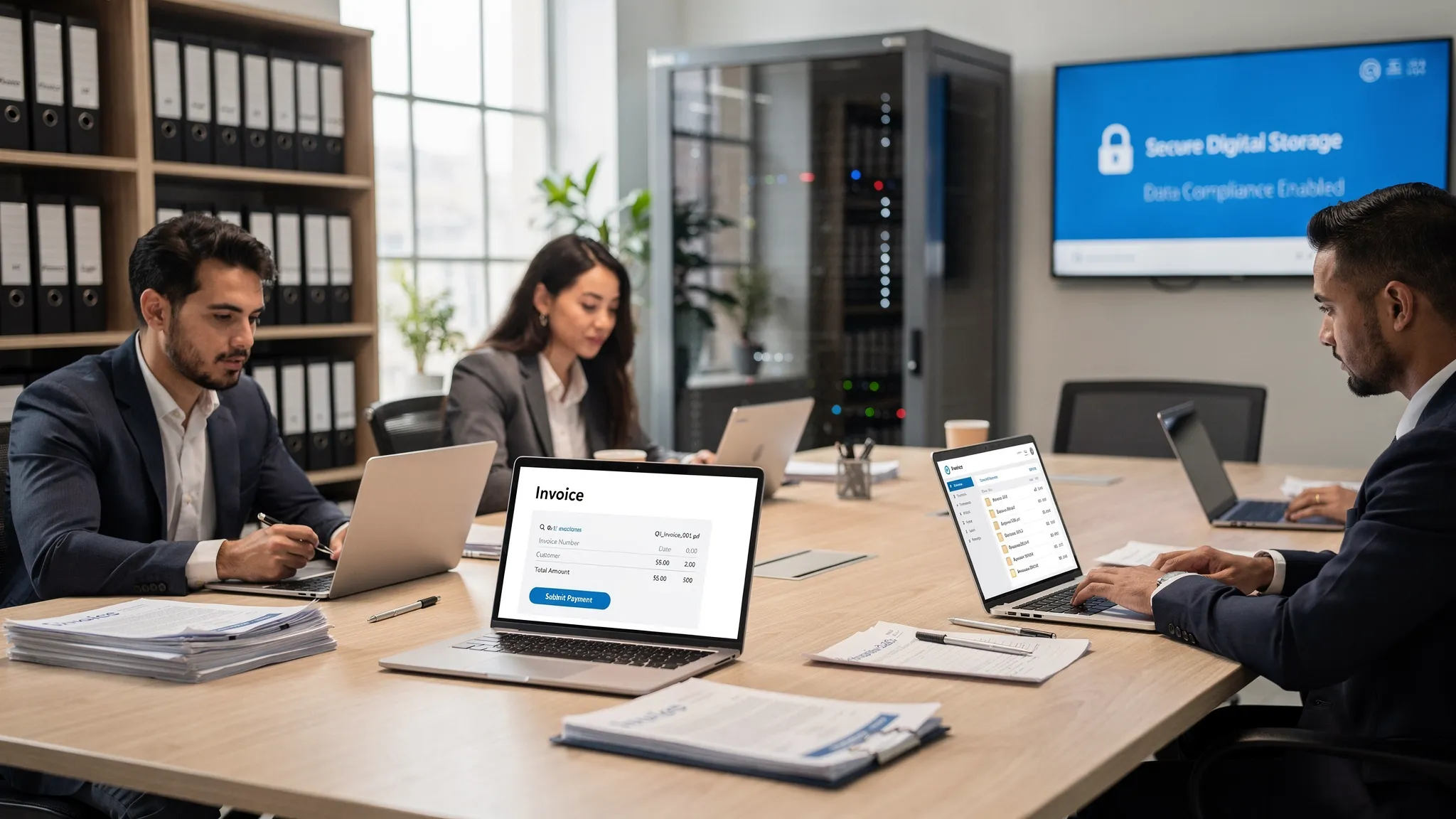
An e-invoice isn’t “complete” just because you’ve issued it and saved it to a folder. The real risk typically arises later: during an audit, when you need to quickly prove exactly which document is the original, who had access to it, whether any changes were made, and how the invoice’s journey unfolded (issuance → delivery → receipt → accounting → archiving). This requires not only retention but also access and an audit trail.
This article provides a corporate, audit-ready framework for the topic of e-invoice storage: what needs to be retained and for how long, how it should be retrievable, and what technical and process controls provide the audit trail required by an auditor or a tax authority audit.
What does storing e-invoices mean in practice?
Storing (or, more accurately, archiving) e-invoices is not merely a matter of “file storage.” The goal is to ensure that the invoice remains available until the end of the retention period:
remain readable (including in a format that humans can understand),
be intact (demonstrably unchanged),
can be reliably linked to its creation and the issuer (authenticity of origin),
be readily available during an inspection,
and all of this must be done in an auditable manner (logging of access, operations, and exports).
For most companies, the problem isn’t that “the PDF isn’t available,” but rather that:
invoices are generated in multiple systems (invoicing, ERP, e-commerce),
there is no consistent identification and search logic,
archiving cannot be verified (no log, no integrity protection),
The process of producing the document during an audit is too labor-intensive.
Retention: What, for how long, and with what evidence?
What is the retention period?
In Hungarian corporate practice, there is a mandatory retention period —typically eight years—for documents supporting accounting entries (such as invoices). The exact interpretation may depend on the industry, the type of document, and internal policies, so it is advisable to confirm accounting and tax compliance tailored to your specific situation.
For reference:
It is advisable to verify the principle of accounting record retention within the context of the Accounting Act (for example, using the National Legislation Database search tool),
The requirements related to tax audits can be easily tracked through the NAV’s guidance materials and system documentation (for example, within the Online Invoice ecosystem).
What actually needs to be preserved?
When storing e-invoices, the term “invoice” can refer to multiple entities, and it matters which one is considered the primary one:
Structured e-invoice (typically in XML format, following the EN 16931 standard): many systems process this automatically.
Preview image (PDF or HTML): This is what people read; it is common even in disputed situations.
Related metadata: account number, dates, partner IDs, system IDs, statuses.
Supporting evidence: digital signature, timestamp (if used), hashes, and delivery and receipt records.
If you plan to transition to structured e-invoicing (EN 16931) around 2025–2026, it is particularly important that your storage solution not rely solely on a “pretty PDF.” Official background on EN 16931: European standard EN 16931 (eInvoicing).
Retention requirements: minimum standards (from a corporate perspective)
Requirement | What does the auditor ask? | What makes it defensible? |
Readability | Will you still be able to open it in 6–8 years? | Standard format, preview image, migration plan |
Innocence | Can it be proven that it has not been altered? | Hash, signature/timestamp, or WORM/immutability + log |
Authenticity of the source | Who organized it, and how? | System checks, permissions, integration logs |
Traceability | Can it be produced on a per-order basis within 1–2 hours? | Indexing, unique identifiers, searchable metadata |
Safety | Who has access, and on what basis? | RBAC, MFA, SoD, audit log, regular review |
For more in-depth technical content (internal reading material):
Access: How can it be fast, secure, and auditable?
During audits, it is typically expected that you will be able to produce documents and related data on short notice. If the search and export process relies solely on one person’s memory, or if you’re manually sifting through your email, it’s not only slow but also risky.
Minimum access model for the e-invoice archive
It is advisable to define roles and apply the principle of least privilege:
Finance (viewing + exporting), limited admin
Accounting (reading + accounting statements)
Auditor (periodic, read-only, logged export)
IT/Operations (technical admin, with limited access to content where possible)
We have a separate article on basic security practices (MFA, RBAC, logging, technical users): E-invoice Login: Access Management and Basic Security Practices.
What makes access "audit-proof"
Not because there is a password, but because it can be proven after the fact:
who came in,
what was he looking for,
what he opened,
what it exported,
and whether there has been any mass downloading or unauthorized access attempts.
In practice, this involves logging, alerts, and regular reviews (e.g., quarterly authorization reviews).

Audit trail: What should a good e-invoice archive include?
The essence of an audit trail is that the entire lifecycle of a document can be traced. It is not just the document that matters, but the process: how it was created, how it was received, and who did what with it.
What kinds of events should you log?
A minimum set of events for audit-friendly purposes:
Invoice received (channel, date and time, technical ID)
Validation completed (result, error code, version)
Posted to accounting (ERP transaction ID)
archived (archive object ID, hash, version)
Open/View (user, date and time)
export/download (user, scope, date and time)
Change in permissions (who granted them to whom and why)
A simple example: what should a blog post look like?
Field | Example | Why is it important? |
Invoice ID | HU-2026-000123 | Unique link |
SourceSystem | ERP / Billing System | Proof of origin |
Event Type | ARCHIVED | Life cycle event |
Timestamp (UTC) | April 11, 2026, 7:22:10 PM | Chronological order |
Actor | user:eva.kovacs | Responsibility |
ObjectHash | SHA-256:… | Innocence |
StorageObjectID | archive://… | Search |
If you use both digital signatures and time stamps, it’s worth familiarizing yourself with the eIDAS framework. Official source: eIDAS Regulation (EUR-Lex).
Where to store it? (On-premises, cloud, service provider) decision-making framework
The "best" solution depends on the company. When making a decision, it’s better to focus on verifiability rather than technology.
Model | Advantage | Typical risk | When is it a good choice? |
On-premise DMS/archive | Full control, self-managed keys | Operational burden, updates, DR | With strict internal IT policies and robust operations |
Cloud Object Store + Immutability | Scalable, WORM-compliant, cost-effective archiving | Incorrect IAM configuration, lack of key management | If there is a cloud-based baseline (IAM, logging, backup) |
Billing/archiving service provider | Quick start, less internal load | Vendor lock-in, export restrictions, and audit log limitations | For SMEs, provided that export and record-keeping are clearly specified in the contract |
Regardless of the model, the key question is: will you receive a set of supporting documents that you can quickly provide during an audit (invoices + metadata + audit log extract)?
Common mistakes that tend to cause problems during audits
"Archiving" PDFs received via email in an inbox: no unified index, no integrity protection.
Manual renaming and folder organization: human error, duplication, missing items.
There is no link to the ERP accounting entries: the invoice exists, but the accounting trail cannot be verified.
Insufficient retention period for logs: invoices are retained for 8 years, but access and event logs are only retained for 90 days.
“Everyone is an admin”: no clear division of responsibilities, no accountability.
Rapid Implementation Plan: An audit-ready foundation in 2–4 weeks
Once e-invoicing is already in place, setting up e-invoice storage can typically be handled as a short, focused project:
Week 1: Scope and Evidence
Establishing retention and access requirements (at the internal policy level)
Definition of “audit pack” (what you submit during an audit)
system map (where the invoice comes from and where it goes)
Week 2: Identifiers, metadata, discoverability
Uniform InvoiceID and source system identifiers
required metadata fields
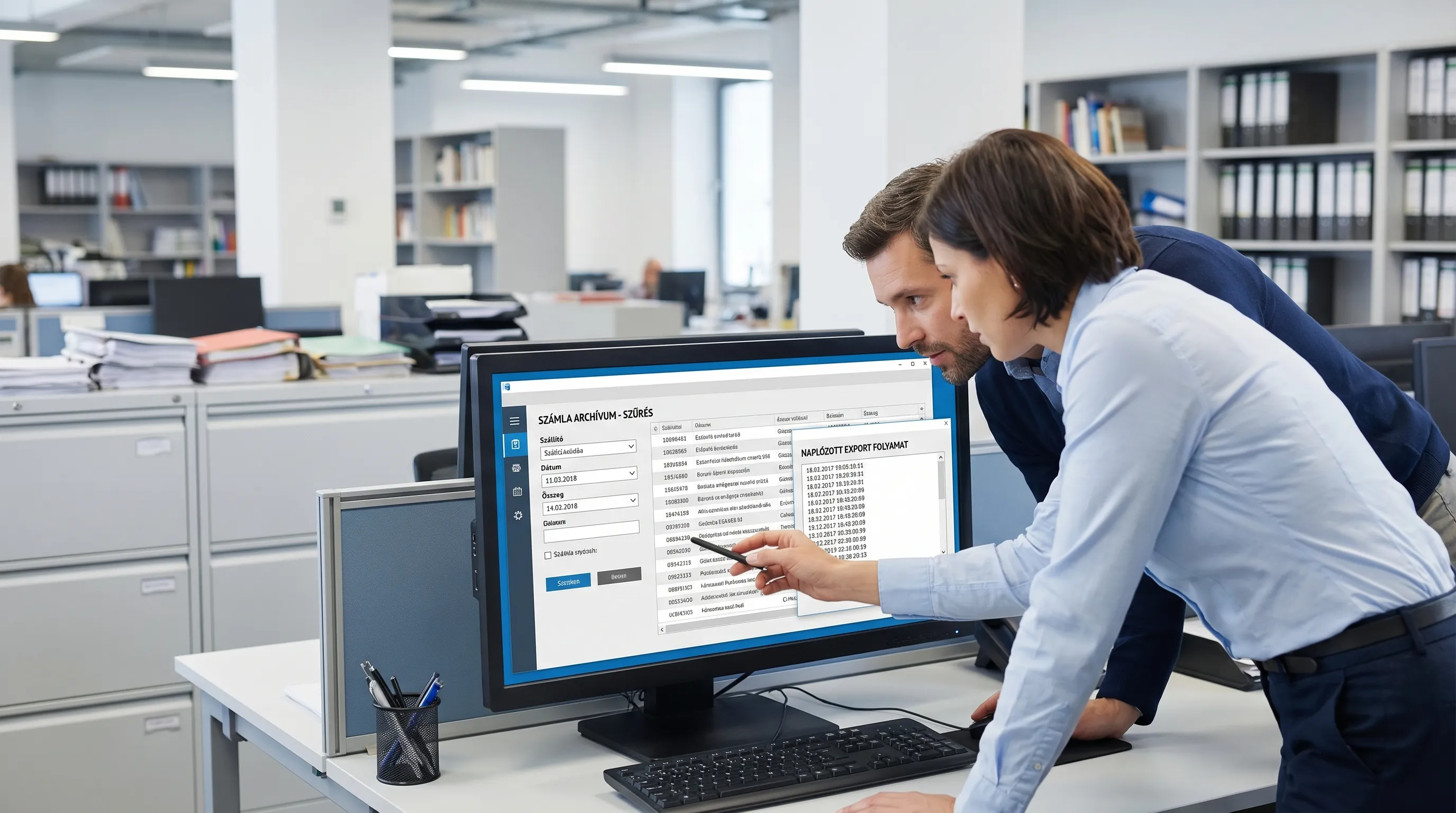
Search and export process (who, how, using which log)
Weeks 3–4: Integrity, Logging, Authorization
immutability/WORM or cryptographic integrity (hash, signature, timestamp, where appropriate)
RBAC + MFA + Permission Review Schedule
Log retention period and access
If you’re looking at the bigger picture (AP automation, OCR, ERP integration), it’s worth considering the entire process: digitizing accounting—from e-invoices to the general ledger.
Frequently asked questions (FAQ)
How long must e-invoices be retained in Hungary? In business practice, the retention period for invoices is typically 8 years, but the exact interpretation depends on your company’s specific circumstances; it is advisable to document accounting and tax compliance requirements in internal policies.
Is it enough to just save the PDF to a folder? Rarely. During an audit, the integrity, traceability, and audit trail are just as important as the document itself. The “folder + manual name” approach is typically not defensible.
Is a digital signature required to archive e-invoices? Not always. In many cases, secure process controls (immutable storage, logging, access control) may be sufficient instead of a signature. To help you decide, see: Digital signatures for electronic invoices: Will they be required in 2026?
What is an audit trail? It is a recorded sequence of events that tracks the lifecycle of an invoice (receipt, validation, posting, archiving, access, exports) and verifies that no unauthorized modifications have been made.
How can I prepare so that I can quickly produce invoices during an audit? Index them with metadata (partner, date, amount, InvoiceID), set up a standard export, and implement logging that also records the export. The goal is to ensure this isn’t an ad-hoc search, but a repeatable process.
How can Syneo help with this?
If e-invoicing is already in place but the storage, access, and audit trail for e-invoices are not fully integrated, a brief assessment and a targeted implementation plan will typically yield the fastest results.
The Syneo team supports companies in IT and information security projects, such as:
Clarification of archiving and access management requirements (audit pack, policy, roles)
System and integration overview (ERP, invoicing, DMS, NAV integrations)
Implementation of auditable logging and controls (RBAC, MFA, log retention)
Practical implementation support and vendor coordination
To get started, check out the related resources or contact us at https://syneo.hu to schedule a brief, targeted review of your current invoicing process.