Digitization of accounting: automation from e-invoicing to general ledger
Digitalization
Digitization of accounting: automation from e-invoicing to general ledger | Syneo
Automate your accounting from e-invoices to the general ledger: invoice receipt, OCR/AI-based validation, approval, automatic account assignment, ERP integration, and KPIs with 30-90 day pilots.
digitization, e-invoicing, accounting, automation, OCR, AI, ERP, integration, AP, KPI
February 12, 2026
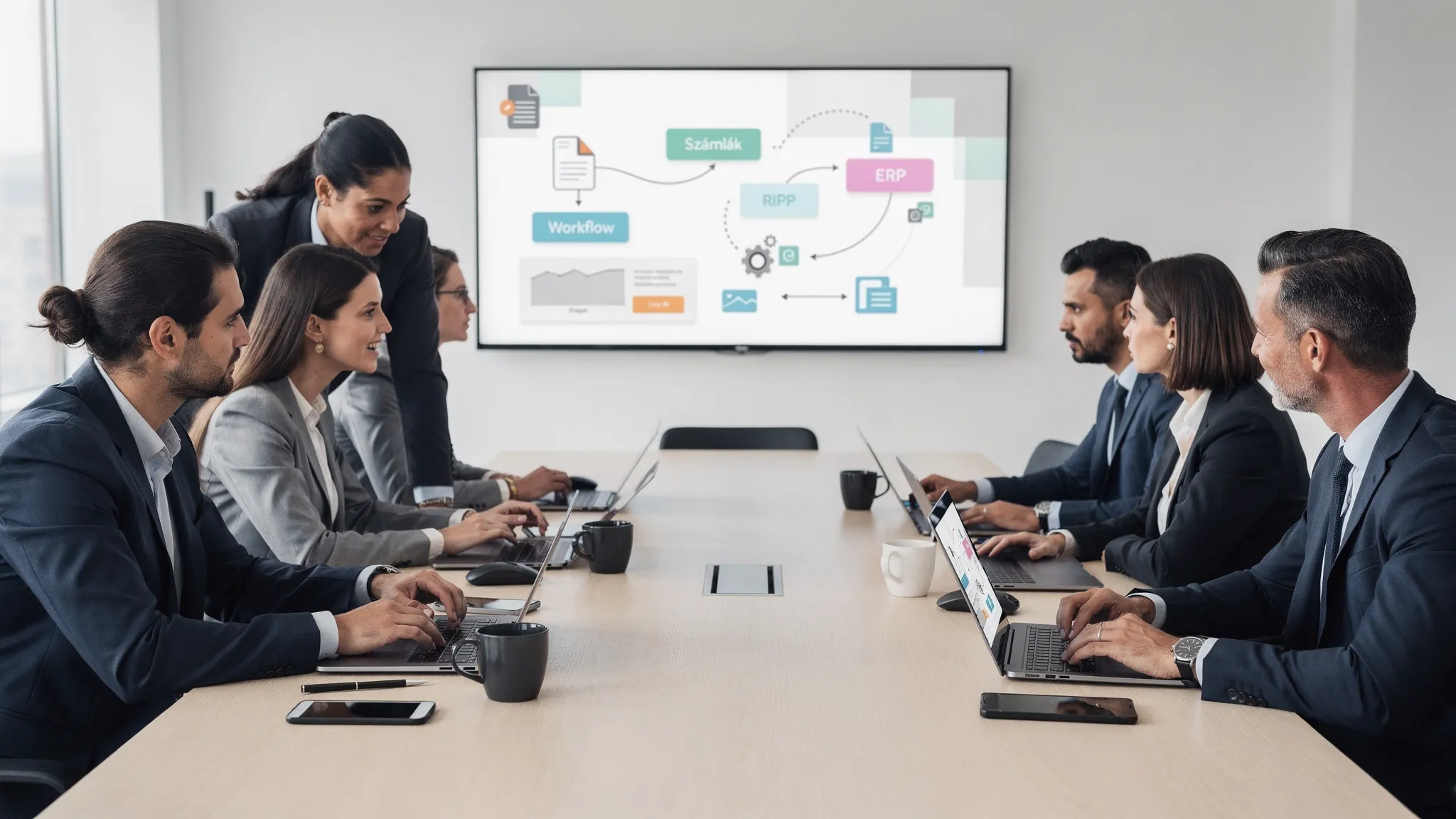
In accounting, "digitization" has long meant scanning paper documents and then manually recording the data. In 2026, this will no longer be enough. The real value comes when the data from e-invoices (or digitally received invoices) is automatically and verifiably converted into approved receipts, accounted items, reconciled bank transactions, and finally general ledger entries with an auditable trail.
This article guides you through how automation is structured "from e-invoicing to general ledger," what technological elements are required, what the typical pitfalls are, and what KPIs can be used to demonstrate return on investment.
What will the digitization of accounting mean in 2026?
The digitization of accounting is not a single software program, but rather a chain of interconnected processes. Its goal is to enable financial administration to:
be faster (shorter turnaround time from receipt to posting),
be more accurate (fewer manual errors),
be more controllable (authorizations, approvals, audit trail),
comply with legal and audit requirements (e.g., preservation, integrity, logging),
integrate into corporate systems (ERP, banking, document management, BI).
An important distinction: digitization only truly works if the data is digital from the moment it is created, not just converted to PDF at the end. This is why e-invoicing and EU standardization (e.g., EN 16931 and the PEPPOL ecosystem) have become central topics. On the Hungarian side, the focus is on the NAV online data reporting environment and related processes.
If you are interested in learning more about the regulatory and technical background of 2026, we recommend reading Syneo's summary: E-invoicing 2026: what every entrepreneur needs to know.
From e-invoicing to general ledger: the ideal automated process
At most companies, it is worth treating two major routes separately:
Incoming invoices (AP, suppliers): this is where the manual workload is greatest (receipt, approval, posting, payment, reconciliation).
Outgoing invoices (AR, customer): discipline and compliance (invoicing, data reporting, receivables management, bank reconciliation) are key here.
The term "ledger" is most painful on the AP side: if incoming receipts are quickly and accurately converted into accounting entries, closing is accelerated and financial forecasting is improved.
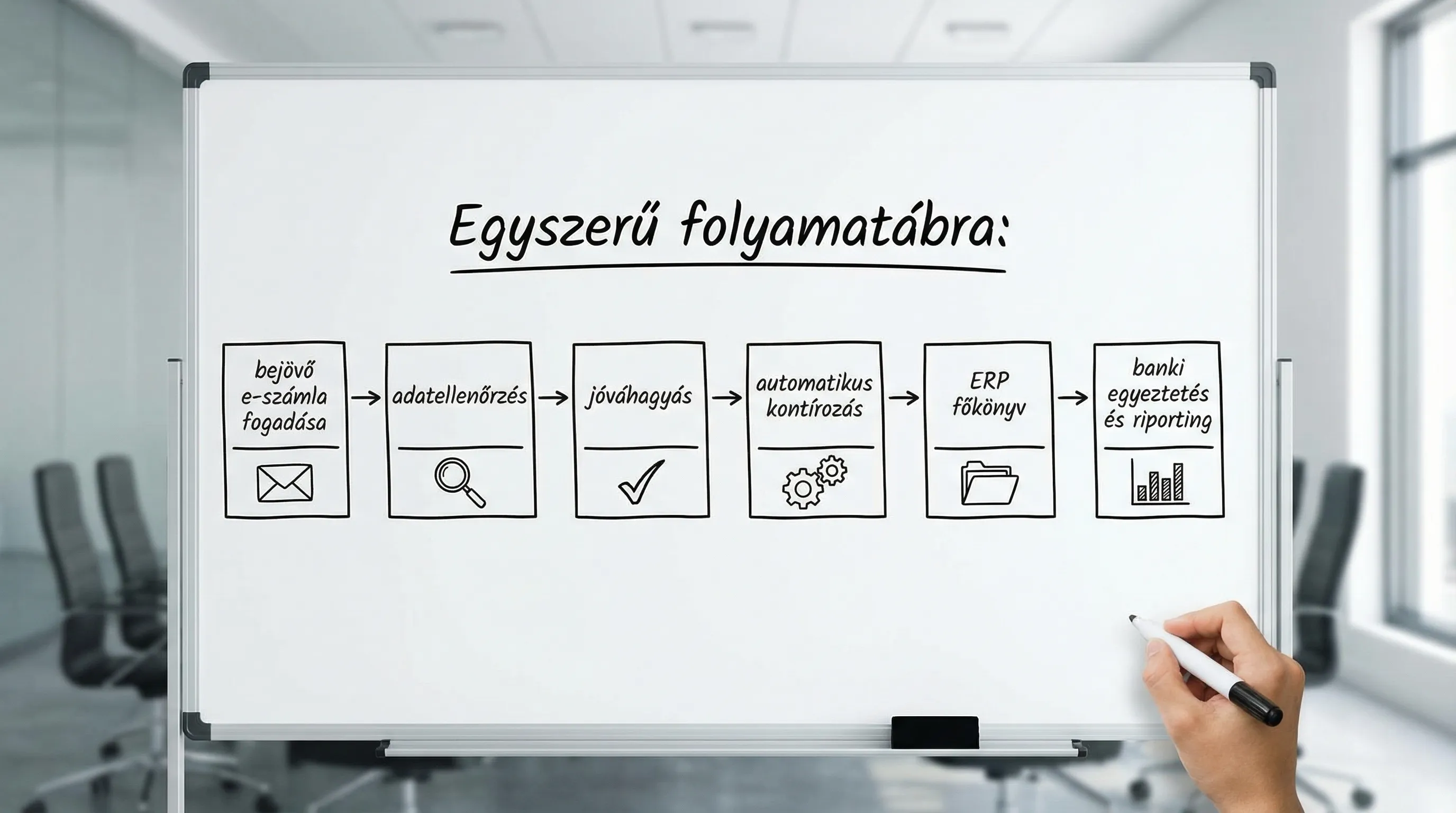
1) Invoice acceptance and channel management
The first "bottleneck" of digitization is reception. Typical channels:
structured e-invoice (XML) or service provider portal
e-mail attachment (PDF, possibly hybrid)
EDI, PEPPOL
paper (as an exception)
The goal is to have a single point of entry and to assign the invoice a case ID, which can be used to track its entire journey.
2) Data extraction and validation (quality gate)
The next step is to retrieve and verify the billing information:
mandatory fields (supplier, dates, amounts, VAT rates)
formal and logical checks (gross = net + VAT, currency, fulfillment date)
supplier master data match (tax number, bank account)
duplication check (the same invoice should not be processed twice)
This is where the true value of AI, OCR, and rule engines comes in: not in "recognizing" the invoice, but in building a quality gate. If validation is weak, automation only produces errors faster.
3) Approval workflow and permissions
Accounting automation is not just about finances. Most incoming invoices require professional approval (customer, cost center manager, project manager). The goal:
Predefined approval routes (based on amount, cost center, supplier)
substitutions and deadlines
mandatory comment/justification for exceptions
logging (who approved what and when)
This step often speeds up the process more than the data extraction itself.
4) Accounting and automatic accounting entries
"Accounting" is the biggest professional bottleneck because it requires the following at the same time:
accounting logic,
company-specific rules,
and high-quality master data (ledger numbers, cost centers, projects, VAT handling).
Typical automation solutions:
rule-based accounting (based on supplier, item type, cost center, order)
PO-based accounting (2-way or 3-way match: order, receipt, invoice)
AI-supported account proposal (pattern recognition from previous items)
The bottom line: automatic posting always requires exception handling, and you need to define what can be entered into the general ledger in a "touchless" manner.
5) Integration with ERP and general ledger
The general ledger will be a "source of truth" if accounting entries are received in a standardized manner:
API integration (ideal)
middleware/iPaaS (if transformation between multiple systems is required)
RPA (if integration is not possible, but temporarily necessary)
This is where it will be decided whether digitization will be sustainable. Too much RPA is fast, but fragile in the long run. APIs are more stable, but require preparation.
6) Bank statements and reconciliation
The story does not actually end with the "ledger": the movement of money confirms the process. Valuable automatisms:
automatic bank import
Matching customer invoices and incoming transfers (message, reference, amount, partner)
reconciliation of supplier payments
list of exceptions (partial payment, deviation, incorrect notification)
The digitization of accounting provides spectacular ROI here: less "hunting," faster receivables management, and a clearer cash flow picture.
7) Closing, reporting, and audit trail
The goal is not to "get it booked faster," but rather to:
close your finances faster and with less stress,
the entire chain (document -> approval -> item -> payment) must be traceable,
closing adjustments should be reduced.
Technological building blocks: what should be put together with what?
Most companies don't rely on a "know-it-all" system to solve everything, but rather a targeted stack.
Building block | What does it do in practice? | Typical decision-making criteria |
E-invoicing / invoicing system | Outgoing invoices, data reporting, formats | Legal compliance, integrations |
Invoice recipient + AP automation | Processing incoming invoices, workflow, exceptions | Touchless ratio, audit trail |
DMS / archiving | Preservation, versioning, retrieval | 8-year preservation, integrity |
ERP finance + general ledger | Accounting, VAT, closing, controls | Master data quality, reporting |
Integration layer (API, iPaaS, middleware) | Connecting systems, transformation | Stability, scalability |
AI/OCR + rule engine | Data extraction, validation, recommendations | Accuracy, exception handling |
The good news: you don't have to implement everything at once. The bad news: without integration and a data foundation, partial solutions will quickly hit a wall.
Security, compliance, and controls: this is what makes it audit-proof
The most common misconception in financial digitization is that "if it's automatic, it requires less control." In fact, automation is only secure if it operates with built-in controls.
Key areas:
Authenticity and integrity: the document must remain unchanged and its origin must be verifiable.
Retention and retrievability: in addition to legal retention requirements, audit questions must also be answered.
Authorization management (SoD): who can record, who can approve, who can pay.
Logging: logging events, modifications, approvals.
The security aspect of e-invoices should also be taken seriously. A practical, Hungarian-focused summary can be found here: E-invoice security: protect your customers' data.
Integration patterns: how to connect without breaking?
The digitization of accounting typically consists of "many small integrations." Some proven examples:
Sample | When is it good? | Risk |
Direct API to ERP | Few systems, clean data model | Impact of ERP-side changes |
Middleware/iPaaS layer | Many sources, different formats, expansion expected | Poorly defined data mapping will be costly |
RPA (transitional) | No API, quick workaround needed | Fragile, sensitive to UI changes |
Success often depends not on technology, but on:
who is the master data owner (supplier, cost center, project),
where "the source of truth" (ERP vs. other systems),
and how error handling is defined.
The 30-60-90 day approach: how to get started without risk?
Many companies don't take action because the project seems too big. However, accounting automation can be easily piloted.
Time slot | Realistic goal | Typical output |
0-30 days | Process and data mapping, baseline | process diagram, exception list, KPI baseline |
31-60 days | Pilot for some of the incoming invoices | workflow, automatic validation, first-time accounting rules |
61-90 days | Integration stabilization, extension | ERP accounting with automated entries, report on touchless ratio |
The Syneo framework approach is also linked to the logic of rapid, measurable digitization, which helps avoid the trap of "buying a tool and then something will happen": corporate digitization step by step.
KPIs that will satisfy both finance and management
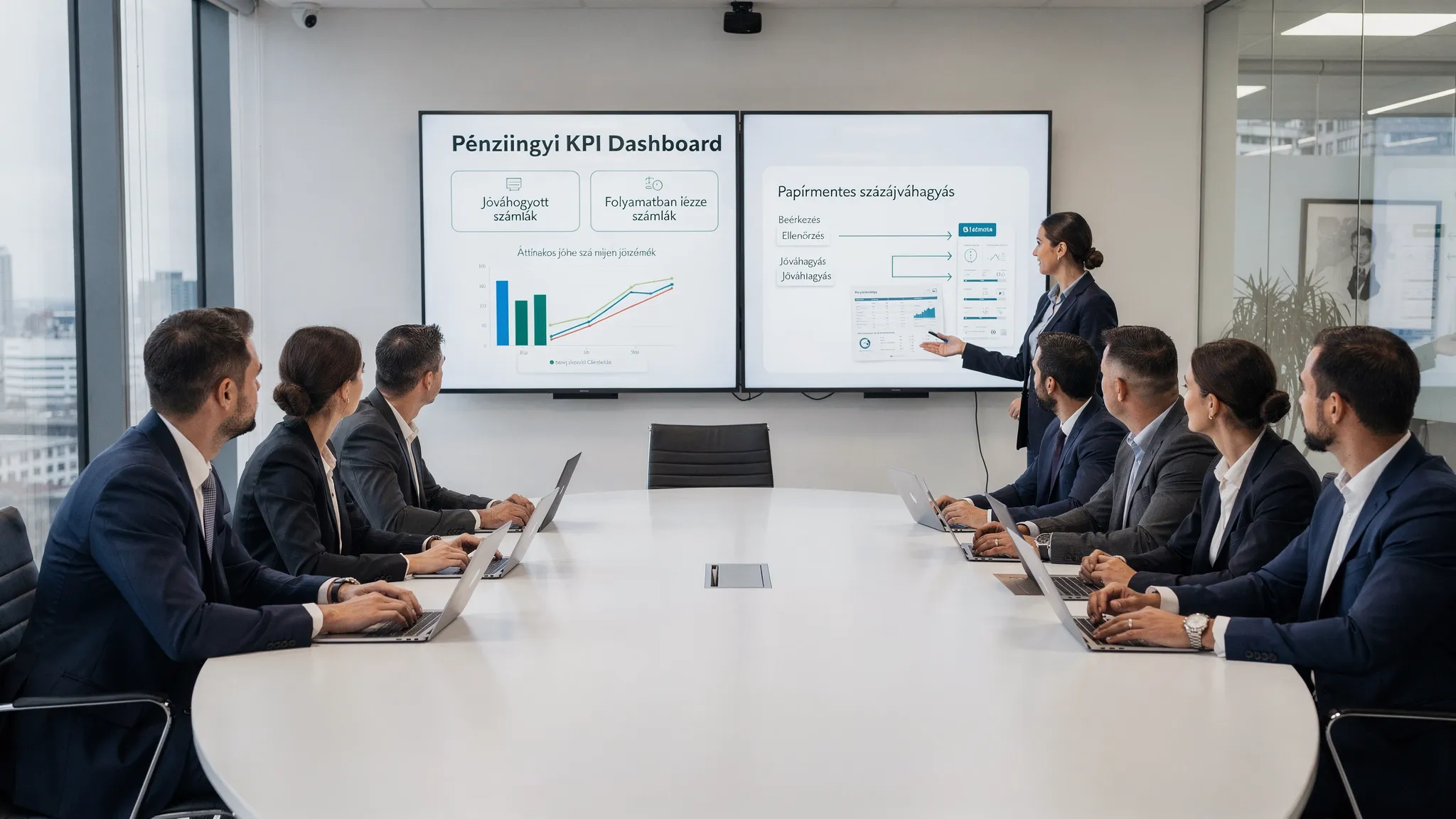
Automation is easy to promise, but harder to prove. The most useful metrics are:
Processing time (from receipt of invoice to accounting and payment)
Touchless ratio (how many invoices were processed without human intervention or with minimal verification)
Exception rate and reasons (PO shortage, discrepancy, incomplete data)
Error rate (incorrect VAT, wrong partner, duplication)
Closing time (how many days until month-end closing)
Outstanding receivables / DSO and supplier side DPO (not only financial but also operational impact)
KPIs work when there is a baseline, a target value, and someone responsible. A good project plan and risk management can also help with this, see: Planning a digitalization project: goals, KPIs, risks.
Common pitfalls (and how to avoid them)
The "the system will take care of it" attitude
If exception handling, workflow, and responsibilities are not clearly defined, automation will only accelerate the chaos.
Master data debt
If the supplier database is incorrect (tax numbers, bank accounts, addresses), validation and accounting will also be incorrect. Digitization is often also a "data hygiene project."
Overuse of RPA
RPA can deliver quick results, but API-based integration is generally better at the strategic level. Especially in an ERP environment.
Safety after the fact
This is particularly dangerous in finance. Authorizations, logging, archiving, access: these need to be in the plan at the outset, not after go-live.
How can Syneo help with the digitization of accounting?
Automation from "e-invoicing to general ledger" typically affects several areas at once: finance, IT, security, integration, and data quality. In such cases, the greatest value often lies not in selecting a single tool, but in developing a realistic target architecture and implementation plan that fits into the existing ERP/CMS/CRM environment.
Syneo provides support to companies that want to modernize their accounting processes:
process and system assessment (where are the biggest losses, where is the fastest ROI),
integration and automation design (API, workflow, exception handling),
custom development, if boxed solutions do not cover the actual need,
incorporating information security and compliance considerations.
If you wish, the next step could be a short, targeted survey and a 90-day pilot plan that already includes KPIs and controls. For more information about the company's services, visit Syneo.hu.