Digitalization tender 2026: what should you spend it on to get a real return?
Digitalization
Digitalization tender 2026: what should you spend it on to really get a return on your investment? | Syneo
Make good use of the resources available under the Digitalization 2026 program: focus on integration, data quality, administrative automation, and training. Pilots, KPIs, and measurement ensure a return on investment.
digitalization, tender, ROI, integration, automation, CRM, ERP, AI, cybersecurity, change management
February 14, 2026

Digitization alone is no guarantee of return on investment. Money can easily be spent on "boxes" (licenses, devices) while processes, data, and teams remain fragmented. In 2026, however, the key to success is often simple: invest in capabilities that measurably accelerate work, reduce errors, and connect your systems.
This article will help you not only spend your 2026 digitization grant, but also turn it into ROI (return on investment). This is not legal advice on grants; in all cases, the official documents of the call for proposals are authoritative, but the logic of return on investment works regardless of industry.
First, clarify: how does a digitization investment "pay off"?
In practice, returns come from three channels. If your project proposal cannot tangibly capture at least one of these, there is a high chance that it will be "nice, but not useful."
1) Time savings (capacity release)
Typical examples: automated invoice processing, document workflow, automated quotation creation in CRM. Here, the key to return on investment is the time measured (baseline and follow-up measurement).
2) Error reduction (rework, complaints, rejects, financial discrepancies)
Typical examples: uniform article master, ERP integration, approval cycles. Here, the key to return on investment is the error rate and the cost of error correction.
3) Cash flow and revenue (faster invoicing, higher conversion, better pricing)
Typical examples: e-invoicing and automated receivables management, sales pipeline organization, inventory optimization.
If you want KPI ideas and measurement logic, Syneo's guide to goals and metrics is a good starting point: Planning a digitalization project: goals, KPIs, risks.
Best investments in 2026: a combination of "funds" and "quick profits"
Many tender projects fail because they aim too high (ERP replacement, AI, automation) without a stable foundation. In 2026, the most effective approach is generally a two-track portfolio:
Quick profits within 30–90 days, which finances confidence and the next steps.
Fundamentals (data, integration, security), without which future developments will be expensive and fragile.
In connection with this, it is also worth reviewing Syneo's 90-day approach: IT solutions for SMEs: quick profits in 90 days.
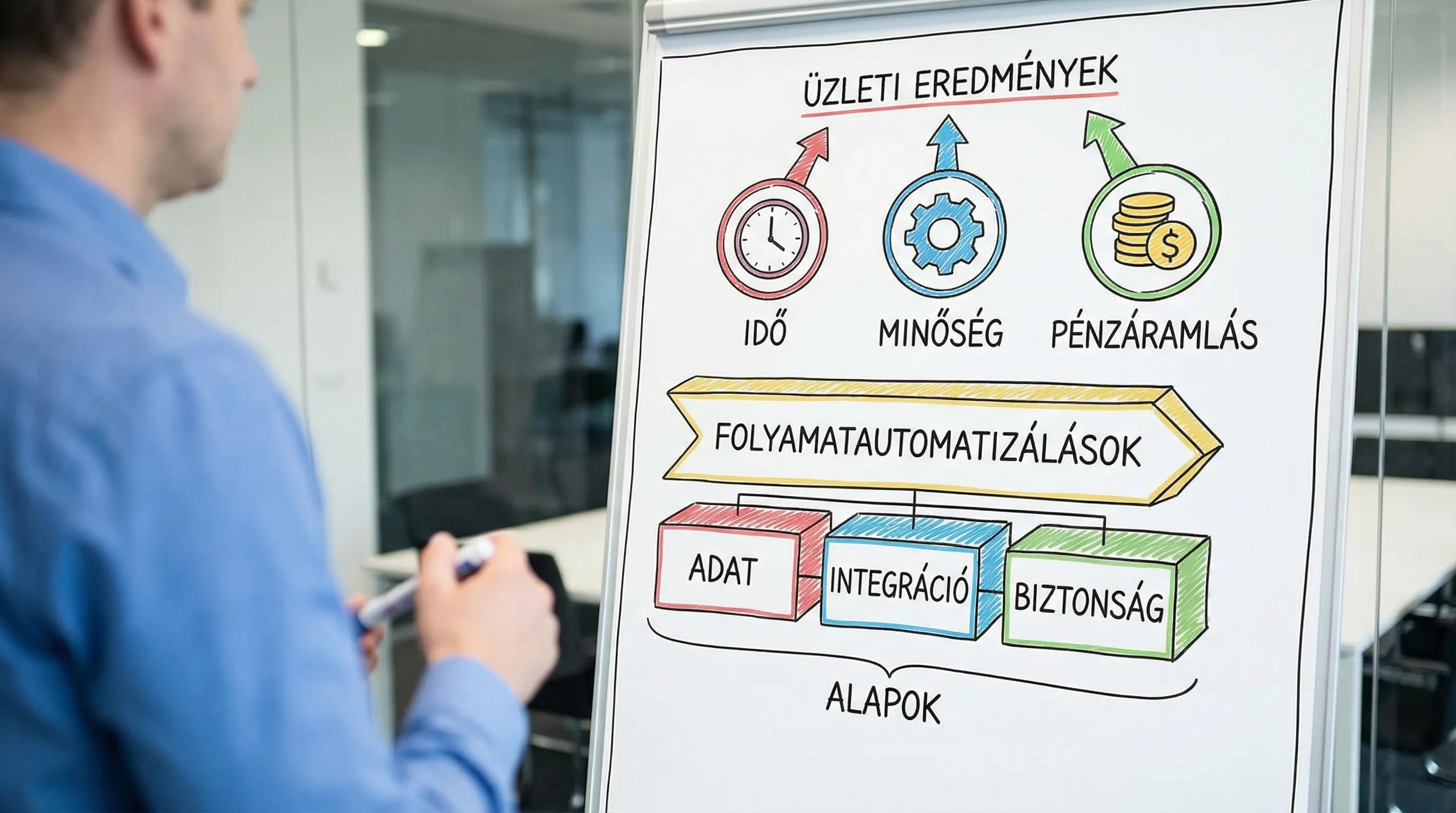
How should you spend your digitization grant to ensure a real ROI?
The following areas work well in a grant environment because they provide tangible deliverables and their impact can be measured.
1) Integration and data: the most common "hidden" return on investment
If you have multiple systems (invoicing, webshop, CRM, ERP, warehouse, manufacturing, HR), money is often wasted because data is transferred manually. Integration is not spectacular, but it often accounts for 30-60 percent of a project's ROI.
What is worth financing here:
Integration between systems (APIs, data connections)
Uniform master data (customer, item, price, partner)
Basics of reportability (reliable data sources, uniform definitions)
Deceptive trap: buying a BI dashboard when the source data is inconsistent. In this case, the report looks "nice," but it is not true.
2) Document and financial administration automation (e-invoicing, approval, archiving)
In 2026, e-invoicing and electronic document management will not only be a matter of convenience, but increasingly a matter of compliance and efficiency.
The fastest-paying-off items are typically:
E-invoicing process (issuance, acceptance, statuses)
Approval workflow for invoices and contracts
Archiving and retrievability
Syneo's summary may be useful for related background information: E-invoicing 2026.
3) CRM and sales: fewer "invisible losses"
In many companies, revenue is not lacking because there is no interest, but because:
the tracking breaks down,
no uniform customer profile,
offers, tasks, follow-up in Excel,
There is no pipeline discipline.
A well-implemented CRM is not "software" but an operating system. If you are unsure whether CRM or ERP development will bring faster results, it is worth taking a look at this framework: CRM vs ERP: which system do you need?
4) ERP, production, and operations: spend where the bottleneck is
Many people apply for ERP, warehousing, and production data, but the return on investment only comes if the selection and implementation are focused.
The 2026 "good spending" ERP generally does not involve replacing everything, but rather:
fit-gap-based modular implementation,
stabilization of critical processes (inventory, production orders, finance),
integration with existing systems.
The Syneo guide provides more detailed criteria for making this decision: Selecting an ERP system: 7 criteria for companies.
5) Automation and AI: invest in it if you have data and processes
By 2026, most companies will have seen AI demos, and many will want to "spend the grant" here. This may be a good decision, but only if the fundamentals are in place:
organized data,
clean process,
integration opportunity,
compliance frameworks (GDPR, internal rules).
Good, ROI-friendly AI targets:
automation of customer service responses with a knowledge base,
internal search and document summary,
classification and prioritization of incoming requests,
Predictive signals where there is a lot of historical data (maintenance, inventory, demand).
You can find a good overview of the practical issues involved in implementing AI in your company here: Implementing artificial intelligence: frequently asked questions.
In terms of compliance, the text and summaries of the EU AI Act are good starting points (official source): European Commission, AI Act.
6) Cybersecurity and business continuity: "does not produce," yet one of the best investments
A typical mistake in tender projects is that security is only considered at the end. However, a single incident can wipe out the entire ROI.
What many organizations should also arrange for from their grant budget (depending on the call for proposals):
MFA (multi-factor authentication) and authorization management
backups and restore tests
logging and basic monitoring
basic vulnerability management
The NIST Cybersecurity Framework provides a stable, widely referenced framework for general best practices.
7) Change management and training: the "invisible" ROI accelerator
A system is 60–80 percent implementation. If the team does not adopt it, there is no data discipline, no owner, then even the best software is a loss.
Here is the key to profitability:
appointment of process owners,
short, role-based training,
internal rules (who records what and where),
post-implementation support.
Quick decision-making framework: how to choose what to spend your grant on?
The simplest method is to ask the same five questions for each planned item. If there is no good answer, the item is suspicious.
What is the baseline? (how much does it cost today in terms of time, errors, money)
What changes in the process, not just in the tool?
Which systems do you need to integrate with?
Who will be the business owner? (non-IT)
What KPI proves within 90 days that you are on the right track?
ROI scoring table (quick prioritization)
It is worth going through the table below in a workshop. The goal is not to arrive at a perfect number, but to ensure that management and IT understand the same thing by "value."
Consideration | 1 point | 3 points | 5 points |
Business pain | convenience | perceptible problem | critical, daily problem |
Measurability within 90 days | difficult | in part | clear KPIs |
Integration readiness | none | medium | API, clean data |
Risk (introduction) | high | medium | low |
Scalability | one-time | in part | can be extended to multiple areas |
Items with high total scores are generally good core projects for applications, while those with low scores often need to be postponed or require preconditions.
A concrete example: what does a simple ROI calculation look like?
The ROI of a typical admin automation task (such as invoice receipt and approval) can often be quickly demonstrated.
Example (deliberately simplified, hypothetical):
2 people spend 10 hours per week on manual recording and reconciliation
total wage cost: 8,000 HUF/hour
automation can realistically save 60 percent of time (not 100)
Estimated annual savings:
2 people x 10 hours/week x 52 weeks x 8,000 HUF/hour x 0.60 = 4,992,000 HUF/year
If the total cost of the project (license, implementation, integration, training) is HUF 6–7 million, the return on investment can be around 14–17 months. In reality, this needs to be clarified, but the logic is the same: number of hours x hourly rate x reduction.
Important: grant funding can reduce the financial burden, but poor spending means that "subsidized losses" remain losses (team time, protracted implementation, poor data).
Typical pitfalls that make digitization of applications unprofitable
Purchasing equipment without changing processes
"We are introducing CRM" is not a project goal. A project goal would be, for example, "the time taken to prepare a quote will be reduced from 3 days to 1 day, and the accuracy of the pipeline will improve by 20 percent."
Integration after the fact
If integration is not within the scope, there will be manual workarounds and the system will not be viable.
Too big a system too fast
In the case of ERP or large platforms, a modular, step-by-step approach often yields a better ROI than a "big bang" approach.
Ignoring TCO
It's not just the implementation costs that matter, but also:
operation,
updates,
license scaling,
internal admin time.
No owner, no measurement
Without an owner, users do not feel obligated, and without KPIs, there is no conclusion to the discussion, only opinions.
Sample cost sharing: two proven application "baskets"
The percentages are guidelines, not universal rules. The tender and the maturity of the company are decisive factors.
Basket | What is it good for? | Integration, data, security | Introduction, customization | License, device | Training, change |
Fast ROI basket | 90-day profits, admin automation, CRM hygiene | 25% | 35% | 25% | 15% |
Strategic fundamentals basket | ERP fundamentals, integration layer, data quality, scaling | 40% | 30% | 20% | 10% |
The two baskets can often be combined well: the quick ROI elements provide momentum, while the fundamentals prevent the next project from costing twice as much.
What does a good project structure look like in 2026?
To sum it up in one sentence: pilot + measurement + scaling plan.
Pilot: a selected process, a site, a team
Measurement: baseline, KPI, monthly review
Scaling: "If it works, where are the next two areas?"
Syneo's step-by-step approach provides a good framework for this: Step-by-step corporate digitization: a proven framework.
FAQ (Frequently Asked Questions)
What should I spend the 2026 digitalization grant on if I want a quick return on investment? Most often on document and financial administration automation, CRM organization, integrations, and basic security measures (MFA, backup, logging), because these can be measured quickly.
I would invest in ERP, but I'm afraid it's too big a bite. What should I do? Think about a modular implementation and stabilize the process that addresses the biggest business pain first. Use fit-gap analysis and a TCO approach to make your selection.
Can an AI project be implemented to ensure a return on investment? Yes, but only if you have organized data, clear processes, and the solution can be integrated into daily work (e.g., customer service triage, internal knowledge search, document processing). If this is not the case, start by laying the groundwork.
What is the most common mistake in application digitization? Purchasing software or equipment without a process owner, KPIs, or an integration plan. In such cases, the system is "there," but it is not being used.
How can I measure return on investment easily? Select 2–3 KPIs (time, error rate, turnaround time, cash flow), measure the baseline before starting, and record monthly follow-up measurements. The goal is to see a trend within 90 days.
When is it worth involving an external IT consultant in a tender project? If there are multiple suppliers, integration needs to be planned, or the scope and KPIs have not yet been clarified. A good assessment is often cheaper than a failed implementation. Background: IT consulting: when is it needed and what do you get for it?
Next step: turn your application into a measurable business program
If you want to use the 2026 digitalization grant framework in such a way that at the end of the project you not only have a system, but also measurably faster operations, then the best first step is a short, structured preparation:
clarification of objectives and KPIs,
scope and schedule (pilot logic),
integration and data plan,
Review of risks and compliance.
Syneo can provide end-to-end support with consulting and implementation, custom development, integration, AI, and operational (DevOps) tasks. Check out the services on the Syneo website, and if you like, let's discuss the ROI-focused structure of your tender project.