Digital signatures on electronic invoices: Will they be required in 2026?
E-Invoice
Digital Signatures on Electronic Invoices: Will They Be Required in 2026? | Syneo
Will a digital signature be required for e-invoices in 2026? An overview of the legal framework (eIDAS, VAT), when a signature is recommended, and when EDI/process controls are sufficient.
digital signature, e-invoice, e-szamla, eIDAS, timestamp, PEPPOL, EDI, archiving, audit, NAV Online Invoice, verifiability, process control
March 16, 2026

In 2026, many companies will hit the same snag when implementing e-invoicing: “Okay, we’re going with e-invoicing, but do we need a digital signature or not?” It’s a valid question, because the answer isn’t a simple yes or no—it’s a decision that balances risk, technology, and verifiability.
In this article, I’ll explain what the regulations require in principle, when a digital signature is actually necessary, and when you can substitute it with process controls, EDI, or integrated systems.
What does “digital signature” mean in the context of an e-invoice?
In everyday language, the term "digital signature" can mean many things, but in the context of e-invoicing, we are generally referring to an electronic signature, which is:
verifies the identity of the signatory (who “issued” the document),
protects the content from being modified (if it changes, the signature verification will fail),
In a dispute, it can provide strong evidence (its nature makes it impossible to deny).
Important: Time stamps are often mentioned in connection with e-invoices. A time stamp is not the same as a signature, but together they provide stronger evidence (for example: “This invoice already existed at that time and has not been altered since then”).
The EU framework for the types and legal effects of electronic signatures is provided by the eIDAS Regulation (eIDAS, EUR-Lex).
What is the legal logic in 2026: what does “mandatory” actually mean?
When it comes to e-invoicing (based on EU principles), the question is not whether there is a "signature," but whether it is secure:
authenticity of origin,
the integrity of content,
legibility.
There are several ways to meet these requirements. Digital signatures are a strong option, but not the only one. The EU VAT Directive explicitly states that these requirements can be met through business controls, EDI, or technical solutions, among other means (Directive 2006/112/EC, EUR-Lex).
Practical translation for 2026:
As a general rule, the goal is not the signature itself, but rather the ability to verify it,
The correct answer to the question “Should I sign?” is often: It depends on how you can verifiably ensure authenticity and integrity.
Note: In certain cases, there may be partner, industry, or internal audit requirements that make signing the document the right decision. If you have questions regarding legal interpretation, it is advisable to consult with an accountant or tax advisor.
When should you use a digital signature for e-invoices?
A digital signature is particularly valuable when the chain of events—from issuing the invoice to delivering and storing it— is otherwise weak.
Typical situations where this is appropriate for many companies:
1) If you send a "PDF e-invoice" via email and there is no robust process control
If the invoice is essentially a PDF sent via email, a common question is: “What proves that it hasn’t been altered?” In this case, the signature and timestamp serve as tangible, technical proof.
2) If there are frequent disputes, complaints, or "battles over evidence" with customers
If disputes arise frequently (regarding fulfillment, price, or credit), a signed document reduces uncertainty regarding who sent it, when it was sent, and what it contained.
3) If the invoice is generated from multiple systems and it is difficult to audit the changes
For example: a separate pricing team, a separate order processing team, and a separate billing team. In such cases, designing “business controls” can work, but it’s a lot of work. A signed package is sometimes a simpler way to provide proof.
4) If the ability to prove retention and retrieval is critical
It’s not enough to simply say, “I have the PDF somewhere.” A typical question during an audit is: Can you prove that this version is the original and hasn’t been altered? A signature and a timestamp provide a strong answer to this.
5) If you are subject to a supply chain review, a public procurement process, or a rigorous internal audit, or
In such cases, signing is often not a legal requirement, but rather a requirement based on trust and oversight.
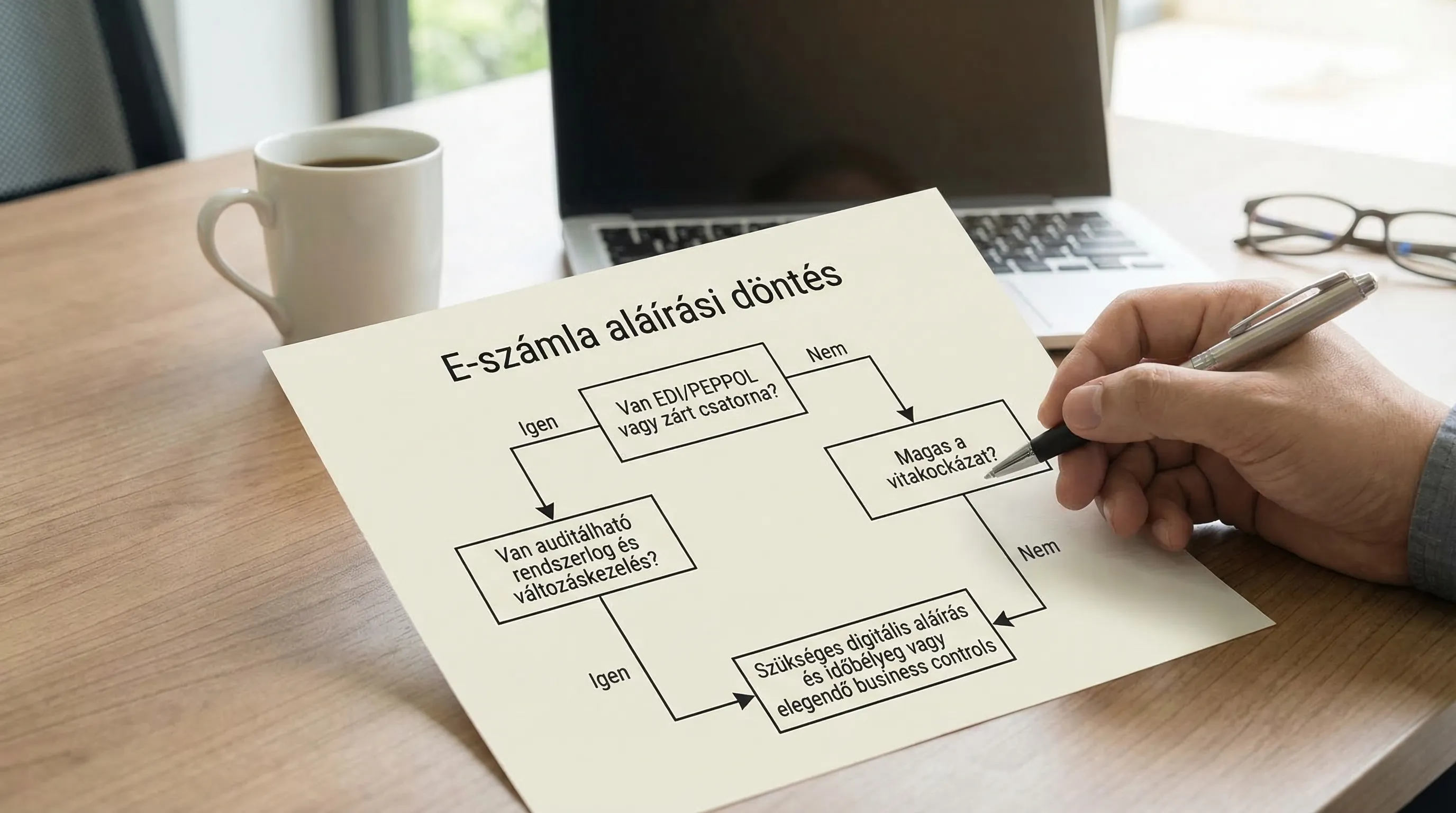
When is a digital signature not required (and is that okay)?
In many modern e-invoicing systems in 2026, the process and the system themselves serve as proof rather than a digital signature.
Common cases:
1) If you have an integrated invoicing system + ERP + archiving, with a fully logged process
If the generation, numbering, access control, issuance, and storage of invoices can be traced, then system controls can also ensure their authenticity and integrity.
You may also find the following useful:
2) If EDI or a standard, controlled channel (such as PEPPOL) is the backbone
The essence of EDI-type models is that the channel, the agreement between the parties, logging, message identifiers, and acknowledgments together provide an audit trail.
3) If you don’t “send” the invoice, but grant access to it (via a portal)
With portal-based invoicing (downloads, statuses, event logs), it is often easier to ensure auditability through logging and access controls than through document-by-document signatures.
4) If your focus is more on automation (touchless) rather than "stamping" the document
If the goal is to automate processing (AP automation, ERP posting), then the signature alone rarely adds business value. In such cases, process protection and integration are more valuable.
Related: Digitization of Accounting: Automation from E-Invoices to the General Ledger
Quick Decision-Making Framework: 6 Questions That Will Help You Make the Right Choice
Answering the following questions will take you 10 minutes and help you determine whether you need a digital signature.
Through which channel is the invoice sent? The risk of disputes is higher when sent as a PDF via email, and lower when sent through a secure channel.
Is there an auditable log from issuance to archiving? Who generated what and when, who approved it, and what was sent out?
How robust is the access control? If many people have "edit" permissions, the value of the signature increases.
How common are disputes and credit adjustments? If they are common, it is better to have documentation as evidence.
Do your customers ask for signed invoices? Often, it’s not a legal requirement but a business expectation.
Does your archiving solution provide proof of integrity? If so, it can be protected even without a digital signature.
If 3 or 4 of the points above point toward “risky,” signing is often a good investment. If most of them are fine, it’s often unnecessary complexity.
Comparison of Methods (What does a signature provide, and what does the process provide instead?)
Approach | What does it prove? | Advantage | Typical risk / disadvantage | When is it a good choice? |
Digital signature (and often a timestamp) | Document-level integrity and authenticity | Strong, tangible evidence in a dispute | Certificate management, automation, and auditing are more complex | PDFs sent via email, much debate, a strong need for evidence |
EDI / controlled channel | Message path, confirmation, agreement between the parties | Good scalability, industry-proven | Introduction and Partner Coordination | Higher volume, stable B2B network |
Business controls (system and process audits) | Deployment process, change management, access, log | Flexible, integration-friendly | Auditable evidence must be deliberately designed | Integrated ERP, invoicing, and archiving system with well-managed operations |
Service Provider E-Invoicing Platform + Archiving | End-to-end traceability within the platform | Faster implementation, standardized processes | Vendor lock-in, contractual and integration issues | Quick start for SMEs, limited IT capacity |
If you sign: the technical “minimum” to watch out for in 2026
A digital signature alone isn't enough if you can't subsequently verify and prove the chain.
A few practical requirements (especially when dealing with large volumes of automated invoices):
Key and certificate management: who has access, where they are stored, and the renewal and revocation processes.
Automatic verification: The validity of signatures should be verified for both incoming and outgoing invoices.
Timestamping and long-term verifiability: When planning for long-term storage, keep in mind that cryptography and certificates change over time.
Error Handling and Exceptions: What happens if a signature cannot be verified or if you encounter an expired certificate.
Logging: when it was signed, with what certificate, and by which system component.
Most of the points listed above are not “extras,” but are business-critical due to potential future audits and disputes.
Common misunderstandings that lead to unnecessary costs
“A signature is required for the NAV Online Invoice”
Data reporting and proving the integrity of e-invoices are two separate issues. Integration with the National Tax and Customs Administration (NAV) is important, but it does not in itself determine whether a signature is required.
“If it’s a PDF, it’s definitely an e-invoice”
The format alone isn't what matters. What matters is authenticity, integrity, readability, and the process.
“Digital signature = encryption”
No. A signature primarily ensures integrity and authenticity. Encryption is about confidentiality.
“Once we’ve signed it, the archiving is taken care of.”
A digital signature does not replace accessibility, traceability, backup, a migration plan, or access control.
If you want to get a complete overview of e-invoicing with an eye toward 2026, these are some useful tools:
Frequently Asked Questions
Will digital signatures be mandatory for electronic invoices in Hungary in 2026? As a general rule, it is not the “signature itself” that is mandatory, but rather the assurance of the document’s authenticity, integrity, and legibility. This can be achieved through various methods.
When is signing still the best option? When invoices are sent as PDFs via email, logging and access controls are weak, disputes are common, or a signed document is required for partner or internal audits.
Can a digital signature be replaced with EDI or PEPPOL? In many cases, yes, because the secure channel, confirmations, and logging together provide an audit trail that meets the required level of verifiability.
Is it enough for the invoicing software to simply “add a note” saying “authentic”? A note alone is not proof. Verifiability is provided either by cryptographic tools (signatures, timestamps) or by auditable process controls and system logs.
If I sign it, do I also need a timestamp? In many cases, it is strongly recommended, because a timestamp helps verify that the document existed at a specific point in time and has not been altered since then.
What are the most common questions an auditor asks about e-invoices? Typically, they ask whether the origin and integrity of the invoice can be verified, who had access to the invoicing system, whether there is a log and exception handling in place, and how long-term archiving works.
Next step: Decide quickly whether a signature is required, and make sure to include it properly
If you’d like to get a clear picture in just one or two meetings of whether your processes require digital signatures or if a controlled channel and auditable system controls are sufficient, Syneo’s team of consultants can help you assess your current situation, identify risks, and define a realistic, achievable target state.
For more resources, check out Syneo’s e-invoicing materials or contact the team via syneo.hu.