Modernizing legacy systems: when to refactor, when to replace?
Other
Modernizing legacy systems — when to refactor, when to replace? | Syneo
A practical guide for IT leaders: a decision-making framework for modernizing legacy systems in 2026 — when to refactor, when to replace entirely, and how to minimize risk.
legacy, modernization, refactoring, strangler pattern, system integration, DevOps, cloud migration, IT consulting, architecture
March 5, 2026
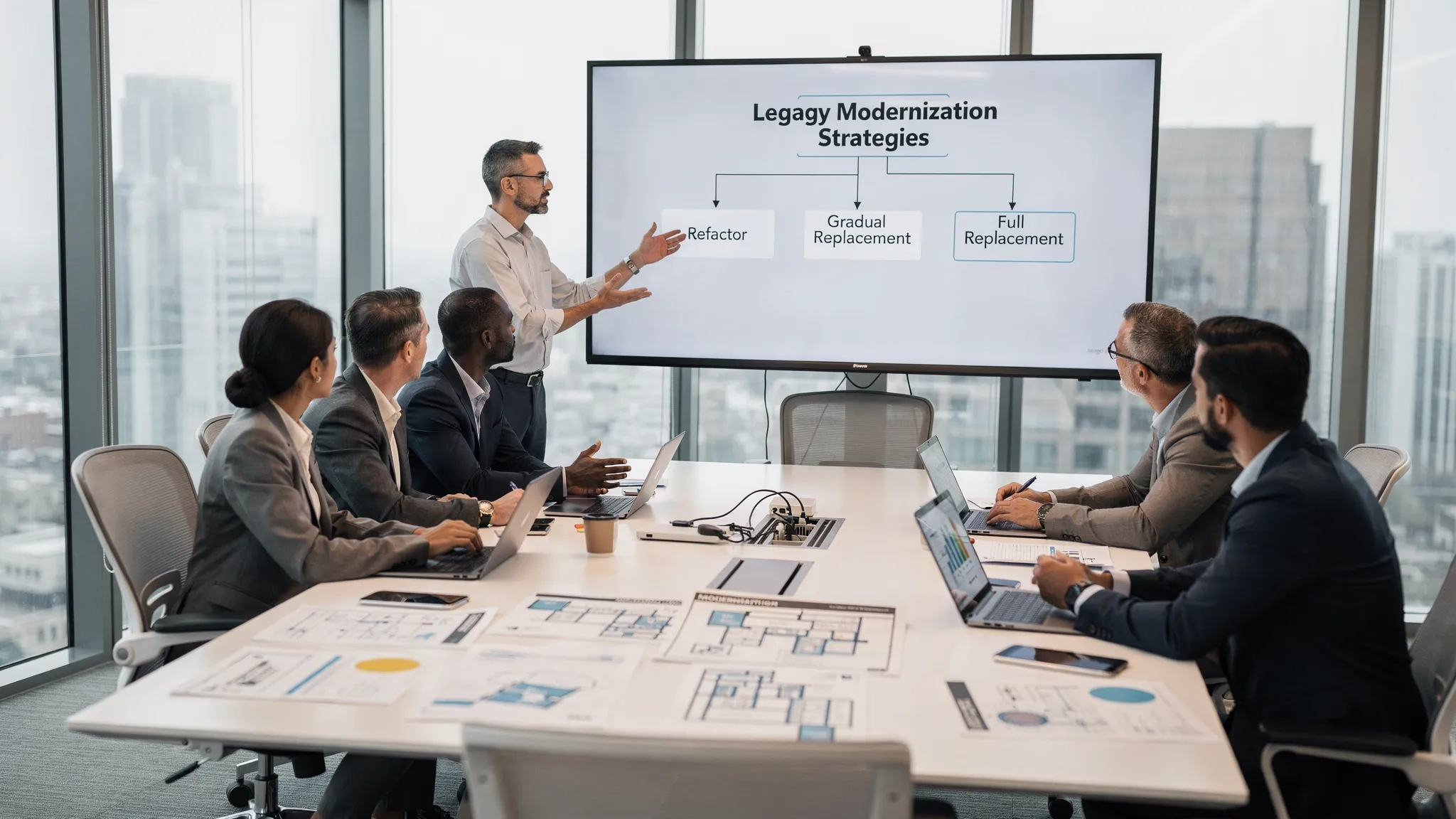
Legacy systems are rarely a problem because they are "old." They become a business risk because they slow down change, increase operating costs, and make it increasingly difficult to meet security, integration, or AI requirements. This is when the classic question arises: should we refactor or replace?
In this article, you will find a practical decision-making framework from an IT management perspective: what signs indicate the need for refactoring, when is replacement more economical, and how can modernization be carried out without interrupting operations.
What do we mean by legacy modernization in 2026?
Modernization does not mean complete rewriting. In most companies, a series of portfolio decisions are made: different strategies for different applications provide the optimal combination of risk, cost, and time.
Large cloud providers and Cloud Adoption Framework-type approaches often describe the options using the "6R" categories (rehost, replatform, refactor, retire, retain, replace). In corporate practice, four of these are generally the most common:
Refactoring: improving the internal structure of the system while maintaining its basic functionality.
Partial modernization (encapsulate + integration): an API layer is added around the legacy system, and new capabilities are created in modern components.
Gradual replacement (strangler pattern): replace legacy parts module by module.
Complete replacement: a boxed (SaaS) or new custom system replaces the old one.
The question of "when to refactor, when to replace" actually means: when is it worth preserving the value of the existing system and making it upgradeable, and when is it better to transfer operations to a new target platform?
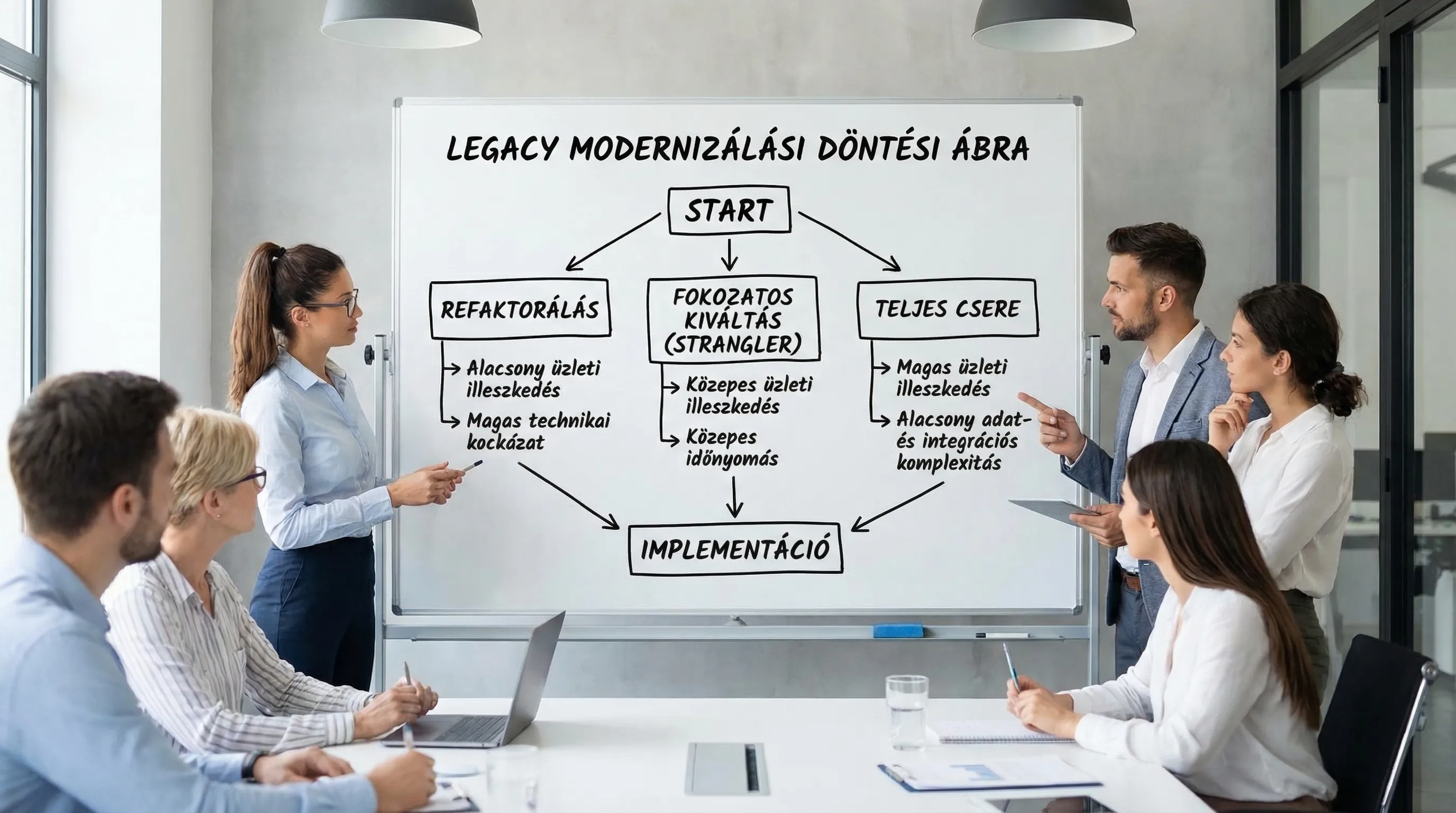
Refactor or replace? The decision is actually influenced by five factors
Most organizations make the mistake of trying to solve the problem from a purely technical perspective. However, to make a good decision, five conflicting factors must be considered simultaneously.
1) Business alignment: Does the system's "knowledge" make a difference?
The balance sheet pushes towards refactoring if the legacy system:
contains company-specific logic (pricing, manufacturing rules, unique scheduling) that provides a competitive advantage,
deeply embedded processes, and "standardization" would result in business losses.
It pushes towards replacement if the system mainly performs a "commodity" function (e.g., basic HR, basic invoicing, standard CRM processes) and market software is already better, more secure, and up to date.
2) Technical condition: how much technical debt are you carrying?
Refactoring works well when the code and architecture can be saved and the team is able to make controlled changes. The decision leans toward replacement if:
critical parts of the system cannot be tested, there is a high risk of regression,
the platform dependencies (runtime, database, OS) are in a state of being phased out of support,
The change cycle time is too long, and error correction is disproportionately expensive.
3) Time pressure: is there a "deadline"?
Classic time pressures in 2026:
compliance requirements (e.g., auditability, logging, authorization management),
security exposure (non-patchable components),
business deadline (acquisition, new product, new country).
When the deadline is tight, a complete rewrite is rarely a good solution. In such cases, a common pattern is encapsulation + gradual replacement, while business-critical parts are quickly moved behind modern APIs.
4) Data and integration: to what extent does legacy software "tie everything together"?
The more integration and data dependency there is, the greater the risk of replacement. In such cases, it is particularly important to:
what is the "system of record" (where the truth comes from),
how data flows (API, CDC, ETL),
what is the quality of the master data.
If this area is uncertain, it is worth first creating an integration map and target architecture. Related framework: System integration: how to connect ERP, CRM, and BI?
5) Organizational capabilities: Is there a team and an operating model?
A replacement project can fail due to change management and data migration, while a refactor can fail due to a lack of DevOps and testability.
Without modern delivery capabilities (CI/CD, automated testing, infrastructure as code), refactoring alone is not enough. A good foundation for this: DevOps Fundamentals: The Path from Zero to Production in 2026
Quick decision table: when to refactor, when to replace?
The table below is not a "universal truth," but rather a quick guide that is worth applying at the portfolio level.
Consideration | Rather refactor | Rather replacement (SaaS or new system) |
Business uniqueness | The system is unique and offers a competitive advantage. | Mostly covers standard processes |
Technical condition | Testable, gradually improvable | "Spaghetti," unsupported stack, high risk |
Integration exposure | A lot of internal logic that is worth keeping | Re-establishing integrations is manageable, or the vendor will resolve it |
Time pressure | There is time for stable modernization | Quick results are needed, standardizable |
Security, compliance | Can be corrected in a controlled manner (logging, IAM, encryption) | Legacy cannot be brought up to an acceptable level reasonably |
TCO logic | Development is cheaper than switching and data migration | License + implementation is cheaper than legacy maintenance |
The third option: gradual replacement (strangler), even if replacement is ultimately the outcome
The "refactor or replace" dilemma is often solved by a hybrid strategy: first stabilize and isolate, then replace module by module.
The essence of the Strangler Fig Pattern is that new capabilities are already being developed in modern services, while legacy services are gradually losing their role. This works well if:
a big bang cutover is too risky,
integrations and data are complex,
Continuous delivery is required for business purposes.
In practice, the tools for this are:
API gateway and anti-corruption layer (between the legacy "dictionary" and the new domain dictionary)
event-driven integration where real-time response is required
dual-write or CDC temporary data synchronization (with strict controls)
Why does modernization fail? 6 typical pitfalls
Most failures are not "technological" but rather errors in decision-making and execution.
Bad goal: modernization without metrics
If it is not specified what will make the system better, the project will permanently go into scope creep. The goals of modernization should be measurable, for example:
lead time reduction (from idea to launch)
incident rate and MTTR
number of integration errors
time of production of audit evidence
Useful for this: Planning a digitization project: goals, KPIs, risks
Rewriting with the illusion of a "reset button"
A complete rewrite is often initiated because the legacy system is frustrating. However, the new system must cover the same complexity, plus migration, plus change management.
Underestimating data migration
Data and process exception handling typically account for 30-50 percent of replacement projects. Without a data owner, rule set, and test load, the risk of go-live skyrockets.
Late handling of security and permissions
Especially in the case of SaaS replacement, it is common for IAM, SSO, logging, and RBAC to only come into play at the end. By 2026, this will no longer be acceptable in many industries.
General, reliable security starting point: OWASP Application Security Verification Standard (ASVS)
Lack of an operating model
Even a modern system can be unstable if there is no monitoring, release process, incident runbook, or accountability model. DevOps is not a list of tools, but a way of working.
Vendor lock-in or excessive customization
In the event of replacement, two extremes are dangerous:
you force everything to be "off the shelf," when the business actually has unique needs
You customize everything, and you're in the same place as the legacy, only more expensive.
Decision-making method: scoring system in a single workshop
A good 2-3 hour workshop is often enough to choose the direction for the largest systems. The scoring model below is simple, but it works.
Rate each factor on a scale of 1 to 5, where 5 is a strong reason for replacement and 1 is a strong reason for retention/refactoring.
Factor | 1 point (towards refactor) | 3 points (uncertain) | 5 points (towards exchange) |
Business uniqueness | Competitive advantage, difficult to standardize | Mixed | Commodity, standardizable |
Technical risk | Stable, testable | Medium | Not supported, unstable |
Integration and data | Irreplaceable dependencies | Manageable | Low dependency, clean data |
Time pressure | There is time for waves | Medium | A quick solution is needed |
Operational capability | We have DevOps and SRE basics | Partially | No, and there won't be in the short term. |
Interpretation (guideline):
5-10 points: refactor or encapsulate the likely winner
11-17 points: strangler, partial replacement, hybrid buy+build
18-25 points: becomes a strong candidate for replacement
The point is not math, but rather that the discussion should be structured and that you base your decision on documented risks.
Implementation: how to do it without interrupting operations?
Modernization is "beautiful" when the user hardly notices anything, while delivery speed increases and risk decreases in the background.
Portfolio assessment and target architecture
Minimum outputs you shouldn't start without:
application portfolio list (owner, criticality, cost, risk)
integration map and system of record decisions
target state architecture (not detailed blueprints, but guidelines)
Wavy delivery, not a "big bang"
It is worth breaking down modernization into segments that add business value in 4-8 week cycles. Parallel operation, controlled user groups, and gradual cutover are particularly useful in the case of replacement.
Cloud and operations: frameworks first, migration later
If modernization also affects the cloud, it is worth setting the cost and security parameters in advance (IAM, logging, backup, network, FinOps basics). Detailed guide related to this: Cloud migration for SMEs: cost, security, scheduling
When is it worth using an external partner? 3 typical situations
Modernization usually involves several disciplines: architecture, data, integration, DevOps, security, and change management. External partners bring the most value when:
the organization lacks the "experience routine" for modernization, and it would be expensive to learn on the job
multiple systems are involved in a coordinated manner (ERP, CRM, manufacturing, BI)
Compliance or security requirements must be met quickly.
If you are currently facing a decision, a brief, documented assessment can save you many months of uncertainty. Syneo IT consulting typically helps in situations such as these: comparing options, creating a risk register, developing a schedule, and establishing metrics. Related: IT consulting: when is it necessary and what do you get in return?
Final thought: don't change technology, optimize risk and speed
Refactoring and replacement are not "better" or "worse" options. Both are good if they fit the actual business goal and the implementation is controlled.
To sum it up in one sentence:
Refactor if the business value of the system is unique and can be saved. Replace if the function is commodity, the technical risk is high, and standardization provides a faster, safer path. If neither is clear, use a strangler to buy time and reduce the risk of a big bang.
If you wish, the Syneo team can help you with a brief modernization assessment and roadmap, providing you with recommended directions (refactoring, strangler, replacement), key risks, and a realistic, phased implementation plan at the system level. For more information, visit Syneo.