Team DevOps: Roles, Workflows, and KPIs in 90 Days
Other
Team DevOps: Roles, Workflows, and KPIs in 90 Days | Syneo
A 90-day, practice-oriented Team DevOps plan for IT leaders: roles, operational rhythms, and measurable KPIs to make delivery faster, more reliable, and more secure.
Team DevOps, DevOps, KPIs, SRE, CI/CD, DevSecOps, observability, operating model, incident management, Syneo
April 5, 2026

DevOps won’t work just because you implement a new tool or change the team’s name. It starts to deliver results when roles are clearly defined, the operational rhythm is predictable, and there is a mutually agreed-upon set of KPIs that truly measure flow and stability—not just generate “pretty numbers.”
This article provides IT leaders and delivery managers with a 90-day, pragmatic plan for setting up a Team DevOps environment. The focus is on how to design the team’s operating model to measurably accelerate delivery and reduce the cost of defects.
Team DevOps: What Does It Really Mean?
The essence of the Team DevOps approach is that development and operations (as well as security and quality) do not simply “pass the buck” to one another, but instead take joint responsibility for the entire lifecycle of the service. In practice, this means three things:
The release and deployment of changes is routine, automated, and rollback-enabled.
Observability and incident management form a learning cycle.
Priorities include not only features, but also stability, technical debt, and security issues.
If you want quick results in 90 days, don’t launch a “DevOps transformation”—instead, focus on your operating model: roles, cadences, KPIs, and basic automation.
Roles: What does a functional Team DevOps setup look like?
The most common misconception is that DevOps is a separate team. By 2026, the operating model in most organizations will be more like:
product team(s) responsible for the service, and
platform/enablement capabilities that accelerate and standardize delivery.
In reality, many roles are combined in SMEs. This is fine as long as the responsibilities are clearly defined.
Minimum roles and decision-making responsibilities
The table below shows a "minimum viable" Team DevOps role map. These are not job titles, but areas of responsibility.
Role (persona) | Primary focus | Common decisions | "Ready" definition (as defined by the DoD) |
Product Owner / Service Owner | Business objectives, prioritization, risk-taking | What should we go live with now, and what should be our stability investment? | The release delivers value, the risk is acceptable, and there is a rollback plan |
Engineering Lead / Tech Lead | Architecture, development quality, delivery flow | Branch/PR policy, release strategy, tech debt guidelines | The change has been tested, reviewed, and can be built automatically |
Platform Engineer (or DevOps Engineer) | CI/CD, golden path, developer platform | Pipeline standards, IaC patterns, self-service | 80–90% of teams can start from a template; they don’t build from scratch |
SRE / Ops (or on-call lead) | Reliability, incident management, SLO | Monitoring standards, alert policies, incident response process | After an incident, a post-mortem is conducted, and the lessons learned are added to the backlog |
QA / Test Lead | Test strategy, automation, quality gates | What should we automate first? Which test serves as the gateway to the pipeline? | The regression rate is decreasing; the release has not yet passed manual testing |
Security Champion / DevSecOps Lead | Risk-based security integration | SAST/SCA policies, secret management, SBOM requirements | The security check is automated and developer-friendly, not retrospective |
Tip: If you already have a separate operations team, designate a “Service Owner” on the business side who is truly committed to the SLA/SLO commitments. Without this, the DevOps team will quickly become “everyone’s and no one’s.”
RACI: Critical Intersections in a Nutshell
The goal of the 90-day kickoff is not to produce a complete RACI document, but rather to clarify 8–10 typical scenarios. Examples:
Situation | The one who takes the initiative | Whoever approves | The person who carries it out | The person providing information |
Incident P0 (business interruption) | On-call/SRE | Service Owner | Dev + Ops Together | Stakeholders, Customer Service |
Hotfix release | Engineering Lead | Service Owner | Dev/Platform | Security, support |
Tightening of the pipeline gate | Security Champion | Engineering Lead | Platform | PO/Service Owner |
SLO change | SRE | Service Owner | SRE/Platform | Dev team |
If these four lines are clear, the number of "unknown" errors will drop dramatically.
Rhythms: The Team DevOps Operational Calendar (Decision Points Instead of Meetings)
The purpose of these cycles is not to increase the number of meetings, but rather to:
there should be fixed decision points,
there should be feedback on the KPIs,
Let there be room for stability and security.
The proposal is a "lightweight governance" framework that scales well even for small teams.
Recommended routines for a 90-day program
Rhythm | Frequency | Participants | Output | A typical anti-pattern |
Delivery sync (short) | Daily or 3 times a week | Dev + Ops + Product Owner | Unblocking blockers | 30- to 45-minute status meeting |
Backlog refinement (including DevOps items) | Weekly | PO, Lead, QA, Security | Value + stability + security in a single backlog | Tech debt on a "separate list" that never gets addressed |
Release readiness check | Before every release | Lead, QA, Ops, Product Owner | Go/No-Go, rollback decision | The “we’ll see when it comes down to it” mentality |
Incident review + postmortem | Weekly / After an incident | On-call, Dev, PO | 1–3 tasks in the backlog, with an owner | Blame, or “closing the case without learning a lesson” |
SLO and Alert Review | every two weeks | SRE/Ops, Lead, Product Owner | Alert noise reduction, SLO refinement | Too many alerts that everyone ignores |
KPI Review (Management) | every 2–4 weeks | IT Management + Service Owner | Decision on 2–3 targeted interventions | Reviewing 20 KPIs without making a decision |
Important: These rhythms only work if the output actually appears in the backlog (such as post-mortem actions) and is reviewed at the next review meeting.
KPIs: What should you measure to ensure that progress is truly visible within 90 days?
Team DevOps’ KPI system has two rules:
First, establish a baseline; then set a goal. During the first 2–3 weeks, the best KPI goal is simply to ensure that measurements are reliable.
Less is more. Six to ten well-defined metrics are more than enough for 90 days.
The DORA metrics framework (deployment frequency, lead time for changes, change failure rate, time to restore) is a good starting point for classic DevOps performance measurement. The official supporting materials are available on the DORA research website.
Recommended set of KPIs for launching Team DevOps
KPI | Why is it useful? | Brief definition | Typical data source |
Lead time for changes | Shows the process (from idea to launch) | PR merge or work item start, until production deployment | Git, CI/CD, Azure DevOps/Jira |
Frequency of deployment | Print capacity and batch size | Number of production deployments per time period | CI/CD, release tool |
Change failure rate | Quality and risk | Of the changes that have gone live, how many cause incidents or rollbacks? | Incident system + deployment log |
MTTR (mean time to restore) | Operational stability | Recovery time for P0-P1 events | ITSM, on-call tool |
SLO achievement (1–2 SLOs) | Enterprise-level reliability | For example, an availability or latency SLO for a critical service | Observability (metrics, traces) |
Signal-to-noise ratio | Focus and Load | Percentage of false alarms, or number of alarms per on-call shift | Monitoring/Alerting |
Pipeline success rate | Maturity of automation | Ratio of successful build/test runs | CI/CD |
Automated test coverage (trend) | Reducing Regressions | It’s not about a percentage obsession, but about covering trends and critical paths | Test reports |
Vulnerability fix lead time (critical) | Keeping Safety Under Control | Turnaround time for critical vulnerabilities | SCA/container scan, ticketing |
Note: Don’t set “elite” industry targets for a 90-day period. The goal is to improve the trend and stabilize the metric. Instead of getting bogged down in numbers, the question is whether you can make decisions based on the metric (for example, “increase release frequency with smaller batches” or “reduce the change failure rate with a quality gate”).
KPI Definitions: 3 Common Pitfalls That Ruin Measurement
Different start and end points for each team. If the lead time is "ticket created" in one place and "dev start" in another, they cannot be compared.
Incidents and changes are not linked. The change failure rate only makes sense if you know which release caused the incident.
Too much manual data. If your KPIs are generated from Excel, they’ll quickly become obsolete. Choose data sources that can be automated.
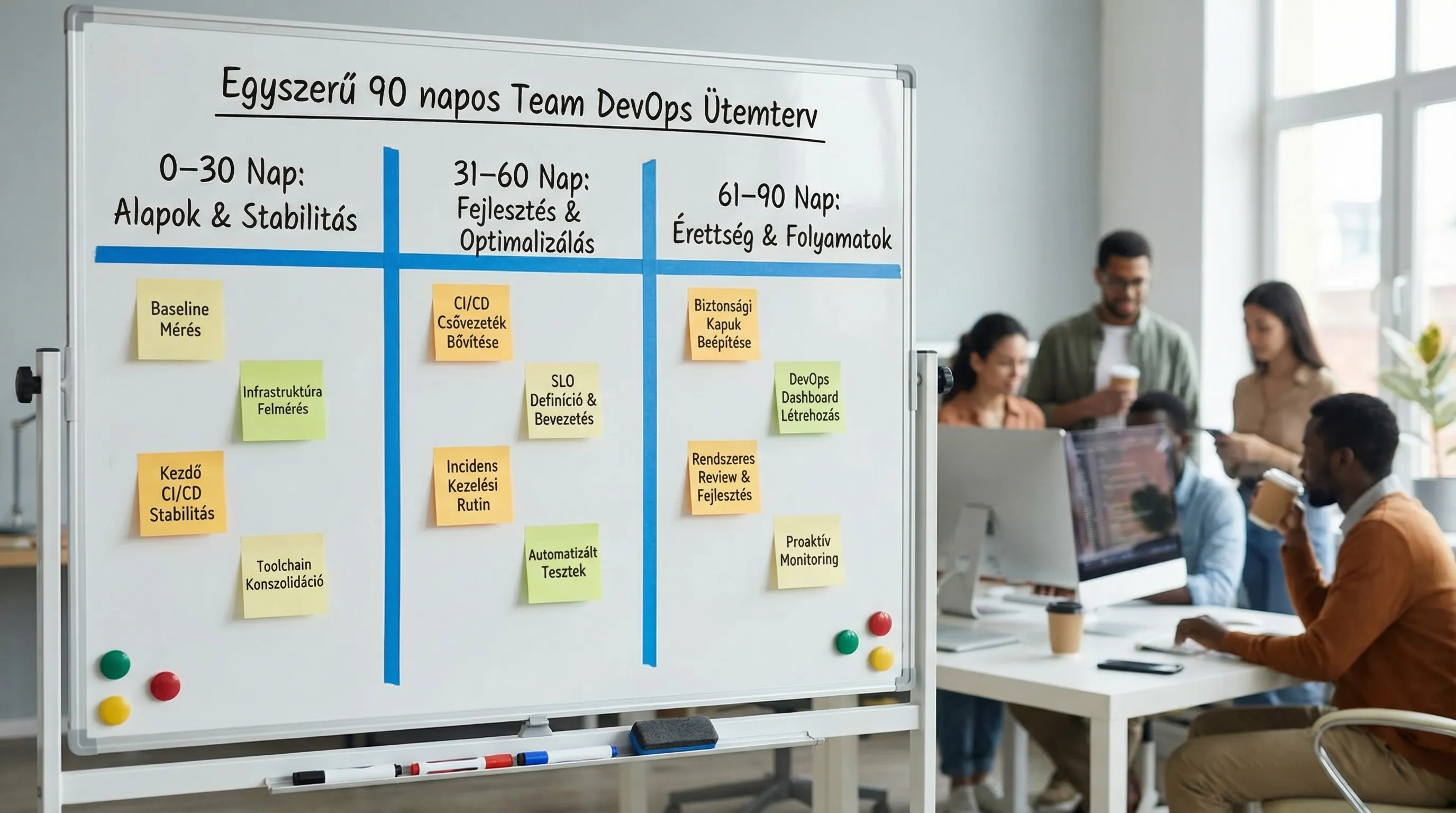
90-Day Rollout Plan: Roles, Rhythms, and KPIs in Production
The following approach works well if you focus on a single (1) service or product line as a pilot and scale up only after that.
0–30 days: baseline, accountability, visibility
At this stage, the main benefit is not “faster releases,” but rather that the system is measurable and controllable.
Key deliverables:
Define roles (Service Owner, on-call manager, platform manager) and clarify 8–10 critical RACI responsibilities.
KPI Definition Sheet (1 page): what was measured, where it was measured, and the formula used.
“Minimum observability”: basic metrics and logs, with SLIs for at least one core service.
Incident process: severity levels, on-call, and postmortem template.
If your backlog isn't measurable enough yet, you might want to check out this practical guide on work item structure: DevOps work items: How to build a well-measurable backlog.
31–60 days: Automations and quality gates (but in a developer-friendly way)
This is where you’ll see the greatest “visible” acceleration, but only if the goal isn’t too complex.
Key deliverables:
Stabilization of the CI pipeline and ensuring the reliability of builds and basic tests.
A CD foundation, at least one automated deployment process, and a rollback routine.
Minimum PR policy: review, linked work item, and a green build are required for a merge.
Security minimum gates (secret management, SCA, image scanning) with risk-based rules.
It’s best to build security in at this stage; otherwise, it will come back to haunt you in 61–90 days. Practical starting point: DevSecOps in practice: how to build secure CI/CD.
Note: If you have on-premises infrastructure (office, warehouse, server room), DevSecOps is not just about code and pipelines. Controlling physical access (access control, alarms, cameras, maintenance procedures) is also part of risk management; a good example of this is a professional, certified service provider, such as a security technology provider with VEB certification.
61–90 days: steady rhythm, SLOs, and scaling fundamentals
At this stage, the goal is for Team DevOps to become a routine rather than a campaign.
Key deliverables:
Focus SLOs on 1–2 critical user journeys (and tailor alerts to them, not the other way around).
Execution rate of post-mortem actions (e.g., "80% of actions completed within 30 days").
KPI dashboard, aligned with management review cycles, and identification of 2–3 key initiatives for the next quarter.
A Golden Path template (repo/pipeline) so that the next team doesn't have to start from scratch.
If you want to get a quick overview of where you stand and what the next 2–3 best steps are, here’s a useful framework: DevOps Maturity Assessment: Where Does Your Team Stand?
Common Mistakes That Prevent a DevOps Team From Delivering Results Within 90 Days
Most of the bottlenecks are not technical, but operational.
There is no designated Service Owner, so decisions regarding stability are always “someone else’s problem.”
The DevOps backlog has a life of its own; in a sprint, the feature always takes precedence.
There is no "definition of done" at the release level, so quality is always a point of contention.
The measurement is done manually, so the reliability of the KPI review is questionable.
Security isn't factored in until the end, so the momentum built up in the second month is offset by risk in the third month.
FAQ
What is the difference between DevOps and Team DevOps? DevOps is a mindset and a set of capabilities, while Team DevOps is a specific team-level operating model: roles, decision points, cadences, and KPIs centered around a service.
How many KPIs should you track during the first 90 days? Generally, 6 to 10 are more than enough. First, establish a stable baseline and consistent definitions; only then should you consider expanding.
What are the four most important DevOps metrics? A good starting point is the DORA quartet: lead time for changes, deployment frequency, change failure rate, and MTTR. In addition to these, you often need one or two SLO-type business reliability metrics.
Is it possible to implement Team DevOps with a small team and combined roles? Yes. The key is not the job title, but clarifying responsibilities. One person can wear many hats, but in that case, it’s even more important to establish a consistent workflow and define decision-making authority.
When should you seek outside help? If you lack reliable baseline metrics, have no incident or release discipline, or if your team gets bogged down in “tool debates” while delivery and stability fail to improve, a brief assessment and a 90-day action plan can quickly pay off.
Next step: A 90-day Team DevOps pilot with Syneo
If you want to see measurable progress within 90 days (faster releases, fewer production defects, transparent KPIs), the Syneo team can assist you with IT consulting and implementation support to help you develop your operating model, establish a measurement framework, and implement the minimum requirements for CI/CD, DevSecOps, and observability.
Check out Syneo’s services at syneo.hu, and launch a focused, pilot-style Team DevOps program for a selected service, which can then be scaled to other teams as well.