DevOps from 2022 to 2026: What Has Changed in Practice?
Other
DevOps from 2022 to 2026: What Has Changed in Practice? | Syneo
What practical changes have taken place in the field of DevOps between 2022 and 2026? Platform engineering, GitOps, SBOM, observability, FinOps, and the impact of AI—practical steps for SMEs.
DevOps, GitOps, Platform Engineering, DevSecOps, Observability, OpenTelemetry, SBOM, FinOps, CI/CD, AIOps, IT Consulting
March 27, 2026

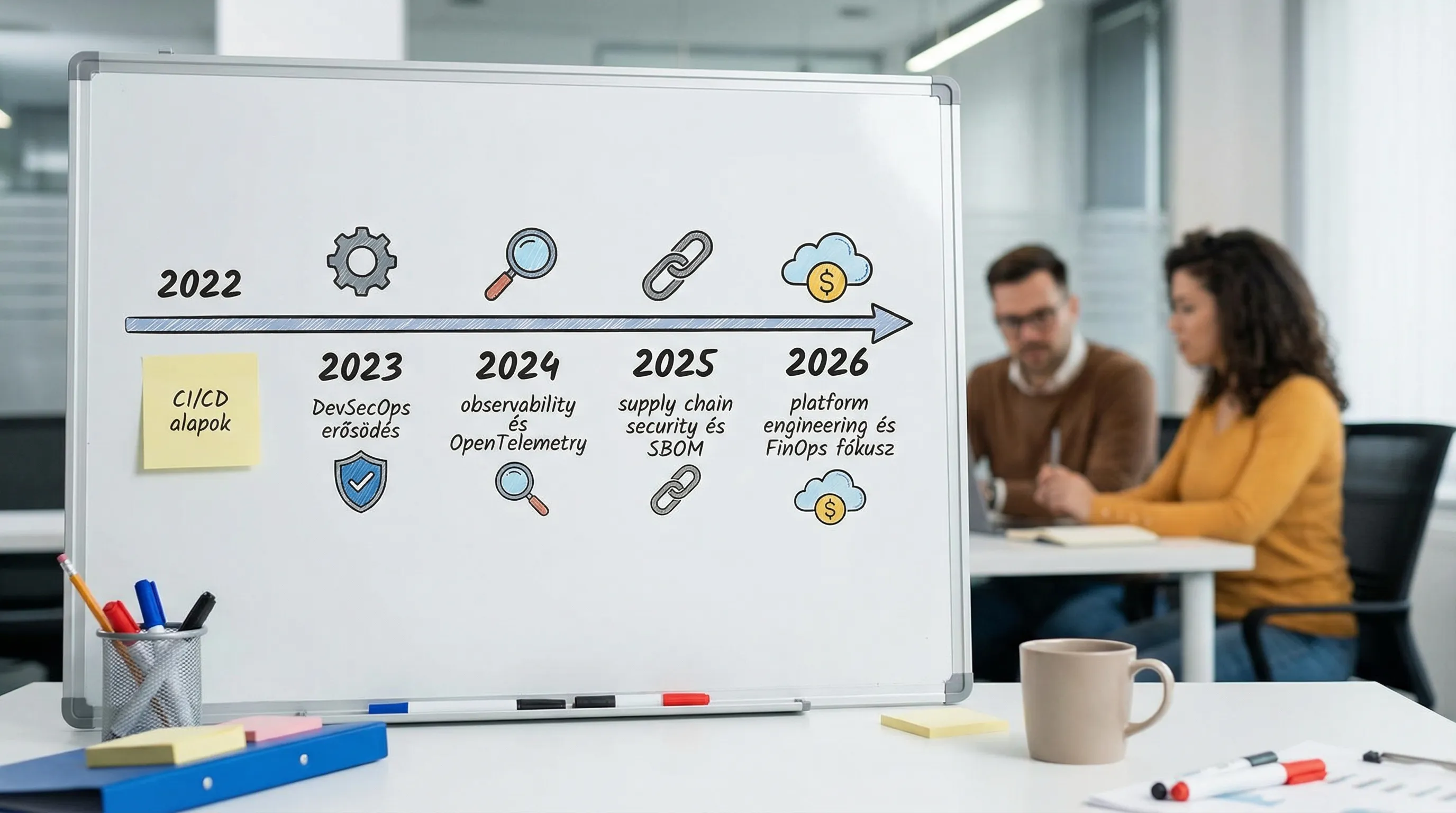
Around 2022, for many companies, DevOps was still synonymous with the goals of “set up a CI/CD pipeline” and “move to the cloud.” By 2026, the focus had shifted in many places: speed alone is no longer enough, because auditability, supply chain security, cost control, and reliability must also be addressed within the same system. Furthermore, AI has transformed development and operations (coding assistants, AIOps, LLM-based knowledge search), bringing new risks and new opportunities for acceleration.
Below, I summarize how DevOps has evolved in practice from 2022 to 2026, and what specific steps your organization should take to implement these changes.
In short: What was the typical DevOps landscape in 2022?
For many organizations, the 2022 “basic package” looked like this:
CI pipeline builds and basic tests (sometimes just smoke tests).
CD is partially automated, but requires manual approvals and includes context-dependent exceptions.
Docker + some form of Kubernetes or managed PaaS (though often with few standards).
We’ve started using IaC (Terraform, Ansible), but we’re facing issues with drift and state management.
Monitoring tends to focus on metrics and logs; traces are used less frequently, and SLOs are even rarer.
Security is "built-in" (SAST/SCA runs occasionally), but it isn't always developer-friendly in the development workflow.
Many teams get stuck at this point: they have a pipeline, yet release dates remain unpredictable; there are numerous exceptions regarding environments and permissions; and the lack of metrics makes it difficult to demonstrate progress.
If you want to build a DevOps workflow with a 2026 perspective, here’s a good starting point: DevOps Fundamentals: The Path from Scratch to Production in 2026.
2022–2026: The 7 Most Important Practical Changes
In recent years, it hasn’t been a single “major” technology that has transformed DevOps, but rather several mutually reinforcing shifts.
1) Platform engineering and internal developer platforms (IDP): moving toward "self-service DevOps"
In 2022, DevOps was largely about coordination between teams. By 2026, the practice will increasingly involve the platform team delivering products to developers.
What does this mean in everyday life?
“Golden Path” application templates (repo template, pipeline template, log/trace basics).
Self-service provisioning (environments, databases, queues, secrets) with controlled guardrails.
Standardized deployment and rollback templates.
A documented, measurable developer experience (DX).
The goal is to reduce the “every team does it differently” approach and ensure that speed does not come at the expense of stability.
2) GitOps and drift control: the foundation of auditability and predictability
In 2022, many people thought in terms of the “pipelines = deploy” logic. By 2026, it has become increasingly common for the desired state to be defined in Git, with environments converging declaratively and continuously toward that state (Argo CD, Flux, and the like).
GitOps has become much more important because:
There are fewer manual adjustments to the environment, so there is less hidden drift.
Better traceability (who changed what and when).
It is easier to implement policy-as-code and gather evidence of compliance.
If you're interested in the "audit-ready" aspects of secure CI/CD, check out this related article: DevSecOps in Practice: How to Build Secure CI/CD.
3) Software supply chain security: SBOM, signing, provenance
This may be the biggest shift in mindset since 2022. These days, it’s no longer enough to simply “run a vulnerability scan.” In 2026, more and more clients and auditors are asking questions such as:
SBOM (Software Bill of Materials): exactly which components are included in the build.
Artifact signing and integrity (e.g., the Sigstore ecosystem).
Build provenance, traceability of the supply chain.
Minimum high school graduation requirements (e.g., SLSA recommendations).
Practical implication: the pipeline is supplemented with “non-functional” steps, without which a supplier due diligence process would not be considered complete in many industries today.
Two good, widely cited starting points:
OWASP Software Supply Chain Security
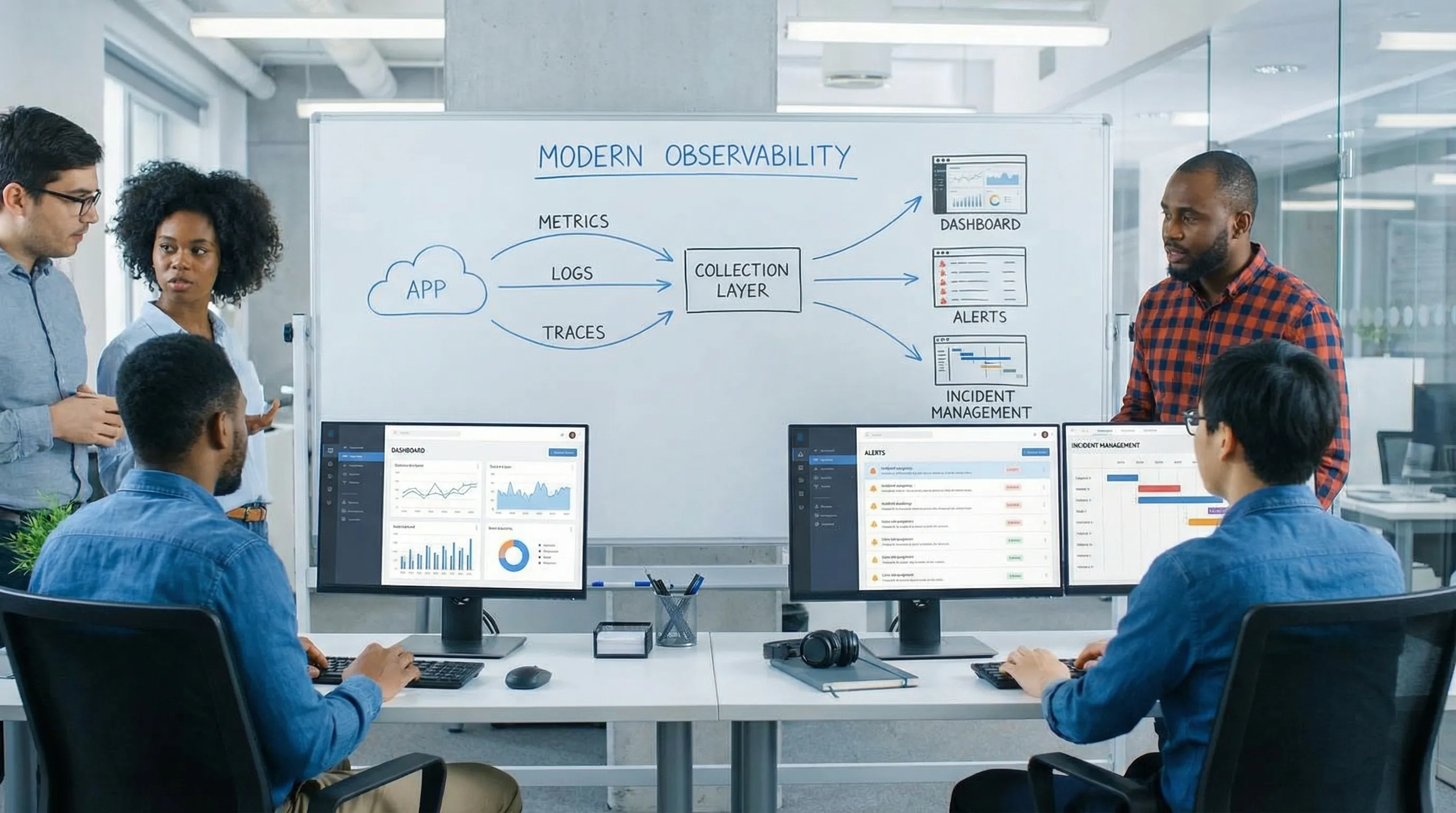
4) Observability 2.0: OpenTelemetry, traces, and SLOs instead of “monitoring”
In 2022, “monitoring” often simply meant having a dashboard for CPU and memory usage and logging. In 2026, the focus is more on observability:
Unified instrumentation ( OpenTelemetry in many places).
Metrics + logs + traces together, in a way that allows for correlation.
Service Level Objectives (SLOs) and error budget approach.
The practical benefits: faster troubleshooting, less time spent in the "war room," and a more measurable business impact (such as checkout error rates and order processing latency).
5) FinOps and Cost Engineering: Cloud Costs Have Become Part of DevOps
As cloud maturity has increased, by 2026, cost per transaction or cost per customer has become just as important as “faster releases” for many companies.
In practice, this is how it looks from the DevOps perspective:
Minimum requirements for tagging and cost allocation (tagging policy).
Rightsizing and autoscaling standards.
Environmental life cycle management (with control of temporary preview environments).
Cost alerts and cost KPIs alongside delivery metrics.
In this regard, if you’re an SME looking for a cost- and security-focused approach: Cloud Migration for SMEs: Cost, Security, and Timing.
6) Compliance and cybersecurity: DevSecOps has become a “must,” not an “extra”
In 2022, DevSecOps was often considered a “nice-to-have” in many organizations. By 2026, due to regulatory and vendor pressure, as well as an expanding attack surface, it will become a minimum requirement for an increasing number of organizations:
Secrets management and access control (RBAC, MFA, rotation).
IaC scanning, container scanning, and dependency scanning are included by default.
Logging and evidence collection for audit purposes.
If you want to quickly get your SME’s cybersecurity up to speed: Cybersecurity for SMEs: 10 Minimum Controls by 2026.
7) AI in development and operations: faster progress, but with new risks
AI has become deeply integrated into the 2022 DevOps landscape by 2026:
Code assistants speed up development, but the risk of "it seems to work" scenarios is increasing.
LLM-based knowledge retrieval from runbooks and tickets is useful for incident management, but logging and access control are also important.
AIOps-style anomaly detection can help reduce alert noise, but false positives and model drift require management.
Best practices for 2026: AI can be integrated into the process, but with safeguards (who approves it, what can go into production, what can be shared outside the organization, and how it can be audited).
2022 vs. 2026: Summary Table (Practical Perspective)
Area | A typical 2022 solution | A typical 2026 solution | What do you gain from it? |
Deployment | Pipeline-centric, multiple manual steps | GitOps, declarative desired state | Less drift, better traceability |
Safety | SAST/SCA "occasionally" managed by a separate team | DevSecOps by design, policy-as-code | Fewer late bug fixes, auditability |
Evidence of release | Ticket and meeting minutes | SBOM, signature, provenance | Meeting supplier and compliance requirements |
Monitoring | Log + metric, limited correlation | OpenTelemetry, traces, SLOs | Faster troubleshooting, better SLAs |
Organizational Operations | DevOps "methodology," many unique solutions | Platform engineering, golden path | Scalability across multiple teams |
Cost | Unexpected costs down the road | FinOps Basics, Cost KPIs | Predictable cloud costs |
Automation | Scripts, local knowledge | Standardized templates + AI support | Faster delivery, lower bus factor |
How do you decide what to pursue in 2026?
You don’t have to implement everything at once. The best order depends on where the pain is greatest. Here are three quick decision-making questions that work well in practice:
1) Is speed or stability the bottleneck?
If releases are infrequent and “daunting,” standardization, CI/CD quality, and environment management (GitOps, Infrastructure as Code) can deliver quick wins.
If there are frequent outages and incidents, prioritize observability, SLOs, and operational guardrails.
2) Are there any audits, supplier due diligence, or compliance requirements?
If so, supply chain security (SBOM, signing, logging) often cannot be postponed, as it brings business to a standstill.
3) How big is the "gap" between the teams?
If every team builds its own pipeline, its own logging system, and its own deployment template, the fastest way to standardize them is through a platform engineering approach.
What should you measure in 2026 to ensure DevOps doesn’t become a “debate”?
DevOps maturity can now be reliably measured. The best-known industry framework is DORA, whose annual reports provide a useful benchmark (see: DORA studies from Google).
In practice, many organizations find it helpful to supplement their DORA metrics with 2–3 “guardrail” indicators:
Rate of incidents caused by changes (breakdown of the change failure rate).
Mean Time to Repair (MTTR) trend.
Lead time for critical vulnerabilities (for example, how long it takes to move from the fix to production).
Cost-based metric (such as cost per environment or per transaction).
If you want to quickly assess where you stand and what your focus should be for the next 30–90 days: DevOps Maturity Assessment: Where Does Your Team Stand?
A realistic minimum "modernization" package for 2026 (if quick results are needed)
If an SME or mid-sized company wants to see tangible results within 6 to 10 weeks, the following combination offers the best value for money in practice:
Improving CI quality (testing, deterministic builds, and fast rollback capabilities).
Infrastructure as Code (IaC) management and drift control (at least for critical resources).
Basic DevSecOps steps in the pipeline (SAST/SCA, container/IaC scanning, and basic secrets management).
Basic observability (at least service-level metrics and trace correlation).
Introduction of 1–2 central templates to prevent the proliferation of custom solutions.
Useful for defining roles and KPIs in an "SME-friendly" way: DevOps Framework for SMEs: Roles and KPIs.
Frequently Asked Questions
Will DevOps be more of a tool or more of an organizational practice by 2026? By 2026, it will still be about both practice and culture, but due to the need for scalability, standardized platforms and automated guardrails will play a much greater role.
What is the biggest difference between DevOps in 2022 and 2026? The focus: In 2022, the goal was often speed and the implementation of CI/CD; by 2026, supply chain security, auditability, observability, and cost control had joined speed as key priorities.
Does every company need GitOps? No, but in environments where configuration drift is common, multiple teams work in parallel, or audit trails are important, GitOps pays for itself very quickly.
When should you implement an SBOM? If you need to conduct supplier due diligence, meet compliance requirements, or deal with high-risk components (many third-party dependencies), you should implement it as soon as possible, at least for critical systems.
Isn't AI dangerous during development and operation? It's useful, but risky without proper controls. By 2026 at the latest, there must be data management rules, approval points, logging, and role-based access.
Where do I start if I don’t have metrics, just a hunch? Start with a DORA baseline assessment and 2–3 guardrail metrics. If you don’t have data, you should first log events from the pipeline and incident management so that you can measure the flow.
Next step: a quick DevOps assessment and a targeted action plan
If you’ve been “doing DevOps” since 2022 but are still seeing slow releases, numerous exceptions, or facing audit and security requirements by 2026, it’s worth starting with a brief, structured assessment. The Syneo team provides support in both DevOps and IT consulting, from clarifying goals, metrics, and risks through to implementation.
Related, useful resources:
If you’re interested in a 2–3-week, evidence-based DevOps assessment and a prioritized 30–90-day plan, check out the options on the Syneo website or contact us for a consultation.