DevOps personas: roles, responsibilities, and metrics all in one
Other
DevOps personas: roles, responsibilities, and metrics all in one | Syneo
How to assign accountability and KPIs in DevOps? A practical persona canvas, roles (PO, Engineering Lead, Platform, SRE, DevSecOps, QA, Release), and recommended metrics (DORA, SLO, MTTR).
DevOps, personas, roles, responsibilities, metrics, DORA, SLO, MTTR, DevSecOps, SRE, platform engineering, IT consulting
March 29, 2026

The implementation of DevOps rarely stalls because “there aren’t enough tools.” A much more common reason is that it’s unclear who is responsible for what, what decision-making authority they have, and which metrics they’re optimizing for. In such cases, CI/CD is running, but releases are still delayed, operations are overburdened, developers “pass the buck” on bugs, and security stops the deployment at the last minute.
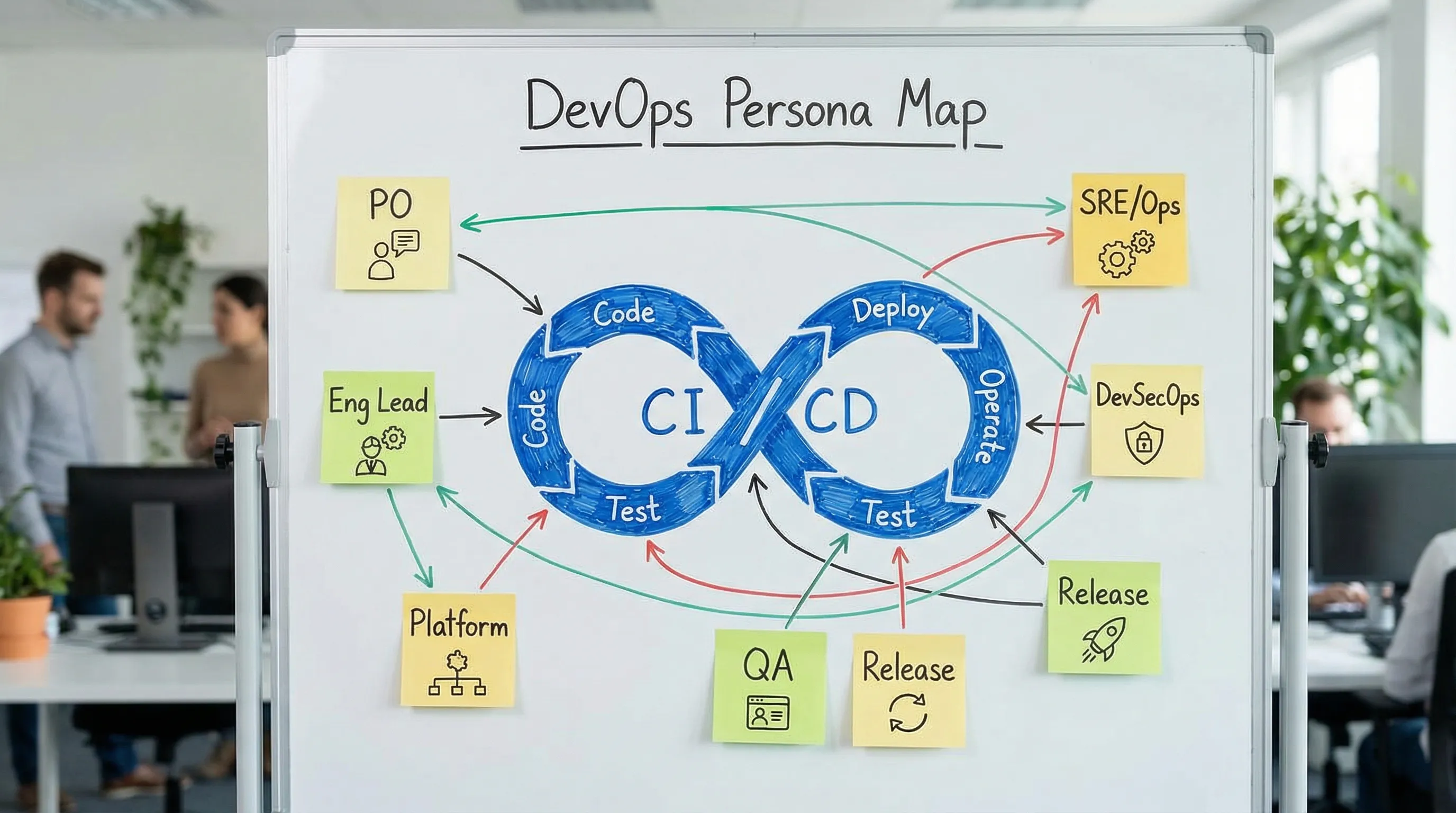
The DevOps personas approach is a good solution for this: rather than listing job titles, we identify recurring “role personas” that come with specific responsibilities, expected outcomes, and KPIs. A single person can take on multiple personas (especially in SMEs), but this does not obscure the responsibilities or the metrics.
When it comes to the fundamentals and the entire supply chain, it’s also worth checking out Syneo’s DevOps overview: DevOps Fundamentals: The Path from Scratch to Production in 2026.
What is a DevOps persona, and how does it differ from a job title?
Job title: whatever HR lists (e.g., “DevOps Engineer”).
Role: what the organization expects (e.g., “release manager,” “incident commander”).
Persona: a typical "archetype" associated with specific goals, decisions, responsibilities, and metrics.
The persona approach is practical because:
helps coordinate development, operations, security, and the business side,
speeds up the onboarding process (“What does it mean to excel in this role at our company?”),
and reduces "no man's land" tasks (such as SLOs, runbooks, and ownership).
A simple "persona canvas" that you can fill out in 60 minutes
It’s a good idea to fill out the following template for each key person during the workshop. This alone will clear up a lot of misunderstandings.
Persona canvas element | What should you write in it? | Example (short) |
Mission | Why does this persona exist? | “Fast and secure issuance with minimal manual effort” |
Decision-making authority | What decisions do you make on your own? | “Release go/no-go”, “rollback trigger” |
Accountability | Why is he the one who ends up taking the blame? | “Post-discharge stability during hypercare” |
Typical deliverable | What is a tangible outcome? | “Pipeline template,” “SLO document,” “runbook” |
Key metrics | 3–6 KPIs to Optimize For | DORA, SLO, MTTR, Vulnerability SLA |
Interfaces | Who do you need to work with on a daily basis? | Dev, Ops, Security, Product |
Own goals | What is it that you don't expect? | “Manual arming,” “hero mode” |
DevOps personas: roles and responsibilities (with practical descriptions)
The following personas are found in most organizations, even if they aren't called by those names.
1) Product Owner (or Product Manager) persona
Why is this critical? DevOps isn’t just about technical acceleration; it’s about business flow. Without clear prioritization and a definition of “what counts as done,” the team will deliver the most visible work, not the most valuable.
Main Responsibilities
value- and risk-based prioritization (what makes a deal better, and what constitutes the “off-limits” zone),
release scope and rollout strategy (e.g., feature flags, phased rollout),
Definition of Done, which includes operational and security minimums.
A common pitfall: the PO is merely a "ticket admin" and has no ownership over the product's operational quality.
2) Engineering Lead (Tech Lead or Engineering Manager) persona
Why is this role critical? This person bridges the gap between product requirements and a deployable, maintainable solution. If this role is missing, technical debt increases and budget predictability declines.
Main Responsibilities
architectural decisions (platform, service boundaries, integration patterns),
development standards (branching, code review, testing strategy),
Establishing a "you build it, you run it" model with realistic boundaries.
A good sign: it doesn't just look at velocity, but also at stability and sustainability.
3) Platform Engineer (internal platform) persona
Why is this critical? One of the most powerful models in modern DevOps is the platform team: they make delivery “self-service” and reduce context switching for feature teams.
Main Responsibilities
Establishing a CI/CD "golden path" (pipeline templates, standard builds, artifact management),
infrastructure as a product (IaC, environments, standard modules),
Developer experience (DX): documentation, internal catalog, onboarding.
Anti-pattern: a platform team acting as a "ticket factory," where every request is handled manually.
4) SRE / Operations Owner persona (reliability and operations)
Why is this critical? If there is no clear operational ownership, issue resolution becomes ad hoc, MTTR increases, and firefighting becomes the norm.
Main Responsibilities
SLI/SLO-based reliability (failure cost, error budget logic),
incident management (triage, on-call, postmortem),
Observability minimums (logs, metrics, traces, alert quality).
A good, widely cited resource for SLOs is Google’s SRE material: Service Level Objectives.
5) DevSecOps / Security Enablement persona
Why is this critical? The role of security is not to “stop the release,” but to build controls and feedback into the pipeline. The goal is fast, risk-based decision-making.
Main Responsibilities
automation of security controls (SAST/SCA/DAST, secrets, IaC scanning),
"policy-as-code" guardrails in the CD,
auditable evidence (logging, artifact signing, SBOM, permissions).
Regarding practical implementation: DevSecOps in practice: how to build a secure CI/CD pipeline.
6) QA / Quality Engineering persona
Why is this critical? Quality isn’t a “testing phase”—it’s a built-in system. The QA persona’s role is typically to ensure that the team delivers in a testable, measurable, and stable manner.
Main Responsibilities
Test pyramid and automation strategy (unit, integration, end-to-end),
quality gates in the pipeline,
test data, test environment, regression testing.
7) Release Manager / Change Owner role (organizational level)
When is it needed? When there are multiple teams, extensive integration, strict compliance requirements, or when coordinating spending is “behind-the-scenes work.” In smaller companies, this role is often filled by the Tech Lead or Platform Lead.
Main Responsibilities
release schedule and change coordination,
rollback plan and communication,
Change risk classification and approval cycle.
Metrics: What Should Be Measured, and Who Is Responsible for What?
DevOps metrics work when there’s not just a dashboard, but also someone responsible for the metrics. The most common mistake is that everyone looks at DORA, but no one is accountable for driving improvement.
1) Flow metrics, DORA
The DORA metrics are considered an industry standard. The definitions and research background are available on the DORA website.
Deployment frequency: how often you deploy.
Lead time for changes: the amount of time that elapses between a commit and the successful deployment.
Change failure rate: the percentage of changes that result in an incident, rollback, or hotfix.
Time to restore service (MTTR): the time required to restore service after a failure.
2) Reliability metrics, SLI/SLO
The key here is focus: you don’t want to eliminate “every single error,” but rather improve the user experience.
SLI: measured metric (e.g., response time, error rate).
SLO: target (for example, 99.9% of requests successful within a 30-day window).
Error budget: how much "error margin" is allowed before you restrict the changes.
3) Risk and security metrics (guardrails)
The goal is not for security to "slow things down," but to deliver a measurable reduction in risk.
time-to-remediate for critical vulnerabilities,
number of incidents,
privilege drift (such as service accounts with excessive privileges),
completeness of audit evidence (e.g., logging, audit trails).
Persona-based KPI map (all-in-one)
The table below serves as a practical starting point. You don’t have to measure everything at once, but it’s important that every metric has an owner.
DevOps persona | Primary responsibility | Recommended Key Metrics |
Product Owner | value and scope, release goals | lead time trend, rollout success rate, number of customer-impacted incidents, rework rate |
Engineering Lead | technical quality, transportability | change failure rate, PR turnaround time, automated test coverage trend (within the team), technical debt backlog trend |
Platform Engineer | Development platform and automation | pipeline success rate, environment provisioning time, standardized golden path adoption |
SRE / Operations Lead | Stability and recovery | MTTR, SLO compliance, alert noise, rate of recurring incidents |
DevSecOps | Risk mitigation while maintaining flow | Critical vulnerability remediation time, percentage of policy violations blocking builds, compliance with secret rotation |
QA / QE | built-in quality | Trends in regression defects, percentage of flaky tests, percentage of post-release defects |
Release / Change Owner | coordination and risk | change success rate, rollback rate, accuracy of release communication (e.g., timeliness) |
Note: For metrics such as "debt-to-asset ratio" and "debt," the trend is generally more useful than an arbitrary target value.
RACI Quick Guide: 3 Common Scenarios Where Most Teams Slip Up
You don’t need to overcomplicate things to clarify roles. Just create a RACI matrix for 2–3 typical situations, and you’ll immediately see fewer “Whose responsibility is this?” debates.
Situation | R (Responsible) | A (Accountable) | C (Consulted) | I (Informed) |
Pipeline change (new stage, new policy) | Platform Engineer | Engineering Lead | DevSecOps, QA | PO, Ops |
Critical incident affecting users | SRE/Ops Lead | Engineering Lead | PO, Platform, DevSecOps | relevant stakeholders |
Fixing a critical vulnerability before release | DevSecOps | Engineering Lead | Platform, QA | PO, Ops |
If you’re struggling with the predictability of your projects, here’s a useful supplement to the measurement and governance aspects: Project Management in IT: How to Make Delivery Predictable.
How to Implement the DevOps Personas Framework in 2 Weeks (Without Too Many Meetings)
The goal is not to produce documents, but to establish a shared vision of how we operate.
Day 1: Scope and "What's the problem?"
Choose one product or one delivery value stream (such as a service release process). If you try to do everything at once, nothing will get done.
Week 1: Persona Workshop and Ownership
Fill out the persona canvas for 5–7 personas in 60–90 minutes.
Decide who will carry which character (hats). It’s fine if one person carries 2–3 characters, but make sure it’s clear.
Please select up to 3 primary metrics per person.
Week 2: Baseline and Rhythm
Set up a basic dashboard (even manually at first, with weekly updates).
Establish two regular reviews: a weekly operational review (incidents, workflow) and a monthly development system review (bottlenecks, actions).
If you’d like to assess your current status in a more structured way, this article provides a framework specifically for that: DevOps Maturity Assessment: Where Does Your Team Stand?
Common Mistakes When Defining DevOps Roles
“The DevOps engineer will fix everything”: if you rely on a single person to handle the testing platform, operations, security, and releases, the system will become unscalable, and “hero mode” will become the norm.
The KPI ping-pong game: without a metric owner, numbers only spark arguments. Metrics aren’t meant to be “watched”—they’re meant to be “driven.”
Security is the last line of defense: if the DevSecOps role only comes into play at the very end, risk management will be costly and fraught with conflict. The goal is early, automated feedback.
Without SLO, there are no priorities: if there is no reliability target, every error is treated as “p1,” and the team burns out.
Frequently Asked Questions (FAQ)
What is the difference between a DevOps persona and a DevOps role? A role is a formal position, while a persona is an operational archetype with specific goals, responsibilities, and KPIs. A single person can embody multiple personas.
How many DevOps roles does an SME need? Typically, 5–7 are sufficient: Product Owner, Engineering Lead, Platform, Ops/SRE, DevSecOps, QA, and optionally Release/Change. In smaller teams, these roles can be combined into “hats.”
Which metrics should you start with? If you don’t have any, start with the DORA fundamentals (deployment frequency, lead time, change failure rate, MTTR), and add 1–2 SLOs for your most business-critical service.
Are DORA metrics sufficient on their own? No. DORA provides a good approximation of flow and stability, but it needs to be supplemented with reliability (SLO) and security (risk) guardrails.
What if our team lacks SRE expertise? Start with a minimal observability stack (basic metrics, logs, alerting rules), and designate an Ops Owner. This role can be part-time at first.
How does all this relate to DevSecOps? DevSecOps is a part of DevOps; the role of the DevSecOps specialist is to build risk-based controls into the pipeline, rather than providing “post-hoc approval.”
Next step: Make your DevOps operations measurable
If you want to quickly clarify roles, ownership, and metrics, it’s a good idea to start with a brief assessment and then address bottlenecks with a 30–90-day action plan. The Syneo team provides consulting and implementation support focused on DevOps and information security, guiding you from assessment through to deployment.
Related reading:
If you have questions about a persona and metrics framework tailored to your organization, start here: Syneo.