Benefits of e-invoicing: quick return on investment in both financial and operational terms
E-Invoice
Benefits of e-invoicing: quick return on investment in finance and operations | Syneo
How e-invoicing delivers a quick ROI: structured data, less manual work, shorter processing times, and better financial control in finance and operations.
e-invoicing, digitization, ROI, finance, operations, AP, AR, DPO, DSO, automation, integration
April 12, 2026

The return on investment for e-invoicing often doesn’t come from “replacing paper,” but from the fact that the invoice becomes data rather than a document that people manually forward, verify, and record. Once invoices arrive and are processed in a structured manner (and the process is auditable), finance and operations get the same two benefits: shorter turnaround times and fewer errors. This can deliver a very fast ROI, especially in 2026, when standardization (EN 16931) and the NAV environment will be pushing companies much more toward a “data-first” approach.
What do we mean by "e-invoice" (and why does the definition matter for ROI)?
Most misunderstandings stem from the fact that we refer to a PDF as an “e-invoice.” To achieve a genuine return on investment, the invoice must be available in a machine-readable, structured data format (typically XML), and the entire process (issuance, delivery, receipt, accounting, and archiving) must be verifiable.
If you’re just getting started with the basics, we recommend reading the guide on the introduction page: How to Implement Electronic Invoicing? This article focuses specifically on where and how you can achieve a quick ROI in finance and operations.
The financial benefits of e-invoicing: where the return on investment is fastest
The finance department sees immediate benefits when the invoicing process shifts from “document management” to data flow management. The most immediate impacts typically manifest in three areas.
1) Less manual data entry, fewer errors, less post-processing
The cost of manual data entry isn't just the time spent entering the data. It also includes the costs resulting from data entry errors:
corrections due to incorrect accounting entries
Reopening of approval cycles
complaints, cancellations, re-billing
"firefighting" during closing
Structured e-invoices and consistent validation (fields, tax data, partner master data) prevent errors from occurring in the vast majority of cases, rather than merely correcting them after the fact.
2) Shorter AP (accounts payable) processing time, better DPO control
Reducing processing time in the incoming invoice workflow pays off for two reasons:
fewer "stuck" invoices (visibility, statuses)
faster, rule-based approval
This can improve DPO predictability (when payments are made) while reducing the risk of late payments. If the goal is not to “pay as late as possible” but rather to maintain control, structured invoices and workflows are far more reliable tools than email approvals.
We break down the entire process—from e-invoices to the general ledger—in more detail here: Digitizing Accounting: Automation from E-Invoices to the General Ledger.
3) Faster AR (accounts receivable) cycle, faster cash inflow
On the outbound side, typical sources of quick ROI include:
faster invoice generation (less manual data entry)
fewer delivery disputes (when it was sent, when it arrived)
fewer complaints due to content errors
From a financial perspective, this is often reflected in an improvement in days sales outstanding ( DSO ) and a decrease in the proportion of disputed invoices.
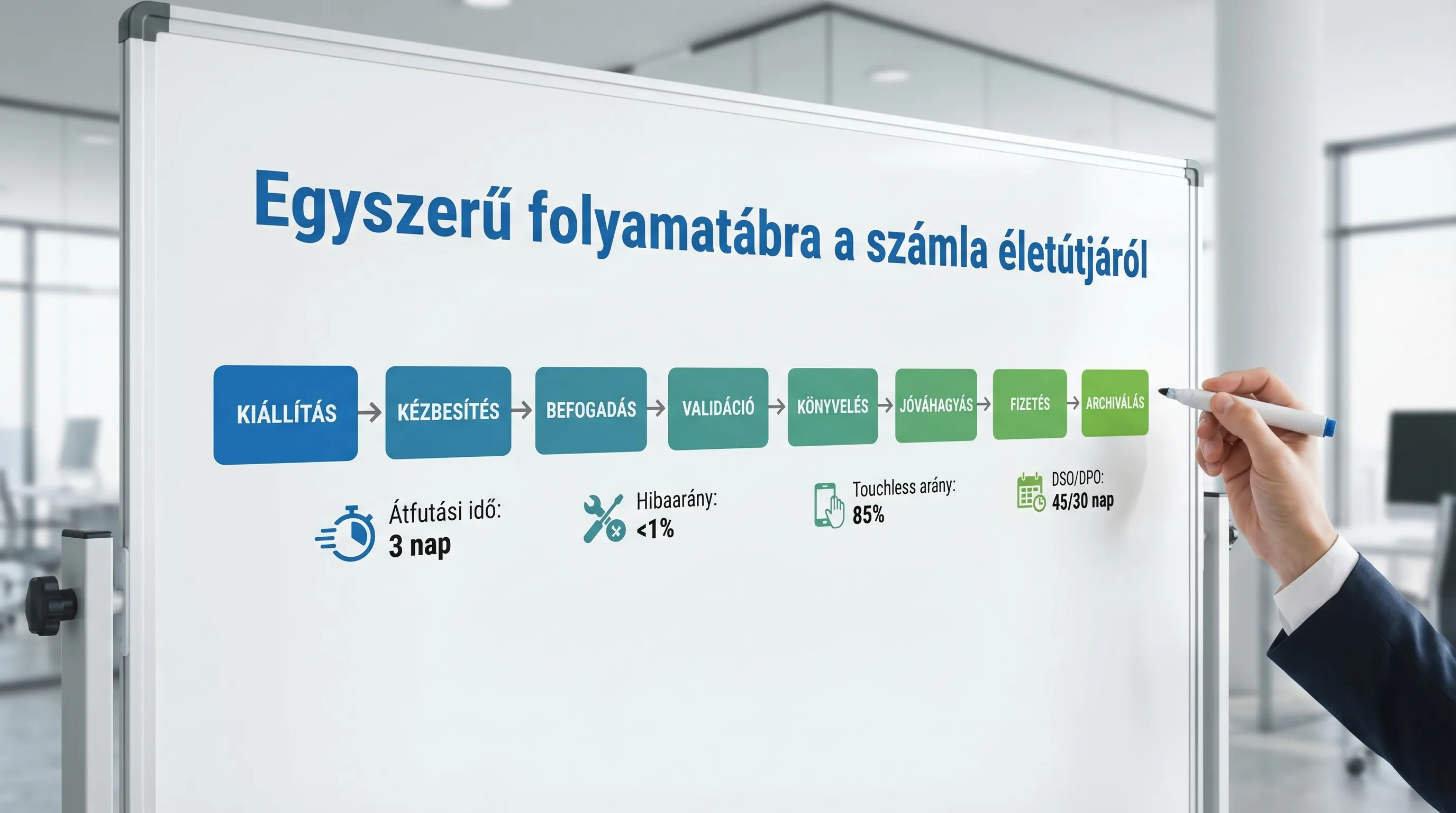
The Benefits of E-Invoicing in Operations: Why Is It a "Process Accelerator"?
From an operational perspective, e-invoicing pays off quickly if you treat it not as a standalone financial project, but as part of the Order-to-Cash and Procure-to-Pay processes.
Fewer "exceptions," fewer disputes, more reliable delivery
In a typical operational chain, billing is often the final link where problems from earlier stages come to light:
different product master or unit price
missing proof of performance
incorrect partner data
incorrect tax rate or tax status
If you combine the implementation of e-invoicing with master data cleansing and automated checks, you’ll have fewer exceptions to handle and greater operational predictability. This directly reduces the time spent on internal reconciliations and can indirectly speed up fulfillment as well.
With system integration, the e-invoice becomes a "data highway"
The biggest quick profits come when the e-invoice data:
automatically links to the order, delivery note, and fulfillment data
For standard error types, the status is set automatically (e.g., missing PO number)
Exceptions are recorded in one place as a measurable backlog
This typically requires the integration of ERP, invoicing, DMS, approval systems, and the NAV Online Invoice data reporting environment. If the integration landscape is incomplete, it’s worth reviewing the relevant framework: System Integration: How to Connect ERP, CRM, and BI?
Common sources of quick ROI, with KPIs and financial metrics
The table below provides a management "cheat sheet" to help you calculate ROI based on measurable metrics rather than gut feelings. The numbers vary by company, but the logic applies across all industries.
Area | Common source of loss | E-invoicing intervention | Recommended KPIs | The Logic of Financial Impact |
AP (incoming) | Manual recording, correction, and multiple checks | Structured data ingestion, automatic validation, workflow | Touchless rate, processing time per invoice, exception rate | Reduction in working hours + reduction in error correction |
AP approval | Email back-and-forth, missing invoices | Statuses, SLAs for approval, escalation | Approval turnaround time, SLA compliance | Fewer delays, better DPO control |
AR (Outgoing) | Incorrect invoices, disputes, late delivery | Structured exhibition, proof of delivery | Percentage of disputed invoices, percentage of re-billed invoices | Faster cash flow, less paperwork |
Close | Manual reconciliations, missing documents | Audit-traceable data path, automated reconciliations | Number of closing days, reconciling items | Shorter working hours, less overtime, and lower risk |
Operation | PO, GRN, exceptions due to discrepancies in fulfillment | Support for 3-way matching, standardization of exception handling | Exceptions: backlog size, resolution time | Less coordination, faster throughput |
A simple ROI calculation template (that’s actually worth using)
The business case will be defensible if you start from a single, mutually agreed-upon baseline. Here’s a simple example:
Number of incoming invoices: 5,000 per month
Average time for manual processing: 6 minutes per invoice
Target after implementation: 2 minutes per invoice (entry + review)
Net time savings: 4 minutes per invoice
That’s 5,000 × 4 minutes = 20,000 minutes, or approximately 333 hours per month of capacity. If you can redirect this capacity toward truly value-adding work (such as quality assurance, financial controlling, and exception handling), the ROI is typically quick.
It is important not to omit the following when performing the calculation:
exception handling time (this often increases if the system is poorly implemented)
the time required to produce archival and audit evidence
the ongoing costs of integration and operation (monitoring, troubleshooting)
If you’re concerned about NAV-related issues and formatting errors on the operational portal, common errors and their solutions are listed here: NAV e-invoicing: common errors and quick fixes for businesses.
What accelerates and what slows down the ROI of e-invoicing?
A quick return on investment depends not only on technology, but also on process discipline. Three common “accelerators” and three typical “brakes”:
Accelerators
Structured data and validation right from the start: catch errors at the point of entry, not in accounting.
Minimum master data setup: business partner, tax ID, bank account, item master, tax rates.
Integration and status model: every invoice has a clear status, and there are no exceptions to this rule.
Brakes
“PDF digitization” instead of e-invoices: if you’re just switching channels but not the data.
Automation without error handling: when the automated system fails, but there is no quick manual workaround.
Lack of logging and evidence: it comes back to haunt you during audits, disputes, and troubleshooting.
Useful for a brief overview of the legal and regulatory landscape in 2026: Electronic Invoicing Legislation in 2026: A Brief Summary. For context regarding the EU, the European Commission’s eInvoicing page and the framework of the eIDAS Regulation can serve as useful references.
A quick, 30-day approach to demonstrating ROI (pilot approach)
It’s not always a good idea to launch a “major rollout” right away. For many companies, a better strategy is a short, KPI-driven pilot, where the goal is to demonstrate a return on investment and manage risks.
Here's what a realistic 30-day focus looks like:
Week 1: Baseline assessment (account numbers, processing times, error rates, exception types); setting target KPIs.
Week 2: Designing data flows and the entity model (identifying the system of record), minimum validations.
Week 3: Integration testing in a small-scale environment (1–2 suppliers or 1 business unit), defect triage process.
Week 4: Measurement, decision (go/no-go), and scaling backlog.
If you’d like to see this pilot approach within a broader digitalization framework, check out this related article: “Digitalization in 2026: Where Should You Start?”
Frequently Asked Questions
Is a PDF invoice an e-invoice? It depends on what you mean by that. A quick return on investment usually comes when the invoice can be processed in a structured data format (such as XML), not just as “digital paper.”
How long does it take for the implementation of e-invoicing to pay for itself? There is no universal figure for this, but in finance, reductions in capacity and error costs are often visible within a few months if baseline measurements and exception handling are in place.
Will a digital signature be required for e-invoices in 2026? Not always; the legal framework allows for several alternatives (such as auditable process controls). Useful for decision-making: Digital signatures for electronic invoices: will they be required in 2026?
What is the best initial KPI if I want to demonstrate a quick return on investment? For most companies, the touchless rate for incoming invoices and the average processing time per invoice provide the most immediately understandable picture.
What makes the e-invoice project an operational project, rather than just a financial one? It’s because you link the invoice data to the order, fulfillment, and master data, and manage exceptions in a measurable way—not via email.
What is the most common reason why administrative work increases after the introduction of e-invoicing? If there is no clear exception handling and the master data is not in order before automation is implemented, the errors do not disappear; they simply “shift” to another point.
Next step: Generate a quick ROI from your e-invoices in a controlled manner
If e-invoicing is still just a “replacement for paper” at your company, then you’re likely not yet realizing most of its potential. The key to a quick ROI lies in a measurable baseline, exception handling, and the integration of ERP and invoicing processes—all of which must be auditable.
The Syneo team provides IT and digital transformation consulting for e-invoicing and related financial automation projects, from assessment through piloting to implementation. To get started, it’s a good idea to conduct a brief assessment and prepare an ROI outline so that you can demonstrate tangible results within 30 to 90 days. For further background, see the related guide: E-Invoicing 2026: Checklist for Issuance and Archiving.